Links, Apologetics/Defense, References, & News & Opinions concerning my faith journey as a Catholic.
"In the process of salvation by co-operating with
grace through faith
in Jesus Christ, as
sustained by the sacraments
and by works of love, because faith without works is dead."
"In the process of salvation by co-operating with grace through faith in Jesus Christ, as sustained
"In the process of salvation by co-operating with grace through faith in Jesus Christ, as sustained by the sacraments and by works of love, because faith without works is dead."
All Saints' Day and All Souls' Day: Celebrations Among Italians and Italian Americans
This evening marks the Eve of All Saints, or All Hallows' Eve—what we now call "Halloween." While the holiday has been hijacked and claimed by some neo-pagans and satanists, and often derided and slandered by anti-Catholic bigots, its origins are truly rooted in sacred Christian tradition, as it precedes All Saints' Day. This year, I won’t be celebrating the Americanized Halloween—not out of any opposition to it, but simply because I’ve outgrown trick-or-treating, and parties aren’t my thing. Instead, I’ll be observing All Saints’ Day and All Souls’ Day in the traditional Catholic way, honoring my Italian American heritage. I'll attend Mass, light candles, and offer prayers to the saints and for the souls in Purgatory, while also remembering my loved ones who have passed. This reflection will take place both in church and at my home altar.
How do you celebrate All Saints’ and All Souls’ Days? Let’s take a closer look at these cherished Catholic and Italian customs.
All Saints' Day and All Souls' Day: Celebrations Among Italians and Italian Americans
All Saints' Day on November 1 and All Souls' Day on November 2 are significant observances in the Catholic calendar, holding special importance in Italian and Italian American communities. Rooted deeply in Catholic traditions, these days are dedicated to honoring saints and remembering the deceased. However, Italians in Italy and Italian Americans celebrate these days with unique customs, reflecting a blend of historical, cultural, and regional influences.
All Saints' Day (Ognissanti) in Italy
In Italy, All Saints' Day, or Ognissanti, is a solemn public holiday celebrated nationwide. Rooted in ancient Catholic tradition, it is a day set aside for honoring saints, both known and unknown, with a spirit of reverence and family closeness. Here's a closer look at how this day is observed in Italy:
National Holiday and Religious Observances
Mass Attendance: All Saints' Day is a Catholic holiday and an important occasion for Italians, who attend mass to honor saints and reflect on their lives. Major cathedrals and small-town churches hold special services, and the sermons often focus on the virtues of sainthood and the path to salvation.
Day of Reflection: Italians observe the day with a sense of reverence. Shops and businesses close, and the streets take on a calm, quiet atmosphere, as families gather for this religious occasion.
Traditional Foods
Italian cuisine often accompanies cultural celebrations, and Ognissanti is no exception, with families and communities preparing certain dishes specifically for the day:
Fave dei Morti: These small, round almond cookies, meaning “beans of the dead,” are a customary treat associated with All Saints' Day and All Souls' Day. They are believed to symbolize the cyclical nature of life and death.
Ossa dei Morti: Translating to "bones of the dead," these cookies are prepared with almonds and resemble bone shapes, a symbolic nod to those who have passed.
Visiting Cemeteries and Honoring Loved Ones
Although All Saints' Day is dedicated to saints, Italians extend the day to honor their deceased family members. Families visit cemeteries, cleaning and adorning graves with fresh flowers, particularly chrysanthemums. Many cemeteries across Italy are filled with families paying respects, a scene of reverence and deep connection to ancestral roots.
All Souls' Day (Commemorazione dei Defunti) in Italy
The observance continues on November 2 with All Souls' Day, or Commemorazione dei Defunti, dedicated explicitly to remembering and praying for the souls of deceased loved ones. Italian culture deeply values family and ancestry, and this day is a chance to reconnect with those values.
Customs and Traditions
Lighting Candles: Italians light candles at home or in church to represent their prayers and remembrance for deceased family members. The candlelight is symbolic of hope and a belief in eternal life.
Flowers and Graveside Prayers: Families again visit cemeteries, laying fresh flowers on graves and praying for the souls of the departed. Italian cemeteries, already visited on All Saints' Day, remain vibrant and full as families make the rounds to remember their loved ones.
Regional Variations
While the general observance is consistent across Italy, regions have their unique customs:
In Sicily, children may receive treats and small gifts, symbolizing a blessing from their departed ancestors.
In Naples, a tradition called Cibo dei Morti, or "Food of the Dead," involves leaving food out for spirits, a practice derived from ancient traditions.
All Saints' Day and All Souls' Day Among Italian Americans
Italian immigrants brought their Catholic traditions with them to the United States, adapting their customs to fit within American society. Although celebrations are generally more subdued, Italian Americans have developed unique ways to honor these sacred days.
Mass and Prayer Services
For many Italian Americans, All Saints' Day and All Souls' Day begin with attending mass at their local Catholic church. Parishes often hold special services, which are central to the community, bringing families together in prayer and remembrance. Italian American churches also sometimes arrange events or community gatherings after mass, providing a sense of cultural connection and continuity.
Family Gatherings and Dinner
Italian American families often observe these days by gathering at home for a meal. This tradition strengthens familial bonds and serves as an opportunity to share stories about deceased loved ones, passing down family history to younger generations. Dishes may include recipes passed down from Italian ancestors, such as pasta, roasted meats, and biscotti, allowing for a culinary connection to Italian heritage.
Cemetery Visits and the Role of Community
Italian American families, like their Italian counterparts, often visit cemeteries to honor deceased family members. While less common than in Italy, some Italian Americans bring flowers or light candles at gravesites, reflecting the continuity of this ritual in Italian culture. Community groups or societies might also organize gatherings or fundraisers that support local Italian cemeteries, ensuring that the traditions of respect for the deceased are preserved.
Contemporary Celebrations and Cultural Adaptations
Both Italians and Italian Americans have seen adaptations in these traditional celebrations due to modernization and cultural blending:
Italy: Younger generations in Italy, while still observing All Saints' Day and All Souls' Day, sometimes blend these traditions with Halloween festivities, especially in urban areas influenced by American culture.
United States: Italian Americans may also incorporate elements of Halloween, though they maintain a strong sense of cultural identity in their observance of these Catholic holy days. Celebrations become an opportunity to reflect on both Italian heritage and the broader American cultural experience.
Conclusion
All Saints' Day and All Souls' Day are sacred and significant observances in both Italy and among Italian Americans. While rooted in Catholic tradition, these days also carry a broader cultural resonance. Italians in Italy observe these days with a deep sense of respect, family unity, and adherence to customs that have been passed down for generations. Italian Americans, while often blending customs with American influences, preserve a meaningful connection to their Italian heritage through prayer, family gatherings, and cemetery visits.
In both cases, these celebrations reflect a profound respect for ancestry and a commitment to maintaining cultural and religious ties across generations and across borders.
Historic Protestant anti-Catholic bigotry has profoundly shaped America’s perception of Halloween, influencing even Catholics. The slanderous accusations that Halloween has pagan or occult roots were amplified by pop culture, becoming part of the cultural zeitgeist, and are now widely accepted as truth—sometimes even by Catholics, albeit reluctantly. However, the reality is that Halloween, or "All Hallows' Eve," is deeply Christian in origin, rooted in the vigil for the Catholic celebration of All Saints' Day. Let’s explore the true origins of All Saints' Day and examine how and why it became something viewed with suspicion in America:
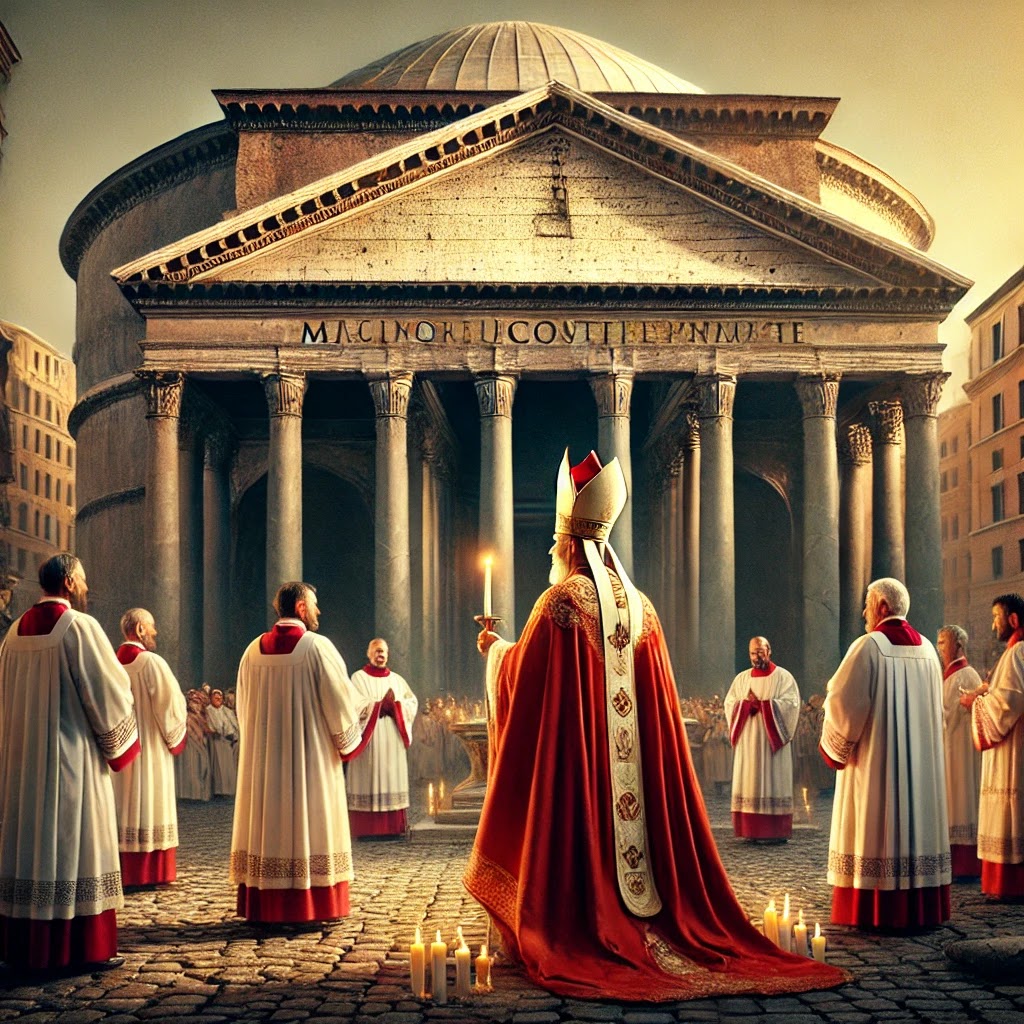
All Saints' Day, celebrated on November 1st, has an interesting history tied to the early Christian Church and the transformation of pagan monuments into Christian sites of worship. The origins of the feast can be traced back to Pope Boniface IV, who in 609 AD re-dedicated the Pantheon in Rome to the Church of All Saints.
Re-dedication of the Pantheon by Pope Boniface IV (609 AD)
The Pantheon, originally a Roman temple dedicated to all the gods of pagan Rome, was an architectural marvel and a significant symbol of the Roman Empire’s religious life. When Christianity became the official religion of the empire, many pagan temples were either abandoned or repurposed for Christian use. Pope Boniface IV saw an opportunity to transform this iconic pagan structure into a place of Christian worship. On May 13, 609 AD, he consecrated the Pantheon to the Virgin Mary and all the Christian martyrs, renaming it the "Church of St. Mary and the Martyrs." This act symbolized the Church's triumph over paganism and honored the memory of those who had died for their Christian faith. This dedication is considered one of the earliest instances of the feast now known as All Saints' Day.
Pope Gregory III Moves the Feast to November 1st
While May 13th was initially observed as a feast day in honor of all martyrs and saints, the date was eventually changed. In the 8th century, Pope Gregory III (731-741) decided to move the celebration of All Saints to November 1st. The reason behind this shift was the dedication of a new church in Rome. Pope Gregory III consecrated a chapel in St. Peter’s Basilica specifically to "all saints," particularly those whose relics were unknown or had no feast day. This new date, November 1st, became the official day of the feast for the entire Western Church.
Thus, the timing of this Christian holiday, falling right after October 31st—what pagans traditionally celebrated as Samhain—is purely coincidental. However, it's important to remember that pagan festivals were closely tied to the seasonal cycle, with major celebrations marking the start of autumn, winter, summer, and so on. Given this natural alignment with the seasons, it's no surprise that some Christian holidays, which also follow seasonal patterns, occasionally overlap with pagan ones.
Broader Significance of November 1st
By the time of Pope Gregory IV (827-844), the observance of All Saints’ Day on November 1st was extended to the entire Christian world. This move allowed for a more universal celebration, encompassing all saints—known and unknown—throughout the Christian Church.
The re-dedication of the Pantheon and the later establishment of November 1st as the date for All Saints’ Day reflect a broader trend in the Christianization of pagan sites and practices. The Church found ways to adapt and sanctify existing structures and celebrations, reorienting them to reflect Christian theology and the lives of the saints. Thus, what had once been a temple to all the gods became a monument to the saints, and a day once rooted in Roman civic religion became a cornerstone of the Christian liturgical year.
The modern tradition of Halloween, particularly the custom of trick-or-treating and dressing up in costumes, has roots in Christian practices, especially those associated with All Saints’ Day (November 1st) and All Souls’ Day (November 2nd). These Christian observances, intended to honor the saints and pray for the souls of the departed, gave rise to several practices that eventually evolved into the secular customs we see today.
Trick-or-Treating and “Soul Cakes”
The tradition of going door-to-door asking for treats on Halloween is believed to originate from the medieval practice known as "souling." On the eve of All Saints' Day (October 31st), also known as All Hallows' Eve, poor Catholic children would go from house to house offering prayers for the dead in exchange for food, specifically small cakes called "soul cakes." These cakes were often spiced or sweetened and marked with a cross, symbolizing their connection to prayers for the souls in purgatory.
In return for these cakes, the children or beggars would promise to pray for the deceased relatives of the household, believing that such prayers could help the souls of the dead find rest or reduce their time in purgatory. This practice, known as "souling," was common in England, Ireland, and other parts of Europe during the Middle Ages. The act of receiving soul cakes gradually transformed into what we now recognize as trick-or-treating, where children go door to door asking for candy rather than offering prayers for the dead
Costumes: Mocking Demons and Evil
The tradition of wearing costumes on Halloween also has Christian origins. During the festivities surrounding All Hallows’ Eve, Christians would sometimes dress up as demons, evil spirits, or villainous characters. This practice was not meant to celebrate these figures but to mock them and demonstrate Christ’s victory over evil. By wearing costumes that represented the powers of darkness, Christians symbolically declared that these forces had been defeated by Christ through His death and resurrection. It was a form of defiance against the devil and a reminder that no power of evil could prevail over the Church or its faithful .
This practice of dressing up as demons and other dark figures was a way to reinforce the Christian teaching that, through Christ, death and evil had been overcome. Over time, the tradition of dressing in costume expanded to include more secular or playful costumes, but the original intent was to mock the forces of evil and to celebrate the triumph of good.
Lighting Candles and Prayers for the Dead
Lighting candles during the Halloween and All Saints’/All Souls’ celebrations has its origins in the Christian tradition of praying for the dead. Candles were often lit in churches, homes, and graveyards to symbolize the light of Christ guiding souls out of purgatory and into eternal peace. On All Hallows' Eve and All Souls' Day, many families would light candles in memory of deceased loved ones, offering prayers for their souls.
The belief in praying for the dead is rooted in Catholic doctrine, which teaches that souls in purgatory benefit from the prayers and good works of the living. All Souls’ Day, in particular, is dedicated to the remembrance of all the faithful departed, and lighting candles was a visible sign of that remembrance .
Visiting Gravesites
Another Christian tradition tied to Halloween is the custom of visiting the graves of loved ones. Families would often go to cemeteries on All Hallows' Eve or All Souls' Day to clean the graves, lay flowers, and pray for the souls of the departed. This practice emphasizes the communal aspect of the Church, which includes not only the living but also the souls of the faithful who have passed away. Visiting gravesites and praying for the dead remind the faithful of their connection to the “communion of saints,” which includes those on earth, in purgatory, and in heaven .
In many Catholic countries, such, the tradition of honoring the dead is still very much alive, especially in celebrations like Día de los Muertos (Day of the Dead), which is closely tied to the Catholic feast days of All Saints’ and All Souls’. Families build altars for deceased relatives, offer prayers, and visit cemeteries to celebrate and remember their loved ones.
Conclusion
The roots of modern Halloween can be traced back to these medieval Christian traditions, where going door-to-door for “soul cakes” reflected Catholic teachings on purgatory and prayers for the dead. The practice of wearing costumes began as a way to mock the forces of evil, celebrating Christ’s victory over death. Lighting candles and visiting graves were essential parts of the celebrations surrounding All Saints’ and All Souls’ Days, serving as acts of prayer and remembrance for the departed.
While Halloween today has become largely secular, these customs have deep connections to the spiritual traditions of the Christian Church, particularly its teachings on death, the afterlife, and the power of prayer.
The perception of Halloween as an "evil" holiday with pagan roots is a belief that has been shaped, in part, by historic Protestant anti-Catholic sentiments in the United States. This suspicion of Catholicism, combined with misunderstandings of Halloween's origins, fueled accusations that the holiday was inherently pagan or even diabolical.
Protestant Anti-Catholic Sentiment in America
During the 19th and early 20th centuries, waves of Catholic immigrants from Ireland, Italy, and other parts of Europe arrived in the United States, bringing with them their traditions, including the observance of All Saints' Day (November 1st) and All Souls' Day (November 2nd). As part of these religious observances, some customs—such as "souling" (offering prayers for the dead in exchange for soul cakes) and lighting candles for deceased loved ones—were adapted into what became the American version of Halloween.
However, at the time, America was predominantly Protestant, and many Protestants harbored deep suspicion toward Catholic practices. Catholic rituals surrounding death and the afterlife, including prayers for souls in purgatory, were unfamiliar to many Protestants and viewed as superstitious or even heretical. This anti-Catholic sentiment became entwined with broader fears about Halloween. The holiday's connection to Catholic traditions led some Protestants to view it with suspicion and to associate it with older, pre-Christian practices, such as the Celtic festival of Samhain, further distorting its origins.
Accusations of Paganism
One of the central accusations against Halloween is that it has pagan roots, particularly in the Celtic festival of Samhain, which was celebrated in Ireland and other parts of Europe on October 31st. Samhain marked the end of the harvest season and the beginning of winter and was associated with death and the supernatural. While some elements of Samhain, like the lighting of bonfires, may have influenced Halloween customs, it is a significant oversimplification to reduce Halloween to a “pagan” festival. The Catholic Church, particularly during the early Middle Ages, transformed many pre-Christian festivals by incorporating Christian elements, often by placing Christian holy days on or near these older holidays to replace pagan rituals with Christian observances. All Saints' Day and All Souls' Day are examples of this adaptation.
Nevertheless, Protestant critics often accused Halloween of being a continuation of paganism, claiming that the Church had merely “baptized” pagan rituals without fully eradicating their heathen origins. The Protestant Reformation further solidified this divide, as Reformers rejected the Catholic veneration of saints, prayers for the dead, and the concept of purgatory—all central aspects of Halloween's religious roots. The continued rejection of these Catholic teachings by many Protestant groups contributed to the perception that Halloween, with its associations with death, saints, and prayers for the deceased, was at odds with biblical Christianity. Some even labeled it “evil” or “Satanic” due to these associations .
The Rise of Anti-Catholicism in the 20th Century
In the 20th century, as evangelical and fundamentalist Protestant groups gained influence in the U.S., they renewed their opposition to Halloween. Many saw the holiday as glorifying death, darkness, and the occult—further reinforcing the misconception that Halloween had deep pagan, and even demonic, roots. Some evangelical leaders warned against celebrating Halloween, claiming that its activities (such as dressing up in costumes and trick-or-treating) had connections to witchcraft and Satanism, despite the holiday’s historical and Christian origins.
This suspicion was often fueled anti-Catholic sentiments, which persisted in some circles. Since Halloween's roots are intertwined with Catholic traditions like praying for the dead and observing All Saints' Day, Protestant groups that rejected Catholic theology saw these practices as suspicious or dangerous. The belief that Catholicism itself was steeped in superstition and idolatry further contributed to these negative perceptions of Halloween.
Conclusion
The accusations that Halloween is an "evil" or "pagan" holiday are, in large part, a product of Protestant anti-Catholic bigotry and misunderstanding. While elements of older traditions, like the Celtic Samhain, may have influenced certain Halloween customs, the holiday's development is deeply rooted in Christian observances of All Saints' Day and All Souls' Day. The perception of Halloween as diabolical or rooted in paganism was shaped by centuries of religious tension and cultural misunderstanding, particularly in the American context, where Protestant fears about Catholic influence played a significant role.
Today, while Halloween is primarily a secular celebration, it retains elements of its Catholic origins, such as the focus on death, the supernatural, and remembrance of the departed. However, much of the criticism about its "pagan" or "evil" nature stems from historical misunderstandings and religious prejudices that date back to earlier periods of anti-Catholic sentiment.
Even today, many Catholics in the United States have come to believe, or have been influenced by the surrounding Protestant and secular culture, to view Halloween as a pagan or evil holiday. This misconception has its roots in both historical anti-Catholic sentiment and the rise of fundamentalist Christian opposition to Halloween in the 20th century, which portrayed the celebration as inherently tied to the occult, witchcraft, and paganism. Over time, these fears seeped into broader American society, affecting Catholics as well.
Influence of Protestant Anti-Catholicism on Catholic Beliefs
During the waves of Catholic immigration to America in the 19th and 20th centuries, Catholics found themselves in a predominantly Protestant culture that often viewed their customs and beliefs with suspicion. The distinctly Catholic traditions of honoring the dead—such as All Saints’ Day, All Souls’ Day, and prayers for souls in purgatory—were misunderstood by many Protestant groups. These groups rejected Catholic teachings on purgatory and the veneration of saints, and they often equated these practices with superstition or even idolatry.
Because Halloween evolved from these Catholic feast days, it too became associated with “superstitious” practices in the eyes of many Protestants. Over time, the idea that Halloween was a continuation of pagan rituals—an accusation originally fueled by anti-Catholic bigotry—took hold in the broader American culture, influencing even Catholics themselves. Despite the Christian origins of Halloween, many Catholics absorbed the dominant cultural narrative that the holiday had pagan or occult roots.
Evangelical Opposition and its Broader Cultural Impact
By the mid-20th century, the rise of evangelical and fundamentalist Christian movements in America further intensified opposition to Halloween. Many evangelical leaders began warning against the holiday, claiming it glorified the occult, witchcraft, and even Satanism. This message was amplified through churches, media, and popular culture, leading to widespread beliefs that Halloween was dangerous and inherently evil.
Catholics, living in an overwhelmingly Protestant culture, were not immune to these messages. Over time, some Catholics came to share the same fears, even though Halloween's origins were rooted in Christian traditions. The idea that Halloween was evil became so widespread that some Catholic parishes began discouraging participation in Halloween celebrations, particularly in areas where evangelical influence was strong. These messages of fear and distrust of Halloween led many Catholics to view the holiday with suspicion, forgetting or never learning about its true Christian roots.
Secularization and the Loss of Christian Context
Another factor contributing to this misconception among Catholics is the increasing secularization of Halloween. As the holiday became more commercialized, the original Christian meaning behind All Saints’ Day and All Souls’ Day faded from popular memory. The focus shifted to costumes, parties, and trick-or-treating, with little to no reference to the holiday’s religious origins. This made it easier for critics to label Halloween as a pagan or occult celebration, further distancing it from its Catholic roots.
In a society where the religious significance of holidays is often overshadowed by consumerism, many Catholics found themselves adopting the secular or anti-religious narratives surrounding Halloween. Some began to believe that the holiday was disconnected from their faith, or worse, that it was incompatible with their Christian beliefs.
The Ongoing Debate Among Catholics
Today, Catholics remain divided on the issue of Halloween. Some recognize its origins in Catholic tradition and celebrate it in ways that honor All Saints’ Day and All Souls’ Day, using the holiday as an opportunity to teach children about the communion of saints and the importance of praying for the dead. Others, however, have internalized the surrounding culture’s suspicion of Halloween, associating it with the occult and choosing to avoid it altogether.
For example, many Catholic schools and parishes now host "All Saints' Day parties" as an alternative to Halloween, where children dress up as saints instead of ghosts or witches. While this practice reinforces Catholic identity and teaches children about the lives of the saints, it also reflects the broader cultural discomfort with Halloween and the belief that the holiday has pagan or evil origins.
Conclusion
The belief that Halloween is pagan or evil, even among some Catholics, is the result of a complex history of Protestant anti-Catholic sentiment, the rise of evangelical opposition to Halloween, and the secularization of the holiday. While Halloween’s roots are deeply tied to Christian traditions surrounding All Saints’ and All Souls’ Days, many Catholics have come to share the broader cultural perception that the holiday is incompatible with their faith. This misconception reflects the powerful influence of surrounding cultural forces on religious practices and beliefs, particularly in a society where religious traditions are often misunderstood or distorted.
However, for those Catholics who embrace Halloween’s true Christian origins, the holiday remains a meaningful occasion to honor the saints, pray for the dead, and celebrate Christ’s victory over evil.
Protestant anti-Catholic bigotry in America has a long and complicated history, and this bias played a significant role in shaping negative perceptions of Halloween. These perceptions, fueled by anti-Catholic sentiment, contributed to the belief that Halloween was pagan or even evil. Below are specific examples of Protestant anti-Catholic bigotry in America, particularly regarding Halloween and its associated traditions:
1. Nativist Movements and Anti-Catholic Rhetoric
In the 19th century, as large numbers of Catholic immigrants from Ireland, Italy, and Eastern Europe began to settle in the United States, they brought with them their Catholic customs, including the celebration of All Saints' Day and All Souls' Day, which eventually influenced the development of Halloween in America. This wave of immigration led to widespread anti-Catholic sentiment among native-born Protestant Americans.
The Know-Nothing Party (active in the 1840s and 1850s) was an influential nativist political movement that promoted anti-Catholic policies and rhetoric. They saw Catholicism as a threat to American values, which they believed were rooted in Protestantism. Catholic practices such as praying for the dead and venerating saints were considered superstitious and foreign, which fed into broader fears about Halloween’s supposedly pagan connections.
Protestant leaders and publications often derided Catholic traditions as idolatrous or overly mystical, and they used Halloween as an example of the “superstitions” that Catholics supposedly carried over from their European homelands.
2. The Ku Klux Klan and Anti-Catholic Attacks
The Ku Klux Klan (KKK), which re-emerged in the early 20th century, not only targeted African Americans but also Catholics, seeing them as a dangerous foreign influence on Protestant America. The Klan was particularly active in promoting the idea that Catholic practices were inherently un-American and pagan.
The KKK distributed pamphlets and held rallies accusing Catholics of engaging in idolatry and devil worship, with Halloween being one of the practices they associated with this. They linked Halloween’s connection to Catholic traditions like praying for the dead and saint veneration with dark, occult forces. By doing so, they perpetuated the myth that Halloween was a pagan holiday, despite its roots in Christian observances such as All Saints’ and All Souls’ Days.
3. Fundamentalist Christian Opposition to Halloween
In the 20th century, many fundamentalist Protestant groups, especially in the United States, became increasingly vocal in their opposition to Halloween. As evangelical and fundamentalist movements grew, they adopted and amplified the notion that Halloween was pagan and evil, largely due to their rejection of Catholic theology and practices related to the afterlife, such as purgatory and prayers for the dead.
In the 1980s and 1990s, evangelical pastors and televangelists such as Jerry Falwell and Pat Robertson warned their congregations about the dangers of celebrating Halloween, labeling it as a Satanic holiday. Much of their opposition stemmed from the belief that Halloween’s origins lay in ancient pagan festivals, which, in their view, Catholicism had failed to fully erase. These pastors often ignored or dismissed the Catholic roots of the holiday in favor of sensationalized claims about its ties to witchcraft and the occult.
Jack Chick, a fundamentalist Christian cartoonist, widely distributed anti-Catholic tracts, one of the most famous being "The Trick" (published in 1986), which portrayed Halloween as a Satanic holiday that involved child sacrifice and devil worship. His tracts regularly featured strong anti-Catholic messages, suggesting that Catholic practices were corrupt and deceptive, contributing to the perception that Catholic-rooted traditions like Halloween were evil.
4. Halloween in Protestant Public Schools
In the mid-20th century, public schools in predominantly Protestant areas of the United States often discouraged or banned the celebration of Halloween. This was, in part, due to its association with Catholic traditions, which many Protestants viewed with suspicion. Schools that were influenced by Protestant sensibilities sometimes avoided the religious undertones of Halloween and replaced it with secular harvest festivals to distance themselves from what they saw as Halloween’s "Catholic superstition."
For example, in certain areas, harvest festivals were promoted as wholesome alternatives to Halloween, emphasizing autumn and agricultural themes, rather than the traditional focus on death, saints, and the afterlife. This shift reflected Protestant discomfort with Catholic practices of remembering the dead and honoring saints, which were integral to Halloween’s origins.
5. The Rise of Anti-Halloween Sentiment in the Evangelical Community
By the late 20th century, the notion that Halloween was a "pagan" or "Satanic" holiday had become widespread, in large part due to evangelical Christian influence. Evangelicals often rejected Halloween because of its connections to death, spirits, and Catholic practices of venerating the dead, which they believed bordered on heresy. The rejection of these Catholic traditions by Protestant leaders reinforced the idea that Halloween was evil.
Some evangelical churches, particularly in the Bible Belt, began organizing “Hell Houses” or “Judgment Houses” as alternatives to traditional Halloween haunted houses. These events often portrayed Halloween as dangerous, promoting the belief that participating in the holiday opened people up to demonic influences. Catholic practices related to Halloween, such as praying for the dead, were depicted as superstitious or occultic, further entrenching the idea that Halloween had pagan or evil origins.
Conclusion
Protestant anti-Catholic bigotry in America has played a significant role in shaping the way Halloween is viewed today. From early nativist movements to the rise of fundamentalist and evangelical Christian opposition, the celebration of Halloween has often been misunderstood and misrepresented. Protestant fears and suspicions about Catholic customs—especially those surrounding death, saints, and the afterlife—led to accusations that Halloween was a pagan or evil holiday. These misconceptions have persisted over time, influencing not only Protestants but also many Catholics, who have come to view Halloween with suspicion despite its Christian origins.
So don’t give in to Protestant anti-Catholic bigotry or the cultural misconceptions it has fostered. Resist being swayed by these false narratives, and don’t allow so-called "pagans" or "devil worshipers" to steal what is rightfully ours. Proudly embrace and celebrate Halloween for what it truly is—a deeply Catholic, thoroughly Christian tradition: All Hallows’ Eve. Honor it for the right reasons—to mock the devil, glorify God, and rejoice in Christ’s victory over death and evil. Celebrate it in a wholesome, moral, and Christian way. It’s time to reclaim Halloween!
Strong Borders, Just Enforcement, and Catholic Moral Law
As a Catholic and a supporter of President Trump’s immigration enforcement, I don’t see any contradiction between border security and Christian morality. In fact, Catholic theology has always recognized that nations have the right — and even the duty — to defend their borders, protect their citizens, and enforce their laws.
The Catechism of the Catholic Church states:
“Political authorities, for the sake of the common good for which they are responsible, may make the exercise of the right to immigrate subject to various juridical conditions.” (CCC 2241)
In other words, immigration is not an absolute right. A nation has the moral authority to say who enters, who stays, and under what conditions — especially when public order, crime, and social stability are at stake.
So when I say I support ICE, deportations, and border security, I am not rejecting Catholic teaching. I am affirming it.
Justice Comes Before Mercy
Catholic theology is clear: mercy does not abolish justice — it presupposes it.
St. Thomas Aquinas taught that mercy without justice becomes injustice, because it destroys the moral order that allows human society to exist. The state’s first duty is to protect the innocent and preserve social order. That includes enforcing immigration law.
The Church has never taught that people have a right to break immigration law. What it teaches is that human dignity must be respected even when law is enforced.
That is where my concern comes in.
Why Optics Matter in Catholic Moral Theology
Catholic moral theology has always recognized something modern politics forgets: Scandal is a sin.
Scandal does not mean shock. It means leading others into sin or into moral confusion. When law enforcement looks brutal, arbitrary, or militarized, it doesn’t just upset people — it damages trust in legitimate authority.
St. Paul warned that lawful authority must be exercised in a way that builds peace, not provokes rebellion (Romans 13). That means the appearance of justice matters, not just the technical legality.
When immigration enforcement looks like a military occupation of American communities — with masked agents, armored vehicles, and chaotic raids — it creates moral scandal, even when the underlying law is just.
It makes people doubt authority.
It makes people resist.
It fuels hatred and division.
That harms the common good — something Catholic teaching takes very seriously.
Why Random ID Checks Are Unjust
As a Catholic, I also reject the idea that the government should randomly demand papers from ordinary people without reasonable suspicion.
The Church’s social doctrine insists on the dignity of the human person and protection against arbitrary power. A system that allows people to be stopped and questioned merely for how they look or where they live is morally corrupt, even if done in the name of law.
Law must be enforced through warrants, courts, and due process, not dragnet suspicion.
America, the Revolution, and Natural Law
One of the sparks of the American Revolution was the quartering of British soldiers in colonial communities. The colonists weren’t wrong to resist that — Catholic natural law recognizes that when armed force becomes a constant presence in civilian life, it creates fear, instability, and injustice.
Seeing federal officers in military gear roaming American neighborhoods triggers that same instinct — even in people who support law and order.
That’s not weakness.
That’s human nature.
And Catholic teaching respects that reality.
Why I Want All Illegal Immigration Ended
Let me be clear:
Catholic teaching does not require a nation to tolerate lawlessness.
I want all illegal immigration ended.
I want all illegal aliens ultimately deported.
I want borders enforced.
But I also want that done in a way that:
respects human dignity
preserves public peace
avoids scandal
and maintains legitimate authority
That means:
securing the border
stopping new entry
deporting criminals first
and then systematically removing everyone else
Not through chaos.
Not through spectacle.
But through lawful, orderly, morally grounded enforcement.
Conclusion
Strong borders are not un-Catholic.
Deportations are not immoral.
Law enforcement is not tyranny.
But how authority is exercised matters to God.
As Catholics, we must demand justice without cruelty, authority without oppression, and enforcement without scandal.
That is how you defend both the nation and the moral order God ordained.
Every so often, I hear the accusation that the Catholic Mass is “pagan,” “evil,” or even “devil-worship.” To some, it’s a recycled Babylonian mystery rite, a continuation of ancient idolatry dressed in Christian robes. I’ve read the pamphlets, the Chick tracts, the sermons, and the rants — from Alexander Hislop’s The Two Babylons to Protestant reformers, evangelicals, and even the modern fringe.
But as a Catholic — and as someone who studies both history and faith — I’ve come to a different conclusion: the Mass is not pagan. Yet I understand why people make that claim. The imagery, the ritual, the incense, the bells — to modern eyes, they look old, even “foreign.” But appearances can deceive. What’s often dismissed as “pagan” is, in truth, a continuity of something older than paganism itself: the ancient worship of the one true God.
1. Where the Criticisms Come From
The Babylonian Theory
The most popular version of the “Mass is pagan” argument comes from Alexander Hislop’sThe Two Babylons (1853). Hislop claimed that the Catholic Church is the modern face of the cult of Nimrod and Semiramis, ancient Babylonian deities. According to him, nearly every Catholic ritual — the altar, the candles, the priesthood, the Virgin Mary — descends from ancient pagan fertility cults and goddess worship. He wrote:
“The papal worship is nothing else than the worship of Nimrod and his wife.” — Alexander Hislop, The Two Babylons (1853)
This view influenced countless Protestant tracts, from Jack Chick’s comics to Adventist and Jehovah’s Witness literature. Some Lutherans, in the Smalcald Articles, called the Mass “a human invention” that “obscures the Gospel.” Even groups like the Ku Klux Klan, in their anti-Catholic phase, echoed the same rhetoric — claiming that Catholic ritual was “Roman paganism reborn.”
I get where they’re coming from: the imagery of a robed priest offering sacrifice before an altar, lighting candles, and swinging incense — it does look like something out of the ancient world. But history and theology tell a different story.
2. The Ancient Roots of the Mass
The Altar and Sacrifice
Every ancient religion had altars — including Israel. In Exodus, God commands Moses to build an altar of acacia wood (Ex 27:1–2). The Temple in Jerusalem, where Jesus worshiped, had an altar for sacrifice and incense. The early Christians saw the Eucharist as the fulfillment — not the abolition — of that altar. As St. Paul wrote:
“We have an altar from which those who serve the tabernacle have no right to eat.” — Hebrews 13:10
In the early centuries, the altar became both table and sacrifice — echoing the Last Supper and Calvary. It was not about re-sacrificing Christ but re-presenting His one sacrifice in time. Pagan altars may have looked similar, but the meaning could not be more different. Pagans offered to gods they invented; Christians offer through the one sacrifice of the God who revealed Himself.
Incense and Candles
Incense is one of the most misunderstood symbols in Catholic worship. Yes, pagans burned incense — but so did the Jews. The Book of Exodus commands:
“You shall make an altar on which to burn incense… Aaron shall burn fragrant incense on it every morning.” — Ex 30:1, 7
The smoke rising symbolizes prayer ascending to heaven:
“Let my prayer be incense before you, the lifting up of my hands as an evening sacrifice.” — Psalm 141:2
Candles, too, were not pagan but practical and symbolic. The early Christians worshiped in catacombs — dark, candle-lit spaces where the flame symbolized Christ, “the light of the world” (Jn 8:12). Long before electric light, candles were the human way to fight darkness, both physical and spiritual.
Bells
Bells in the Mass developed in the Middle Ages, not from pagan magic, but to alert the faithful at key moments — especially when people couldn’t see or hear the priest. In large cathedrals or outdoor gatherings, the bell was a call to attention, a cue to reverence. Symbolically, it echoes the trumpet of Sinai — a divine announcement, not an occult charm.
Vestments and the Priesthood
Critics say the Catholic priesthood looks “pagan” — with robes, symbols, and hierarchy. Yet every sacred order in history has had set-apart ministers. In Judaism, the priest wore sacred garments (Ex 28) “for glory and beauty.” The Christian vestments evolved from the tunics and cloaks of the Roman world — but were consecrated for sacred use. They’re not costumes of a mystery cult; they’re uniforms of service and humility.
The word priest itself (from presbyteros, elder) is biblical. The New Testament is full of priestly language: offering sacrifice (Rom 15:16), serving the altar (1 Cor 10:21), forgiving sins (Jn 20:22–23). If pagan priests distorted the image, that’s because they were imitating something real — the original priesthood that God revealed to Israel and fulfilled in Christ.
3. Pagan Parallels and the Search for God
I’ll admit — some pagan rites look similar to Christian ones. Ancient Rome had holy water, candles, and chants. Egypt had bread offerings and incense. Babylon had processions and altars. But to assume that similarity equals imitation is poor scholarship. As Catholic historian H. J. Thurston noted, “the existence of a pagan parallel does not prove a pagan origin.”
In truth, every ancient culture groped toward God. As St. Paul told the Athenians:
“Men of Athens, I see that in every way you are very religious… What you worship as unknown, I proclaim to you.” — Acts 17:22–23
That’s how I see the ancient pagans. They weren’t all malicious idolaters. Many were searching for the divine — but without revelation, their worship got distorted. In that sense, pagan rituals were like fractured mirrors: they reflected genuine religious intuition, but the image was twisted. Christianity, then, was not born from paganism — it corrected it. The true worship they longed for became real in Christ.
4. The Continuity of the Temple
The Catholic Mass is not a copy of Babylon, but the continuation of Jerusalem. The structure of the liturgy — readings, psalms, offering, incense, prayers, and communion — mirrors the pattern of Jewish Temple worship and synagogue service.
The early Christians didn’t abandon the sacred; they fulfilled it. When Christ instituted the Eucharist, He did so at Passover, in the context of sacrifice and covenant. He told His apostles, “Do this in memory of me” (Luke 22:19). The Greek word anamnesis means more than “remember” — it means “make present.” That’s what the Mass does: it makes present the one sacrifice of Calvary.
The Catholic Catechism teaches:
“The Eucharist is the memorial of Christ’s Passover, the making present and the sacramental offering of his unique sacrifice.” (CCC 1362)
“In the Eucharistic sacrifice, the whole of creation loved by God is presented to the Father through the death and Resurrection of Christ.” (CCC 1359)
That’s not Babylon — that’s the heart of the Gospel.
5. The Pagan Accusation Reconsidered
When Evangelicals, Fundamentalists, or Jehovah’s Witnesses accuse the Mass of being pagan, I no longer see it as innocent confusion — I see it as prejudice, even hatred. It comes from a long history of anti-Catholic bigotry dressed up as theology. These critics don’t merely misunderstand the externals — they despise them. The vestments, incense, statues, and candles offend not because they’re unbiblical, but because they’re unmistakably Catholic.
This hostility has deep roots: from the Reformation polemics that called the Church the “Whore of Babylon,” to the anti-Catholic propaganda of the 19th century, to Jack Chick tracts in the 20th, and even the slurs of the Ku Klux Klan. The pattern is the same — a desire to delegitimize the oldest form of Christianity by labeling it “pagan.” But hatred doesn’t become truth just because it’s wrapped in Bible verses.
The irony is that Catholicism preserved the very things that made worship sacred — ritual, symbol, and season — because human beings are ritual creatures. We express faith with body and soul. The Mass speaks that universal language — but with Christ, not superstition, at the center.
6. The Mass in Scripture and the Vision of Heaven
One of the most overlooked realities is that the Mass comes straight out of Scripture — not just the Gospels, but especially the Book of Revelation.
From beginning to end, Revelation describes heavenly worship that looks astonishingly familiar to any Catholic: an altar (Rev 8:3), incense (8:4), candles (1:12), vestments (4:4), chants and responses (“Holy, holy, holy” in 4:8), and even the “Lamb standing as though slain” (5:6). The book’s entire structure is liturgical — a heavenly Mass.
Early Christians understood this instinctively. The Mass wasn’t meant to entertain; it was meant to join heaven and earth. When the priest says, “Lift up your hearts,” and the people respond, “We lift them up to the Lord,” it’s not poetry — it’s literal theology. The sanctuary is a meeting place between heaven and earth, time and eternity, the visible and the invisible.
That’s why Catholic churches were designed as microcosms of heaven.
The altar represents Christ Himself, the Lamb and the sacrifice.
The candles symbolize the light of the angels who stand before God’s throne.
The incense evokes the prayers of the saints rising before the Almighty.
The dome or apse often depicts heaven itself, filled with angels and saints.
Every stained-glass window, every golden chalice, every echoing hymn is meant to remind us: this is not merely a human ceremony. It is participation in divine worship.
The Mass isn’t a re-enactment of Calvary — it is Calvary made present. It isn’t pagan ritual — it’s the heavenly liturgy of the New Jerusalem, the worship seen by John on Patmos and handed down through the Church.
7. A Theological Reflection
When people say “the Mass is pagan,” they often mean “it looks old, strange, and mysterious.” And that’s true — because God is mysterious. He meets us not only in ideas, but in flesh, sound, scent, and sight. Christianity did not abolish the language of the sacred; it baptized it.
In my view, paganism was humanity’s first attempt to speak to God without hearing Him first. It was religion built from below — imagination reaching for heaven. Christianity is the opposite: revelation descending from heaven. So if pagans burned incense or raised altars, it was not because they invented the idea of worship — it was because something within them remembered it.
In that sense, the Mass doesn’t imitate paganism; paganism was a shadow of the Mass.
8. Conclusion: The Mass as Fulfillment, Not Borrowing
So yes — incense rises, bells ring, priests wear robes, and candles flicker before the altar. But none of this is Babylon. It’s Bethlehem, Calvary, and the empty tomb — made present again and again in every generation.
I can understand the suspicion of outsiders. I once shared it. But history and faith have taught me this: the Catholic Mass is not the corruption of true worship — it is true worship, restored and perfected. Pagan rites were humanity’s attempt to find God. The Mass is God finding us.
“From the rising of the sun to its setting my name is great among the nations, and in every place incense is offered to my name, and a pure offering.” — Malachi 1:11
That prophecy is fulfilled every day at every altar.
That is not Babylon.
That is the Body of Christ.
Notes and Selected Sources (Chicago Style)
Alexander Hislop, The Two Babylons: The Papal Worship Proved to Be the Worship of Nimrod and His Wife (Edinburgh: 1853).
The Smalcald Articles, II.II.1–3, in The Book of Concord (1580).
Catechism of the Catholic Church (Vatican City: Libreria Editrice Vaticana, 1992), §§ 1359–1362.
H. J. Thurston, “Pagan Parallels and Christian Origins,” The Catholic Encyclopedia (New York: Robert Appleton Co., 1911).
Council of Trent, Decree on the Sacrifice of the Mass (Session XXII, 1562).
Pope Benedict XVI, Sacramentum Caritatis (2007), § 34.
Scott Hahn, The Lamb’s Supper: The Mass as Heaven on Earth (New York: Doubleday, 1999).
Author’s Note
I write this not as an academic alone, but as a believer who has wrestled with faith, history, and doubt. I’ve stood in cathedrals and in deserts; I’ve read the critics and the catechisms. The longer I study, the clearer it becomes: the Mass is not a relic of superstition, but the living heartbeat of Christianity — heaven touching earth, eternity breaking into time.
About the Author
Chris M. Forte is a Catholic writer and storyteller based in Downtown San Diego. His work explores faith, identity, and history — from My Catholic Defense to his historical fiction and cultural projects like The Italian Californian and The Soil Remembers: The Saga of the Sieli Family. Drawing on his Italian-American roots and lifelong study of Scripture and Church history, Chris writes to bridge ancient faith and modern life, confronting the myths, misunderstandings, and prejudices that have long shadowed Catholicism. His essays, novels, and reflections all return to one theme: that truth, beauty, and faith still meet — in the Sacraments, in the Mass, and in the mystery of the God who became man.



.jfif)


