Showing posts with label pontiffs. Show all posts

Tuesday, October 1, 2024

The Papacy


The Papacy: Origins, Teachings, and Historical Development

The Papacy, the office of the Bishop of Rome, is one of the most enduring institutions in history. Rooted in Scripture and Apostolic Tradition, it serves as the spiritual and administrative center of the Roman Catholic Church. Over time, the Papacy developed through theological reflection, the writings of early Christian leaders, and the outcomes of ecumenical councils.


Origins of the Papacy


The Papacy’s foundation is in the New Testament. In Matthew 16:18-19, Jesus declares to Peter:

"You are Peter, and on this rock, I will build my Church, and the gates of Hades will not overcome it. I will give you the keys of the kingdom of heaven; whatever you bind on earth will be bound in heaven, and whatever you loose on earth will be loosed in heaven."

This passage is understood by Catholics to confer a unique role on Peter as the leader of the Apostles and the foundation of the Church. Similarly, in Luke 22:32, Jesus prays specifically for Peter:

"But I have prayed for you, Simon, that your faith may not fail. And when you have turned back, strengthen your brothers."

Early Church Fathers supported this interpretation. Clement of Rome (c. 96 AD) exercised authority over the Church in Corinth in his letter 1 Clement, which demonstrates the primacy of the Roman bishop even in the first century. Ignatius of Antioch (c. 110 AD) described the Church of Rome as the one that “presides in love” (Letter to the Romans, Prologue).

Irenaeus of Lyons (c. 180 AD) emphasized Rome’s unique authority, stating:

"It is a matter of necessity that every Church should agree with this Church [of Rome], on account of its preeminent authority." (Against Heresies 3.3.2)


Development Through the Councils


The Papacy’s authority and its role in the broader Church were shaped and affirmed through several key ecumenical councils:

  1. First Council of Nicaea (325 AD): Convened by Emperor Constantine, this council primarily addressed the Arian heresy, which denied the divinity of Christ. While its primary focus was doctrinal, the council recognized the hierarchical structure of the Church, placing Rome as the first among equals in a system of patriarchates (Rome, Alexandria, and Antioch). The canon on ecclesiastical organization laid the groundwork for the Papacy’s preeminence.

  2. Council of Sardica (343 AD): Sardica is particularly significant for its explicit recognition of the Roman bishop’s authority in resolving disputes. Canon 3 states:

    "If any bishop is deposed and appeals to the Bishop of Rome, his case shall be reviewed anew."

    This formalized an appellate role for the Pope, further emphasizing Rome’s centrality in Church governance.

  3. Council of Ephesus (431 AD): This council condemned Nestorianism, affirming that Mary is Theotokos (Mother of God). Pope Celestine I played a decisive role, delegating his authority to legates who presided over the council. This demonstrated the Papacy’s influence in theological disputes.

  4. Council of Chalcedon (451 AD): Chalcedon is particularly notable for affirming the doctrine of Christ’s dual natures (divine and human) and for recognizing the Pope’s authority. The bishops declared:

    "Peter has spoken through Leo!"

    This referred to Pope Leo the Great’s Tome, which articulated the orthodox position. Although the council granted some privileges to Constantinople, it reaffirmed Rome’s primacy.

  5. Second Council of Nicaea (787 AD): This council, which resolved the iconoclast controversy, once again highlighted Rome’s role as a defender of orthodoxy. Papal legates participated actively, and the decrees were issued in communion with the Pope.

  6. Lateran Councils and the Fourth Lateran Council (1215 AD): The Lateran Councils, held in Rome, further clarified the Pope’s unique jurisdiction. The Fourth Lateran Council, convened by Pope Innocent III, defined the Pope as holding supreme power over the universal Church.

  7. Council of Florence (1438–1445 AD): This council attempted to reunite the Eastern and Western Churches and explicitly affirmed papal primacy. The decree Laetentur Caeli declared:

    "We define that the Holy Apostolic See and the Roman Pontiff holds the primacy over the whole world."

  8. First Vatican Council (1869–1870): This council defined the doctrine of papal infallibility, stating that the Pope, when speaking ex cathedra on matters of faith and morals, is preserved from error through the guidance of the Holy Spirit (Pastor Aeternus).


Teachings of the Papacy

The Papacy is built on two key theological principles:

  1. Apostolic Succession: The Pope, as Bishop of Rome, is seen as the successor to Peter. Cyprian of Carthage (c. 250 AD) wrote:

    "There is one Church and one chair, founded by the voice of the Lord upon Peter." (Letter 43:5)

  2. Papal Infallibility: Defined at the First Vatican Council, this doctrine draws on Scripture, particularly Christ’s prayer in Luke 22:32 and the promise in Matthew 16:18 that “the gates of Hades will not overcome” the Church.


Criticism and Reform

Throughout history, the Papacy has faced challenges. The Great Schism of 1054 divided the Eastern Orthodox and Roman Catholic Churches, partly over papal primacy. The Protestant Reformation in the 16th century, led by Martin Luther, rejected the Papacy, citing perceived abuses of power.

However, the Church has continually sought reform. The Council of Trent (1545–1563) addressed many of the concerns raised by the Reformation, reaffirming papal authority while implementing measures to improve Church discipline and pastoral care.


Modern Role of the Papacy

In the modern era, Popes like John XXIII (who convened the Second Vatican Council) and Francis have emphasized dialogue, social justice, and care for creation. Documents such as Laudato Si’ (Francis, 2015) and Evangelium Vitae (John Paul II, 1995) highlight the Papacy’s ongoing relevance in addressing contemporary issues.


Conclusion

The Papacy’s roots in Scripture, its affirmation through the writings of the early Church Fathers, and its development through the ecumenical councils demonstrate its centrality to the Catholic Church. From the humble beginnings of Peter’s confession of faith to the modern global influence of the Vatican, the Papacy remains a symbol of unity, continuity, and leadership. As the councils declared and the faithful believe, “Peter speaks through his successors.”


Citations

  1. Matthew 16:18-19; Luke 22:32.
  2. Clement of Rome, 1 Clement, c. 96 AD.
  3. Ignatius of Antioch, Letter to the Romans, c. 110 AD.
  4. Irenaeus of Lyons, Against Heresies, c. 180 AD.
  5. Tertullian, On Modesty, c. 200 AD.
  6. Cyprian of Carthage, Letter 43, c. 250 AD.
  7. Council of Nicaea I (325), Chalcedon (451), Vatican I (1870), Pastor Aeternus.
  8. Council of Florence, Laetentur Caeli (1439).

Tuesday, September 3, 2024

Pope St. Gregory the Great Feast Day September 3rd


 Pope Gregory I, commonly known as Pope St. Gregory the Great, was one of the most influential popes in the history of the Catholic Church. His pontificate lasted from 590 to 604 AD, and his contributions to the Church and Western civilization have left an enduring legacy. Let's explore his life, accomplishments, and significance. His feast day is September 3rd.

Early Life and Monasticism

  • Born: Around 540 AD in Rome, Gregory came from a prominent Roman family with a strong Christian background. His family was wealthy and held high positions in society, which provided Gregory with a robust education.
  • Monastic Life: Before becoming pope, Gregory served as the Prefect of Rome, but he later abandoned public life to become a monk. He founded several monasteries, including his own home, which he converted into a monastery dedicated to St. Andrew. His deep commitment to monasticism shaped his papacy and his approach to church reform and administration.

Papacy and Reforms

  1. Gregorian Chant:

    • Gregory is traditionally credited with the development of what is now known as Gregorian Chant, a form of plainchant used in liturgical music. While his direct role in creating the chant is debated, his name has been associated with this style of sacred music, which became a staple of Western Christian liturgy.
    • Church Fathers: Gregory's emphasis on the liturgy and sacred music reflects the early Church Fathers' teachings on the importance of worship and prayer in the life of the Church.
  2. Pastoral Care and the “Pastoral Rule”:

    • Gregory wrote the Regula Pastoralis (Pastoral Rule), a guide for bishops on how to care for their flock. This text became a standard for bishops throughout the medieval Church, emphasizing humility, dedication, and the importance of personal holiness in leadership.
    • Catechism of the Catholic Church: The importance of pastoral care and the spiritual guidance of the faithful as outlined by Gregory is echoed in the Catechism, which underscores the role of bishops as shepherds of the Church (CCC 1560).
  3. Church Administration:

    • Gregory was a skilled administrator who reformed the Church’s governance, improved the management of Church lands (known as the Patrimony of St. Peter), and ensured that the Church's wealth was used to support the poor and needy.
    • His efforts to strengthen the administrative structure of the Church laid the groundwork for the medieval papacy’s role in European politics and society.

Diplomacy and Relations with Barbarian Kingdoms

  • Mission to the Anglo-Saxons:

    • One of Gregory’s most significant achievements was sending St. Augustine of Canterbury to convert the Anglo-Saxons in England. This mission led to the establishment of Christianity in England and the strengthening of the Roman Church’s influence in Northern Europe.
    • Church Councils: Gregory’s missionary work aligns with the Church's universal mission, as articulated in various Church Councils, to spread the Gospel to all nations (cf. Matthew 28:19-20).
  • Relations with the Lombards:

    • Gregory navigated the complex political landscape of Italy, particularly dealing with the Lombards, a Germanic people who were a constant threat to Rome. He used both diplomacy and financial aid to secure peace and protect the city of Rome.

Theological Contributions

  • Theology and Writings:
    • Gregory’s writings had a profound impact on the development of medieval theology. His Dialogues and Moralia in Job are among his most famous works, exploring the lives of saints, the nature of the soul, and the moral teachings of Scripture.
    • St. Augustine’s Influence: Gregory was heavily influenced by the works of St. Augustine, particularly in his views on grace, predestination, and the role of the Church in salvation. He helped transmit Augustine’s theology to the medieval Church.

Legacy

  1. Title "Servus Servorum Dei":

    • Gregory was the first pope to use the title Servus Servorum Dei ("Servant of the Servants of God"), reflecting his humility and his view of the papal office as one of service to the Church and the faithful.
    • Vatican II: This emphasis on service is a theme that resonates with the teachings of the Second Vatican Council, which called for the Church to be a servant of humanity.
  2. Canonization and Influence:

    • Gregory was canonized as a saint shortly after his death and is one of the four great Doctors of the Latin Church. His feast day is celebrated on September 3rd.
    • His influence extended beyond the Church to Western civilization, where he is regarded as a pivotal figure in shaping the medieval papacy and the broader Christian world.

Conclusion

Pope Gregory the Great’s legacy is vast, encompassing liturgical reforms, theological contributions, missionary work, and effective church governance. His impact on the Church and Western Christianity is immeasurable, and his example of humble, service-oriented leadership continues to inspire the Church today. His feast day or memorial is September 3rd.

Sources:

  • The Catholic Encyclopedia: Detailed entries on Pope Gregory the Great and his contributions.
  • Catechism of the Catholic Church: References to pastoral care and the role of bishops.
  • St. Gregory the Great, Pastoral Rule and Dialogues: Primary sources on Gregory’s teachings and writings.
  • Eamon Duffy, Saints and Sinners: A History of the Popes: A historical overview of Gregory’s papacy.
  • Jaroslav Pelikan, The Christian Tradition: A History of the Development of Doctrine: Insights into Gregory’s theological contributions.

Monday, August 19, 2024

The Catholic Church's Leadership Structure: Influences from Jewish and Roman Traditions


Another reason I'm Catholic, another reason I find the Catholic Church compelling is its unique institutional and governing structure. I believe that the fullness of truth resides within Catholicism, but I also acknowledge that other religions hold glimpses of that truth. As the Catechism of the Catholic Church teaches, “The Catholic Church recognizes in other religions that search, among shadows and images, for the God who is unknown yet near” (CCC 843). It makes sense to me that the one true faith would embrace the goodness found in these other traditions while rejecting their errors.

Since Christianity developed from Judaism, I see continuity not only in doctrine and worship but also in the Church’s administrative structure. Just as Judaism had a defined hierarchy—from Moses and Aaron’s leadership to the Sanhedrin—I find it natural that the Church Christ founded would adopt and perfect similar elements of governance (cf. Exodus 18:25-26; Mark 14:55).

I’m also not troubled by certain parallels between the Catholic Church and ancient pagan structures—such as the Pope being called "Pontiff," or the College of Cardinals resembling the Roman College of Pontiffs. I don’t see this as syncretism but rather as a sign of the Church’s ability to absorb and transform elements from other traditions for the service of the Gospel. As St. Augustine said, “If those who are called philosophers...have said anything that is true and consistent with our faith, we should not reject it, but claim it for our own use” (On Christian Doctrine, II, 40).

For me, these similarities affirm Catholicism’s universality and its mission to elevate truths found in other faiths. The Church’s structure is not just a reflection of past influences but a manifestation of its role in perfecting and fulfilling God’s plan for humanity.

The hierarchical structure of the Catholic Church has evolved over centuries, drawing from various sources of inspiration, including the leadership models of the Jewish Temple and synagogue, as well as the Roman institutions of the Pontifex Maximus and the College of Pontiffs. This blend of influences has helped shape the Catholic Church's unique ecclesiastical organization, balancing religious, administrative, and liturgical functions.

Influences from Jewish Temple and Synagogue Leadership


The Jewish Temple in Jerusalem and the local synagogues offered a structured form of religious leadership that left a lasting impact on the early Christian community. The Temple's hierarchy included a High Priest, priests, and Levites, each with specific roles in worship and religious observance. The High Priest served as the chief religious authority, overseeing major rituals, especially on significant occasions like Yom Kippur.

In the structure of the early Church, one can see parallels in the roles of bishops, priests, and deacons. The bishop, akin to the High Priest, serves as the chief shepherd of a diocese, overseeing the administration of sacraments, governing the diocese, and maintaining doctrinal integrity. Priests operate at a parish level, conducting liturgical services, administering sacraments, and providing pastoral care, much like the priests and Levites did in local synagogues. Deacons assist bishops and priests, mirroring the supportive roles of the Levites.


Synagogues, as centers of local worship and community life, were governed by a council of elders, known in Greek as the presbyteroi, which is the root of the Christian term "presbyter" (priest). These elders were responsible for teaching, leading prayers, and maintaining the synagogue's operations. This model of communal governance heavily influenced early Christian communities and contributed to the later hierarchical structure of the Church.


Inspiration from Roman Institutions


The organizational sophistication of Roman institutions also played a significant role in shaping the Catholic Church's hierarchy, particularly through the adoption of models found in the office of the Pontifex Maximus and the College of Pontiffs. The Pontifex Maximus was the chief high priest of the Roman religion, overseeing the other priests and major religious functions, and playing a central role in maintaining religious order within the state.


Above: AI representation of a pagan Roman Pontifex Maximus

Above: An AI representation of a 4th Century Bishop of Rome


As Christianity grew within the Roman Empire, the title of Pontifex Maximus, originally a pagan Roman office, was later appropriated for the Pope, reflecting the role of supreme spiritual authority within the Church. The Pope, as the Bishop of Rome, carries forward this tradition by serving as the chief religious authority, unifying the global Catholic Church and ensuring adherence to its doctrines and practices.

Above: AI representation of the pagan Roman College of Pontiffs


Above: AI representation of the Curia


The College of Pontiffs, a body of high-ranking priests, also provided a model for the Roman Curia, the administrative apparatus of the Holy See. The Curia supports the Pope in governing the Church, similar to how the College of Pontiffs assisted the Pontifex Maximus in overseeing matters of religion in ancient Rome. This collegial body ensures that various aspects of Church administration, doctrine, and liturgy are managed effectively and in accordance with the Pope's directives.

Synthesis and Adaptation

By blending Jewish religious leadership structures and Roman administrative models, the Catholic Church has developed a unique hierarchical system that serves both its spiritual and organizational needs. The continuity from the Jewish traditions underscores the Church's biblical and liturgical roots, while the influence of Roman institutions highlights the Church’s ability to adapt existing governance models to serve its mission.

Conclusion

The leadership organization of the Catholic Church is deeply influenced by the hierarchical systems of both the Jewish Temple and synagogue and the Roman religious institutions. This synthesis has created a robust and enduring structure that supports the Church's role as a global religious institution, preserving its traditions while adapting to the changing needs of its faithful.

The Catholic College of Cardinals and its Roman Inspirations

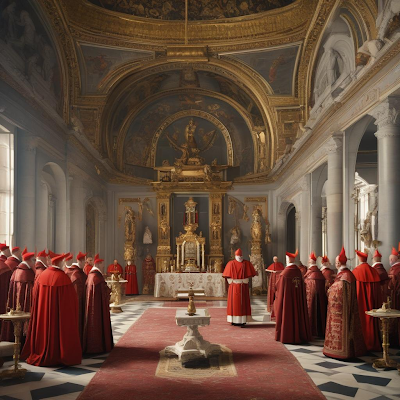
The College of Cardinals, a pivotal institution within the Catholic Church, plays a significant role in advising the pope and, most notably, in the election of new popes. While unique and evolved over time, its structure and function echo aspects of ancient Roman institutions, particularly the Roman College of Pontiffs.

Above: AI representation of the College of Cardinals


The Roman College of Pontiffs


Above: AI representation of the pagan Roman College of Pontiffs


In ancient Rome, the College of Pontiffs was one of the most important religious bodies. It was comprised of high-ranking priests responsible for overseeing Roman religious practices and maintaining the pax deorum, or peace with the gods. The Pontifex Maximus, the head of the college, played a central role in religious ceremonies and was considered the chief priest of the Roman state religion.

The College of Pontiffs functioned both as an advisory body and as a regulatory entity, ensuring that religious rites and rituals were carried out correctly. Its responsibilities included interpreting omens, advising the Senate and magistrates on religious matters, and maintaining the office of the Vestal Virgins, among other duties. The college served as a bridge between religious and civic life, reinforcing the integration of state and religion in Roman society.

The Catholic College of Cardinals


The College of Cardinals, like the Roman College of Pontiffs, is a critical religious institution with significant advisory and ceremonial roles. Established over centuries, particularly after its formalization in the reforms of the 11th century, the College of Cardinals has some structural and functional parallels to its ancient Roman predecessor.

  1. Advisory Role: Like the College of Pontiffs, which advised on religious matters, the College of Cardinals serves as advisors to the pope. Cardinals provide counsel on theological, administrative, and diplomatic issues, helping to steer the Church's direction in complex global and ecclesiastical affairs.

  2. Electoral Function: The most crucial task of the College of Cardinals is the papal conclave, where cardinals under the age of 80 gather to elect a new pope. This reflects the participatory decision-making aspect observed in Rome's religious-political institutions. Although the College of Pontiffs did not elect leaders, its collective authority in religious affairs is mirrored in the conclave's importance for choosing the Church's highest leader.


  3. Structured Hierarchy: Both colleges consist of senior members with specific roles. In the ancient Roman model, the Pontifex Maximus was the chief authority, while cardinals hold senior ecclesiastical offices within the Church, such as Cardinal Bishops, Cardinal Priests, and Cardinal Deacons, reflecting an organized rank and duty system akin to that of the Roman priestly hierarchy.


  4. Cultural Integration: Just as the College of Pontiffs was embedded in the cultural and political life of Rome, the College of Cardinals is deeply interwoven with the broader aspects of the Catholic Church's global influence, signifying its role as a bridge between the spiritual and practical governance of the Church.

Conclusion

While the Catholic College of Cardinals operates within a distinctly Christian framework and theological mission, its structural and functional parallels to the Roman College of Pontiffs demonstrate how the Church historically integrated and adapted elements from existing civic and religious models. This synthesis allowed for a continuity of governance styles while serving the dynamic needs of a growing and global faith community. The adaptation showcases how the Catholic Church has historically drawn on diverse influences to construct a resilient and adaptable organizational framework, ensuring its enduring presence and leadership across centuries.


Conclusion

The leadership organization of the Catholic Church is deeply influenced by the hierarchical systems of both the Jewish Temple and synagogue and the Roman religious institutions. This synthesis has created a robust and enduring structure that supports the Church's role as a global religious institution, preserving its traditions while adapting to the changing needs of its faithful.