Showing posts with label saints days. Show all posts

Tuesday, February 17, 2026

Valentine's Day is Pagan! I. CHICAGO-STYLE ACADEMIC PAPER


Saint Valentine’s Day and the Pagan Origins Claim: Lupercalia, Late Antique Christianity, and the Evolution of a Modern Holiday

I. CHICAGO-STYLE ACADEMIC PAPER

Abstract

Valentine’s Day is frequently described in popular culture as a Christianized continuation of pagan Roman fertility rites, particularly the festival of Lupercalia. This paper argues that such claims are historically overstated and often based on weak causal assumptions. While Lupercalia was a genuine Roman religious festival celebrated in mid-February, the Christian commemoration of Saint Valentine on February 14 originates in martyrological tradition and does not demonstrably derive from pagan ritual continuity. The paper further argues that the holiday’s association with romantic love emerges primarily from medieval literary culture and courtly traditions, later reshaped by modern commercial forces. Finally, Catholic, Protestant, and secular historical interpretations are compared to clarify what can and cannot responsibly be claimed regarding the holiday’s origins.


Introduction

Among modern popular controversies, one of the most persistent claims is that Valentine’s Day is “pagan,” a Christian rebranding of Roman fertility rituals. This argument is commonly presented as self-evident: Lupercalia was held in mid-February; Valentine’s Day occurs one day earlier; therefore the Church must have replaced a pagan feast with a Christian one. Yet historical method demands more than chronological proximity. It requires documentary evidence demonstrating intentional substitution and ideological continuity.

This paper argues that Valentine’s Day, properly understood, is not a pagan feast disguised as Christianity. Rather, it is best interpreted as a Christian martyr commemoration later transformed by medieval romantic symbolism and modern consumer culture. While some Christian authorities did condemn and suppress Lupercalia, the claim that the Church instituted Saint Valentine’s feast as a deliberate replacement is often asserted without strong primary textual grounding. The cultural evolution of Valentine’s Day into a romantic holiday is likewise medieval and modern rather than ancient and pagan.


I. Lupercalia and Roman Religious Culture

Lupercalia was an ancient Roman festival observed on February 15, associated with purification, fertility, and civic religious ritual. Ancient accounts describe sacrifice and ritual actions performed by the Luperci, who ran through the city and struck bystanders—especially women—with strips of animal hide, an act believed to promote fertility.¹ Such rites were not merely social customs but religious practices embedded in Roman sacrificial tradition.

Modern popular accounts often imply that Lupercalia was a romantic festival resembling modern Valentine’s Day. This is misleading. Lupercalia’s rituals were oriented toward civic purification and fertility rather than interpersonal romantic affection. Its meaning was public, ritualistic, and deeply tied to Roman religious identity.²


II. Saint Valentine(s): Martyrdom, Memory, and the Problem of Sources

The Christian figure behind Valentine’s Day is historically elusive. The name “Valentinus” appears in multiple late antique and medieval traditions, and it is likely that more than one martyr named Valentine existed.³ The Church’s commemoration of Valentine(s) is grounded in martyrological tradition rather than theological innovation.

Vatican summaries of the saint emphasize his status as a martyr commemorated on February 14 and buried along the Via Flaminia.⁴ This basic claim is plausible and consistent with known patterns of early Christian cults of martyrs. However, the precise details of his life are uncertain.

The “Secret Weddings” Legend

Perhaps the most popular narrative associated with Saint Valentine is that he was a third-century priest who performed Christian marriages in secret for Roman soldiers, defying an imperial ban on marriage allegedly instituted by Emperor Claudius II. According to this tradition, Valentine was arrested and executed for these actions.⁵

Yet historians generally regard this story as late and difficult to verify. The earliest reliable evidence concerns the saint’s martyr commemoration rather than a detailed biography. The “secret marriages” motif appears to be a later hagiographical elaboration, possibly arising from the medieval tendency to supply saints with moralized narratives reflecting later devotional concerns.⁶ Additionally, confusion between multiple Valentines—often described as a Roman priest and a bishop of Interamna (Terni)—likely contributed to the blending of traditions into a single dramatic story.⁷

Thus, while it is possible that some cleric named Valentine was martyred under Roman persecution, the romanticized marriage narrative is best treated as legend rather than established historical fact.


III. Pope Gelasius I, the End of Lupercalia, and the “Replacement” Claim

The most common argument for pagan origins asserts that Pope Gelasius I abolished Lupercalia and replaced it with Saint Valentine’s Day. Gelasius is known to have condemned the festival, notably in a letter addressed to Roman elites, often associated with the Collectio Avellana.⁸ This letter criticizes the continued participation of Christians in pagan rites and insists that such practices are incompatible with Christian identity.

However, the key historical question is not whether Gelasius opposed Lupercalia, but whether he instituted Valentine’s Day as a deliberate substitute. Modern scholarship often cautions that the “replacement” narrative is asserted without decisive evidence. While later popular histories frequently claim Gelasius replaced Lupercalia with a Christian feast, the surviving evidence does not provide a clear statement that Valentine’s feast was created specifically as a counter-festival.⁹

Therefore, it is historically safer to state that Gelasius opposed Lupercalia and contributed to its decline, while the existence of a February 14 Valentine commemoration may have been inherited from earlier martyrological tradition rather than invented as a direct replacement.


IV. Medieval Transformation: Courtly Love and the “Romantic Valentine”

The association between Saint Valentine and romantic love is not strongly attested in late antiquity. Rather, it appears prominently in medieval Europe, shaped by courtly love conventions and literary imagination. Geoffrey Chaucer is frequently credited with helping popularize the link between Saint Valentine’s Day and romantic pairing, particularly through poetic references to birds mating on “Saint Valentine’s Day.”¹⁰

While scholars debate the exact mechanisms of this association, the broader point is clear: the romantic symbolism of Valentine’s Day emerges in medieval cultural developments rather than Roman fertility ritual continuity. The holiday’s meaning was not fixed but evolved through layers of reinterpretation.


V. Modern Commercialization and the Emergence of the Contemporary Holiday

The modern holiday recognizable today—marked by greeting cards, romantic gifts, flowers, and consumer spending—is largely a product of industrial-era capitalism and print culture. The rise of mass-produced valentines in the nineteenth century accelerated the transformation of the day into a commercialized social ritual. The Library of Congress notes that the holiday’s commercialization developed significantly through the mass production of cards and consumer culture.¹¹

In the United States, Esther Howland is often associated with early mass production of valentines, reflecting the industrialization of sentimental expression.¹² This development demonstrates that contemporary Valentine’s Day is not a direct continuation of pagan religious rites but rather a modern cultural invention layered atop a medieval romantic tradition and an ancient saint’s commemoration.


VI. Catholic, Protestant, and Secular Interpretations

Catholic Perspective

From a Catholic theological standpoint, saint days are defined by liturgical intention and ecclesial memory: the commemoration of martyrs and the encouragement of Christian virtue. Even if a feast day shares proximity with pagan festivals, proximity alone does not establish identity. Gelasius’s condemnation of Lupercalia demonstrates the Church’s opposition to pagan ritual worship rather than an attempt to preserve it under Christian disguise.¹³

Protestant Perspective

Protestant attitudes vary. Liturgical Protestants often retain Saint Valentine as a commemorated figure in ecclesiastical calendars, though without Catholic veneration practices. More evangelical traditions frequently criticize the holiday for lacking explicit biblical foundation and for encouraging moral excess or commercial triviality. Yet even within Protestant critique, labeling the holiday “pagan” is not historically necessary; the holiday can be rejected as culturally unhelpful without asserting direct pagan religious continuity.

Secular Historical Perspective

A secular historian’s approach distinguishes origins from later developments. Lupercalia was a pagan Roman rite; Valentine’s commemoration is a Christian saint’s day. The romantic holiday largely emerges from medieval culture and later commercialism. Claims of direct replacement often depend on weak evidence and retrospective narrative simplification rather than primary sources.¹⁴


Conclusion

The claim that Saint Valentine’s Day is pagan is historically overstated. Lupercalia was a real pagan festival, but its rites differ substantially from the meaning of Saint Valentine’s feast. While Pope Gelasius condemned Lupercalia, the evidence that he instituted Saint Valentine’s Day specifically as its replacement is inconclusive. Saint Valentine’s Day is better understood as a Christian martyr commemoration later reshaped by medieval courtly love literature and modern commercial consumerism.

In sum, Valentine’s Day is not pagan by origin in any straightforward sense. Rather, it is an example of how Christian commemorations can be culturally transformed over time—sometimes to the point that their original religious meaning is obscured.


Footnotes (Chicago Notes)

  1. “Lupercalia,” Encyclopaedia Britannica, accessed February 17, 2026, https://www.britannica.com/topic/Lupercalia.

  2. Ibid.

  3. “Saint Valentine,” Encyclopaedia Britannica, accessed February 17, 2026, https://www.britannica.com/biography/Saint-Valentine.

  4. “St. Valentine, Martyr on the Via Flaminia,” Vatican News, accessed February 17, 2026, https://www.vaticannews.va/en/saints/02/14/st--valentin--martyr-on-the--via-flaminia.html.

  5. “Valentine’s Day 2026: Origins and Meaning,” History.com, accessed February 17, 2026, https://www.history.com/articles/valentines-day-bible-religious-origins.

  6. Ibid.

  7. “Saint Valentine,” Encyclopaedia Britannica.

  8. Roger Pearse, “The Abolition of the Lupercalia: Letter 100 of the Collectio Avellana,” Roger Pearse Blog, March 24, 2011, accessed February 17, 2026, https://www.roger-pearse.com/weblog/2011/03/24/the-abolition-of-the-lupercalia-letter-100-of-the-collectio-avellana/.

  9. “Lupercalia,” in William Smith, ed., A Dictionary of Greek and Roman Antiquities (London: John Murray, 1875), hosted at University of Chicago, accessed February 17, 2026, https://penelope.uchicago.edu/Thayer/E/Roman/Texts/secondary/SMIGRA*/Lupercalia.html.

  10. Geoffrey Chaucer, Parlement of Foules, in relation to Valentine’s Day traditions; see also discussion in modern scholarship: Henry Ansgar Kelly, “Chaucer and the Cult of Saint Valentine,” The Journal of English and Germanic Philology 88, no. 3 (1989): 322–339.

  11. “Commercialization of Valentine’s Day,” Library of Congress Blogs, accessed February 17, 2026, https://blogs.loc.gov/inside_adams/2016/02/commercialization-of-valentines-day/.

  12. “Valentines,” Worcester Historical Museum, accessed February 17, 2026, https://worcesterhistorical.com/digital-exhibits/valentines/.

  13. Pearse, “Abolition of the Lupercalia.”

  14. Associated Press, “Valentine’s Day Isn’t Pagan—Here’s Why Historians Doubt the Lupercalia Myth,” AP News, accessed February 17, 2026, https://apnews.com/article/2d9a2d67c95ae06322aa9417c62a6baf.


Bibliography (Chicago Style)

Associated Press. “Valentine’s Day Isn’t Pagan—Here’s Why Historians Doubt the Lupercalia Myth.” AP News. Accessed February 17, 2026. https://apnews.com/article/2d9a2d67c95ae06322aa9417c62a6baf.

“Commercialization of Valentine’s Day.” Library of Congress Blogs. Accessed February 17, 2026. https://blogs.loc.gov/inside_adams/2016/02/commercialization-of-valentines-day/.

Kelly, Henry Ansgar. “Chaucer and the Cult of Saint Valentine.” The Journal of English and Germanic Philology 88, no. 3 (1989): 322–339.

“Lupercalia.” Encyclopaedia Britannica. Accessed February 17, 2026. https://www.britannica.com/topic/Lupercalia.

Pearse, Roger. “The Abolition of the Lupercalia: Letter 100 of the Collectio Avellana.” Roger Pearse Blog. March 24, 2011. Accessed February 17, 2026. https://www.roger-pearse.com/weblog/2011/03/24/the-abolition-of-the-lupercalia-letter-100-of-the-collectio-avellana/.

“Saint Valentine.” Encyclopaedia Britannica. Accessed February 17, 2026. https://www.britannica.com/biography/Saint-Valentine.

Smith, William, ed. “Lupercalia.” In A Dictionary of Greek and Roman Antiquities. London: John Murray, 1875. Hosted at University of Chicago. Accessed February 17, 2026. https://penelope.uchicago.edu/Thayer/E/Roman/Texts/secondary/SMIGRA*/Lupercalia.html.

“St. Valentine, Martyr on the Via Flaminia.” Vatican News. Accessed February 17, 2026. https://www.vaticannews.va/en/saints/02/14/st--valentin--martyr-on-the--via-flaminia.html.

“Valentine’s Day.” History.com. Accessed February 17, 2026. https://www.history.com/articles/valentines-day-bible-religious-origins.

“Valentines.” Worcester Historical Museum. Accessed February 17, 2026. https://worcesterhistorical.com/digital-exhibits/valentines/.

Monday, January 12, 2026

Valentine’s Day and the Real Saint Valentine


Valentine’s Day: The History, Theology, and the Real Saint Valentine

Valentine’s Day is often treated as a modern invention about romance, cards, and candy, but from my perspective as a Catholic, its roots go much deeper. Long before it became commercialized, this day was connected to Christian martyrdom, sacrificial love, and a very real saint whose witness still matters.

The Real Saint Valentine

The Church recognizes Saint Valentine as a Christian martyr from the early centuries of the Church, traditionally dated to the third century during Roman persecution. Historical records are sparse, which is common for early martyrs, but the consistent thread is clear: Valentine was a priest or bishop who remained faithful to Christ in a hostile pagan culture and paid for it with his life.

One of the strongest traditions surrounding Saint Valentine is that he ministered to persecuted Christians and, according to later accounts, secretly married Christian couples when marriage itself was threatened or restricted. Whether every detail of those stories is historically verifiable or not, the Church has always honored him as a martyr who defended Christian love and fidelity at great personal cost.

What matters most to me is not the romantic embellishments added centuries later, but the core truth: Saint Valentine died for Christ. His witness places him firmly within the early Church’s understanding of love, not as sentimentality, but as self-gift and sacrifice.

How February 14 Became Associated with Love

Saint Valentine’s feast day has been celebrated on February 14 since at least the early Middle Ages. Over time, especially in medieval Europe, cultural customs began associating the day with courtship and affection. Poets and writers layered romantic symbolism onto the feast, eventually giving rise to what we recognize today as Valentine’s Day.

This cultural development does not replace the saint or his meaning. It reflects something deeply Christian: the idea that love, commitment, and faithfulness are worth celebrating. When properly understood, romance is not opposed to Christianity. It is elevated by it.

The Theology of Love Behind the Feast

From a Catholic theological perspective, love is never just a feeling. Love is an act of the will rooted in truth. The Church teaches that authentic love involves sacrifice, commitment, and openness to God’s grace. Saint Valentine’s martyrdom fits squarely within this understanding.

Christian marriage itself is sacramental because it reflects Christ’s love for the Church. That is the theological foundation behind why the Church sees love as sacred, not disposable. When Saint Valentine is remembered correctly, he stands as a witness to faithful love in a world that often misunderstands it.

Addressing the Claim That Valentine’s Day Is “Pagan”

I often hear the claim that Valentine’s Day is a Christianized version of pagan fertility festivals. Like many such accusations, this one relies on surface-level similarities rather than solid evidence.

While ancient Rome did have pagan observances in February, there is no historical proof that the Church simply renamed a pagan festival and replaced its gods with a saint. The Church commemorated Saint Valentine because he was a martyr, not because of a seasonal ritual. The feast follows the same pattern as countless other saint days: honoring a Christian who bore witness to Christ through death.

The presence of love-themed customs does not make a feast pagan. Christianity does not reject love, affection, or marriage. It redeems them. The Church transformed culture by infusing it with Christian meaning, not by borrowing pagan worship.

Why Saint Valentine Still Matters to Me

When I look past the cards and candy, I see Saint Valentine as a reminder of what love actually costs. Love is not shallow or disposable. It demands courage, fidelity, and sometimes sacrifice. That is the kind of love Christ calls me to live, whether in marriage, friendship, or discipleship.

Valentine’s Day, at its core, is not about fleeting romance. It is about a martyr who understood that real love flows from faithfulness to God. Remembered that way, Saint Valentine doesn’t cheapen Christian belief. He deepens it.

Sunday, December 14, 2025

The Feast of Saint Lucy December 13th


Reclaiming the Feast of Saint Lucy as an Italian American Catholic

I did not grow up celebrating the Feast of Saint Lucy.

My family is Italian American, but largely assimilated. While we identified as Catholic and observed major liturgical celebrations such as Christmas and Easter, we did not mark the feast days of saints as part of our religious or cultural life. Devotional practices tied to the liturgical calendar were minimal, and the observance of saints’ days, common in many Italian regions, did not survive the transition into American life.

As an adult, however, I have become increasingly attentive to the devotional and cultural dimensions of Catholicism that were not transmitted to me. The Feast of Saint Lucy, observed on December 13, has become one such point of recovery. My engagement with this feast is not inherited but intentional, shaped by historical study, theological reflection, and a desire to reconnect with forms of Catholic practice that once structured Italian religious life.

Saint Lucy in Historical and Devotional Context

Saint Lucy, or Santa Lucia, was born in Syracuse, Sicily, in the late third century. According to early Christian tradition, she was martyred during the persecutions under Emperor Diocletian after refusing to renounce her faith or enter into a pagan marriage. While accounts of her death vary, she has been consistently honored by the Church as a virgin martyr since at least the fifth century.

The Catholic Encyclopedia describes Lucy as “one of the most venerated martyrs of the early Church,” a designation reflected in the rapid spread of her cult throughout Italy and northern Europe (“St. Lucy”). Over time, devotional traditions associated her with eyesight, and she became a patron saint of the blind and those suffering from eye diseases. While some of these elements developed through legend rather than historical documentation, they nonetheless shaped the theological imagination of the faithful.

What I find most significant about Saint Lucy is not the legendary embellishment of her martyrdom, but her representative status. She exemplifies the early Christian understanding of witness as costly fidelity. Her sanctity is grounded not in institutional authority or intellectual contribution, but in steadfast refusal to compromise belief under coercion.

Light as Theological Symbol and Liturgical Placement

The theological symbolism of Saint Lucy is inseparable from her name, derived from the Latin lux, meaning light. This symbolism is intensified by the liturgical placement of her feast on December 13, which, prior to calendar reform, coincided closely with the winter solstice and was regarded as the longest night of the year.

The Church’s commemoration of a saint named “Light” at this moment reflects a broader Christian theology in which light signifies divine presence, truth, and salvation. The Johannine assertion that “the light shines in the darkness, and the darkness has not overcome it” (John 1:5) has long informed the spiritual interpretation of Lucy’s feast.

From a theological perspective, the emphasis on light does not negate the reality of darkness. Rather, it affirms the persistence of faith under conditions of suffering and obscurity. This framework has shaped my own engagement with the feast, particularly its emphasis on simple ritual actions, such as the lighting of candles, which render abstract theology tangible.

Regional Italian Observances and Cultural Transmission

Italian observance of the Feast of Saint Lucy varies significantly by region, reflecting the localized character of premodern Catholic devotion.

In Sicily, and especially in Syracuse, the feast retains a strongly penitential and communal character. Processions, barefoot pilgrimage, and the public veneration of a silver statue of the saint emphasize her role as a protector during times of famine and crisis. One of the most enduring customs associated with the feast involves the consumption of cuccìa, a dish made from boiled wheat berries. This practice commemorates a 1646 famine during which, according to tradition, a shipment of grain arrived on Saint Lucy’s feast day, prompting the population to consume the wheat without milling it into flour (Di Giovine, The Heritage of Italian Feast Days). As a result, many Sicilians abstain from bread and pasta on December 13.

In contrast, northern Italian observances emphasize Saint Lucy’s role as a gift-bearer to children, particularly in Lombardy and Veneto. In these regions, Santa Lucia visits households on the night of December 12, distributing gifts while remaining unseen. This tradition, while less overtly penitential, nonetheless reinforces the saint’s association with sight and moral vigilance.

My family practiced none of these customs. Their absence in my upbringing illustrates how immigration and assimilation often led to the erosion of localized devotional practices, particularly those not reinforced by the broader American Catholic culture.

Reclaiming Devotional Practice Through Intentionality

As an Italian American Catholic, I increasingly understand my relationship to feast days like that of Saint Lucy as reconstructive rather than preservative. I am not reviving a family tradition that was interrupted; I am engaging in a process of informed recovery.

The loss of saints’ day observances among immigrant families was not the result of indifference, but of adaptation. In a new cultural environment shaped by industrial labor schedules and Protestant norms, the devotional calendar narrowed. What survived were the most universally recognized celebrations.

My attempt to reclaim Saint Lucy’s feast reflects a broader desire to reintegrate liturgical time into daily life. Practices such as lighting a candle on December 13, reading the saint’s hagiography, or preparing symbolic food are modest, yet they function as acts of theological formation. They situate belief within time, memory, and bodily practice.

As Pope Benedict XVI observed, Christianity is not fundamentally “an ethical choice or a lofty idea,” but an encounter with a person (Deus Caritas Est). Saints like Lucy mediate that encounter by embodying belief within historical circumstance.

Conclusion: The Contemporary Significance of Saint Lucy

The Feast of Saint Lucy has become meaningful to me precisely because it was not inherited. Its significance lies in its recovery through study, reflection, and practice.

Saint Lucy represents a form of faith that persists without spectacle. Her symbolism is not triumphalist, but resolute. In a liturgical moment defined by darkness, she stands for the endurance of light that does not overwhelm but remains.

By observing her feast, I am not attempting to replicate a past that did not exist in my family. Rather, I am participating in the ongoing transmission of Catholic tradition, one that allows for retrieval as well as inheritance. In doing so, I have come to understand the Feast of Saint Lucy not as an antiquated devotion, but as a disciplined response to the perennial human need for light.


Sources

  • Catholic Encyclopedia, “St. Lucy (Santa Lucia)”

  • Vatican News, “Saint Lucy, Virgin and Martyr”

  • Di Giovine, Michael A., The Heritage of Italian Feast Days

  • The Holy Bible, John 1:5

  • Benedict XVI, Deus Caritas Est

Appendix: Responding to the Claim That Saints’ Feasts Are “Pagan”

A Patristic and Liturgical-Theological Response

Any contemporary retrieval of saints’ feast days inevitably encounters the objection that such practices are “pagan” in origin or intent. This critique, common in polemical Protestant discourse and occasionally echoed in secular critiques of ritual religion, often rests on a misunderstanding of Christian inculturation, patristic theology, and the Church’s theology of memory. Because the Feast of Saint Lucy employs symbolism associated with light, seasonal transition, and embodied ritual, it is frequently cited as an example of Christianity allegedly absorbing pre-Christian religious practice.

I find it necessary to address this objection directly, not only because it persists, but because it misconstrues the Church’s historical and theological self-understanding from the patristic period onward.

Inculturation and the Patristic Logic of Conversion

The claim that saints’ feasts are “pagan” typically assumes that the use of preexisting cultural forms necessarily entails theological compromise. The Church Fathers consistently rejected this assumption. From the earliest centuries, Christianity articulated itself within Jewish and Greco-Roman cultural worlds, not by erasing those cultures, but by converting their meanings.

Augustine articulates this principle most clearly in De Doctrina Christiana, where he argues that truth belongs to God wherever it is found and may be rightly reclaimed for Christian use. He compares this process to the Israelites’ appropriation of Egyptian gold, emphasizing that cultural materials may be purified and redirected toward divine ends rather than rejected outright.¹ This logic applies not only to philosophical concepts, but also to cultural symbols and temporal structures. Light, seasonal rhythms, and communal ritual are not intrinsically pagan; they become Christian when reoriented toward Christ.

The Feast of Saint Lucy exemplifies this reorientation. Light is no longer treated as a cosmic force or deity, but as a sign pointing to Christ as revealed through the embodied witness of a martyr.

Saints’ Feasts and Ecclesial Memory

From an ecclesiological perspective, saints’ feast days function as acts of ecclesial remembrance rather than mythic celebration. Augustine addresses this concern directly when responding to accusations that Christian veneration of martyrs resembles pagan worship. In Contra Faustum, he insists that Christians do not treat martyrs as gods, nor offer sacrifice to them, but honor them as witnesses whose lives proclaim God’s grace.²

This distinction is foundational. Saints are not autonomous spiritual powers tied to fertility, cosmic cycles, or natural forces. They are historical persons whose lives reveal Christ. Their feast days are therefore Christological and ecclesial in orientation. Saint Lucy’s commemoration does not celebrate light as an abstract principle, but Christ as Light, manifested through a particular life of fidelity under persecution.

Liturgical Time Versus Pagan Temporality

A further misunderstanding underlying the “pagan” critique concerns the nature of liturgical time itself. Pagan religious systems often operate within cyclical or mythic time, in which rituals reenact cosmic patterns believed to sustain or influence nature. Christian liturgy, by contrast, is grounded in historical and eschatological time.

Bede the Venerable articulates this distinction in De Temporum Ratione, where he describes time itself as a created reality ordered toward God. The Christian calendar, for Bede, does not sanctify celestial bodies or seasonal forces, but consecrates time by situating it within the narrative of salvation history.³

The proximity of Saint Lucy’s feast to the winter solstice, therefore, does not imply solar worship. Rather, it proclaims that even the darkest moment of the year belongs to Christ. Darkness is neither feared nor appeased; it is named and overcome through liturgical confession.

Gregory the Great and the Conversion of Custom

Gregory the Great offers one of the most pastorally significant patristic treatments of cultural continuity and conversion. In a letter to Augustine of Canterbury regarding the evangelization of England, Gregory famously advises against the wholesale destruction of local religious customs. Instead, he urges that existing forms be purified and redirected toward Christian worship.⁴

Gregory’s approach reflects deep theological confidence rather than accommodation. Christianity does not fear cultural forms because it trusts in the transformative power of the Gospel. This principle undergirds the Church’s enduring approach to popular devotion, saints’ feasts, and ritual practice.

Applied to Saint Lucy, this logic clarifies that customs involving candles, food, or procession are not remnants of pagan religion, but expressions of faith embodied within particular cultures and histories.

Popular Piety and Theological Discernment

Patristic theology consistently distinguishes between improper worship and legitimate honor. Augustine emphasizes intention and object, Gregory emphasizes pastoral guidance, and Bede emphasizes catechetical clarity. Together, they form a theological framework in which popular devotion is subject to discernment, not dismissal.

This framework is echoed in contemporary magisterial teaching. The Directory on Popular Piety and the Liturgy affirms that popular devotion, when rightly ordered, expresses the sensus fidei of the faithful and participates authentically in ecclesial life.⁵ While abuses may require correction, they do not invalidate the theological legitimacy of devotion itself.

Personal Retrieval as Ecclesial Participation

My own retrieval of the Feast of Saint Lucy is shaped by this patristic and liturgical framework. To reclaim a saints’ feast is not to revert to pre-Christian religion, nor to indulge in superstition, but to participate consciously in the Church’s memory. It is to allow theology to take bodily and temporal form.

The charge of “paganism” ultimately reflects discomfort with embodied religion. Yet Christianity is irreducibly incarnational. Grace operates through material signs, historical lives, and communal ritual. Saints’ feast days are not deviations from this logic. They are its consequence.

To honor Saint Lucy is not to worship light, but to confess Christ as Light through the witness of one who refused to allow darkness the final word.


Footnotes

  1. Augustine, De Doctrina Christiana, trans. R. P. H. Green (Oxford: Oxford University Press, 1995), II.40.

  2. Augustine, Contra Faustum Manichaeum, trans. Richard Stothert, in Nicene and Post-Nicene Fathers, First Series, vol. 4 (Peabody, MA: Hendrickson, 1994), XX.21.

  3. Bede the Venerable, The Reckoning of Time, trans. Faith Wallis (Liverpool: Liverpool University Press, 1999), chap. 2.

  4. Gregory the Great, Registrum Epistolarum, XI.76, trans. John R. C. Martyn, The Letters of Gregory the Great, vol. 3 (Toronto: Pontifical Institute of Mediaeval Studies, 2004).

  5. Congregation for Divine Worship and the Discipline of the Sacraments, Directory on Popular Piety and the Liturgy (Vatican City: Libreria Editrice Vaticana, 2001), §9.

Tuesday, October 8, 2024

Are Catholic Saints Renamed Pagan Gods? Separating Fact from Fiction


 The veneration and intercession of saints have never troubled me. Scripture clearly states that we will “partake of the divine nature” (2 Peter 1:4)—meaning that, in Heaven, we will be like God. In Catholicism, this process is called “sanctification,” and in Eastern Orthodoxy, it’s known as “theosis.” While we won’t become God Himself—an impossibility for created beings—we will share in His attributes, knowledge, and glory (cf. 1 John 3:2; 1 Corinthians 13:12). Christ Himself affirmed that His followers would perform great miracles through Him (John 14:12), which supports the Catholic understanding of saints’ intercessory powers.


I also believe that the pagans, in their own way, received a shadow of divine revelation about the truth of Christianity, including the future role of the saints. However, they misunderstood and distorted this revelation, turning saints into polytheistic gods, goddesses, and demigods. Since all religions contain some measure of truth and goodness—misinterpreted reflections of God’s revelation—it makes sense to me that the one true faith, the Catholic Church, would embody these truths while rejecting the errors. This conviction is yet another reason I’m Catholic.

Nevertheless, critics claim that Catholic saints are simply renamed pagan gods, that the Church compromised the Gospel and adopted a form of polytheism by replacing pagan deities with so-called "saints" to appeal to pagans. But is this accusation really true? Let’s examine this more closely.

Are Catholic Saints Renamed Pagan Gods? Separating Fact from Fiction

The question of whether Catholic saints are merely “renamed” pagan gods is a longstanding accusation that has been directed at the Church for centuries. Critics argue that the Church, in its efforts to convert pagan populations, simply replaced their deities with Christian saints to facilitate the process. But is this claim accurate, or is it a misunderstanding of the Church’s teachings and historical practices? A careful examination of scripture, Church documents, and scholarly opinions provides clarity.

Understanding the Role of Saints in Catholicism


The veneration of saints in Catholicism is rooted in the belief that they are holy individuals who, by God’s grace, exemplify Christian virtues and intercede on behalf of the faithful. The Church does not worship saints as gods, as made clear in the Catechism of the Catholic Church: “The Church venerates the saints and asks for their intercession, but worship and adoration are due to God alone” (CCC 971). Saints are seen as models of faith and conduits to Christ, not deities in themselves.

This distinction is further emphasized by Church Fathers such as St. Augustine, who in his City of God rejected any suggestion that the saints are equivalent to pagan gods. He argued that while pagans worshiped their gods as entities with powers independent of God, Christians view saints as completely dependent on and subordinate to God’s will (cf. City of God, Book VIII).

The Church’s Position: No Syncretism Allowed

The Church has always been cautious about accusations of syncretism (the blending of different religious beliefs). The Council of Nicaea (AD 325) and the Council of Trent (1545-1563) both clarified the role and veneration of saints to ensure it aligned with Christian doctrine. The Second Vatican Council reaffirmed this, stating: “The veneration of the saints is to be distinguished from the worship which is due to God alone” (Lumen Gentium, 51).

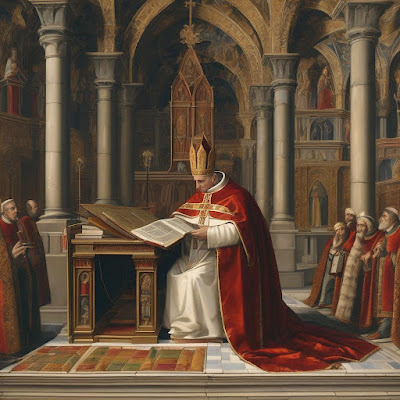
AI created image of Pope St. Gregory


In the fourth century, Pope Gregory the Great clarified the Church’s stance when writing to St. Mellitus, a missionary in Britain. He instructed not to destroy pagan temples but to purify them for Christian use and to encourage the celebration of Christian feast days, so that the people would “celebrate these, instead of the pagan feasts.” However, he was clear that pagan practices and beliefs were to be eradicated, not assimilated (cf. Letter to Abbot Mellitus, 601 AD).

Addressing the Misconception: Origins of the Critique

The misconception that Catholic saints are merely renamed pagan gods likely arises from a superficial similarity between certain saints and pagan figures. For instance, St. Brigid of Ireland is often said to have replaced the Celtic goddess Brigid. However, historical evidence indicates that St. Brigid was a real Christian woman who established monasteries and was known for her charity. The Church did not create or rename her to replace a deity, but rather elevated her to sainthood for her devout Christian life.

This critique is also commonly aimed at the celebration of feast days, which some claim were adapted from pagan festivals. For example, Christmas and All Saints’ Day are said to have replaced pagan solstice celebrations. But as historian Ronald Hutton notes, the selection of these dates was more complex and based on theological considerations, not a deliberate co-opting of pagan holidays (Stations of the Sun: A History of the Ritual Year in Britain, 1996).

Another example of a saint often mistaken for a pagan deity is St. Nicholas, commonly associated with the Greek god Poseidon or the Roman god Neptune. This confusion arises from his connection to sailors and the sea.

St. Nicholas vs. Poseidon/Neptune

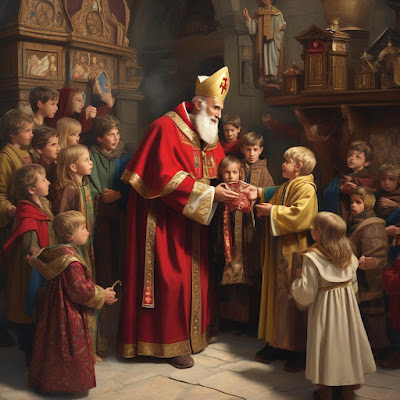
AI created image of St. Nicholas, Bishop of Myra


St. Nicholas, a 4th-century bishop of Myra (in modern-day Turkey), is widely known as the patron saint of sailors. Many legends about St. Nicholas involve his miraculous interventions at sea, such as calming storms and saving sailors from shipwreck. This has led some to draw parallels between St. Nicholas and Poseidon/Neptune, who were revered by ancient Greeks and Romans as gods of the sea.

AI created image of the pagan Roman god Neptune


However, the association of St. Nicholas with the sea has a distinctly Christian origin. Historical records show that St. Nicholas’s protection of sailors was not an attempt to replace or Christianize Poseidon, but rather a reflection of the bishop’s intercessory power and the deep faith of seafaring Christians. His legends emphasize God’s power and mercy, not pagan deities.

According to the Catholic Encyclopedia, the cult of St. Nicholas spread rapidly in both the East and West, and by the 6th century, he was already being honored as a miracle worker. The Byzantine Emperor Justinian I even built a church in his honor, recognizing him as a saint whose life and deeds exemplified Christian virtues, completely separate from any pagan association (Catholic Encyclopedia, "St. Nicholas of Myra").

Moreover, the Catechism of the Catholic Church distinguishes clearly between the veneration of saints and any form of worship that could be attributed to pagan gods. St. Nicholas is celebrated for his generosity, protection, and compassion, qualities that set him apart from the more capricious nature of mythological gods like Poseidon. The celebration of his feast day on December 6th eventually led to the development of various Christmas traditions, but his status as a saint was rooted in historical fact and Christian devotion, not a repurposing of pagan mythology.

Thus, while St. Nicholas’s connection to sailors may superficially resemble that of Poseidon/Neptune, he was not a replacement for these deities but rather a Christian saint whose life inspired devotion among the faithful, especially those who relied on the sea for their livelihood.

St. Martin of Tours and His Association with Pagan Gods

AI created image of St. Martin of Tours


St. Martin of Tours is another example of a Christian saint who has been mistakenly identified with a pagan god. A 4th-century bishop and former Roman soldier, St. Martin is celebrated as the patron saint of soldiers and is known for his acts of charity and humility. His feast day, November 11th, falls around the time of many pre-Christian autumnal festivals, leading some to speculate that his veneration is merely a continuation of older pagan practices.

St. Martin and the God Mars

AI created image of the Roman god Mars


One of the most common claims is that St. Martin replaced the Roman god Mars, the god of war. This association arises from the similarity of their names—Martin derives from "Martinus," which in turn is related to Mars—and the fact that St. Martin is considered the patron saint of soldiers. Some critics suggest that early Christians co-opted the worship of Mars, transforming the war god into a Christian saint who represented virtues appropriate to soldiers, such as courage, charity, and humility.

However, this theory does not hold up under scrutiny. Historically, St. Martin’s veneration has always been centered around his life story, particularly his act of charity in cutting his cloak in half to share it with a beggar, who was later revealed to be Christ Himself. This episode emphasizes mercy and selflessness rather than the martial valor typically associated with Mars. The Catechism of the Catholic Church (CCC 2633) highlights intercession for others as a key Christian virtue, which was embodied in St. Martin’s life, making him a suitable model for Christians, especially soldiers, who were called to follow Christ’s example of peace and compassion.

St. Martin and Pagan Festivals

St. Martin’s feast day, falling on November 11th, coincides with the timing of pagan harvest festivals in Europe, such as the Germanic celebration of Martinalia and the Celtic festival of Samhain. These festivals marked the end of the agricultural season and the beginning of winter. As the Church sought to evangelize pagan communities, it is likely that St. Martin’s feast day was used as a Christian alternative to these pre-Christian observances. However, this does not mean that St. Martin himself was a transformed pagan figure.

Pope Benedict XVI, in his General Audience on July 4, 2007, described St. Martin as “one of the most famous and revered saints in Europe, as well as a great missionary.” He emphasized that St. Martin’s influence and popularity stemmed not from any association with pagan gods but from his dedication to spreading Christianity and caring for the poor.

Historical Misinterpretation

The mistaken association of St. Martin with Mars or other pagan gods is often the result of superficial similarities in name or the proximity of his feast day to pre-existing pagan festivals. As historian Ronald Hutton explains in Stations of the Sun: A History of the Ritual Year in Britain, the Church’s decision to place Christian feast days near pagan festivals was not an attempt to "rename" pagan gods, but rather a strategy to provide the faithful with opportunities to celebrate Christian mysteries in familiar seasonal contexts.

Moreover, the Second Vatican Council's document Lumen Gentium clarifies that the purpose of venerating saints is to honor the work of Christ in their lives, not to continue or replicate pagan customs (cf. LG 50). The Council reiterates that the saints are honored not as deities, but as friends and servants of God, completely distinct from pagan worship.

In summary, while St. Martin’s feast day and some aspects of his veneration might have been positioned to align with the calendar of pagan festivals, his identity and legacy are firmly rooted in Christian theology and practice. St. Martin is celebrated not as a rebranded pagan god, but as a genuine Christian saint whose life and deeds exemplify the virtues of faith, charity, and humility.

Saint Mary vs. Artemis/Diana


Yet another example Catholic detractors love to use is the Catholic view of Saint Mary, claiming she was just the goddess Artemis and Diana renamed. However, Saint Mary is not a renamed version of the pagan goddess Artemis (or Diana). This claim, often made in certain historical theories or anti-Catholic arguments, lacks substantial evidence and oversimplifies the complexities of religious history and theology. Here’s why:


Distinct Origins and Theologies:

The Virgin Mary and the goddess Artemis (known as Diana in Roman mythology) originate from vastly different religious traditions and have distinct roles and attributes. Artemis was the Greek goddess of the hunt, wilderness, and childbirth, and was often associated with nature and fertility. On the other hand, Mary is a central figure in Christianity, revered as the mother of Jesus Christ. Her veneration is rooted in Christian beliefs about her role in salvation history, not in pagan mythology.

Differences in Attributes and Worship:

Artemis was worshiped as a virgin goddess and protector of young women, but her cult and iconography emphasized independence and nature. In contrast, Mary’s veneration focuses on her purity, humility, and her role as the Mother of God. While both are associated with virginity, the significance of this attribute is entirely different. Additionally, Artemis was worshiped with rituals and offerings specific to her domains, whereas Marian devotion in Christianity involves prayers, intercessions, and feast days related to events in Mary’s life.

Historical Development of Marian Devotion:


Marian devotion developed organically within the context of early Christianity. By the time devotion to Mary grew in prominence (around the 3rd and 4th centuries), Christianity had already established its distinct theological identity, separating itself from pagan practices. While it is true that some aspects of Marian devotion may have been influenced by the broader cultural context (e.g., art styles or terminology), this does not mean Mary was merely a rebranded pagan goddess. Theological reflection on Mary’s role began with early Christian writers like the Church Fathers, who emphasized her unique role in the Incarnation and redemption.

Ephesus and the Connection to Artemis:


The claim often arises from the fact that the Council of Ephesus in 431 AD, which proclaimed Mary as “Theotokos” (Mother of God), was held in a city historically associated with the cult of Artemis. However, this does not imply that Mary is a continuation of Artemis worship. Ephesus was an important center for early Christianity, and the council’s decisions were based on Christological debates, not an attempt to syncretize with the local cult. By that time, Ephesus had long been a Christian city, and any similarities in language or symbolism are more likely due to cultural adaptation rather than religious continuity.

Syncretism and Misunderstanding:

While some scholars have noted that early Christianity occasionally adopted certain symbols or terms familiar to converts from other religions (a process known as inculturation), this was done to communicate Christian truths more effectively, not to merge with or continue pagan worship. The distinct doctrines, teachings, and liturgical practices of Marian devotion show no substantial theological overlap with the worship of Artemis or Diana.

In conclusion, while there may be superficial similarities in iconography or terms due to cultural factors, the theological foundations, historical origins, and religious meanings behind the veneration of Mary and the worship of Artemis/Diana are fundamentally different.


The Protestant Perspective

Many Protestant reformers in the 16th century, such as Martin Luther, criticized the veneration of saints as being too similar to the worship of pagan gods. Luther argued that the intercession of saints detracted from Christ’s role as the sole mediator (cf. Luther’s Works, vol. 25). John Calvin took a similar position, accusing the Catholic Church of encouraging “a mere transference of the worship of idols” (Institutes of the Christian Religion, Book I, Ch. 12).

However, contemporary Protestant scholars like Jaroslav Pelikan recognize that while Catholic practice has a “visual and symbolic” aspect that can seem reminiscent of pagan imagery, it is fundamentally rooted in Christian theology and Christocentric spirituality (Mary Through the Centuries, 1996).

The Church’s Response to the Accusation

The Church has always maintained that any superficial resemblance to pagan practices is coincidental and that the sanctification of elements from local cultures, such as architecture or art, is not an endorsement of pagan beliefs. As Pope Benedict XVI stated, “The Church has always taken the best of pagan culture… but she purifies it and transforms it to conform with the Gospel” (The Spirit of the Liturgy, 2000).

Moreover, the Church has officially denounced any attempt to syncretize Christian beliefs with paganism. The Council of Trent explicitly condemned any practice that would imply the worship of saints as deities (Session XXV, Decree on the Invocation, Veneration, and Relics of Saints).

A Balanced Perspective: Why This Argument Persists

Despite clear teachings and historical evidence to the contrary, the idea that Catholic saints are renamed pagan gods persists because of the complex history of the Church’s interaction with diverse cultures. When Christianity spread, it often built churches over former pagan sites and reinterpreted local symbols in light of Christian theology. This led to a perception of continuity where there was actually a deliberate transformation and redefinition.

The Catholic Church’s position is clear: saints are not worshiped as gods, nor were they adopted to replace pagan deities. Instead, the Church seeks to honor holy individuals who exemplified Christian virtues and to present them as models for the faithful. While pagan religions may contain some elements of truth, these truths are perfected in Christ and His Church.


Sunday, September 8, 2024

The Feast of Maria Santissima Addolorata


The Feast of Maria Santissima Addolorata


On Sunday, September 15th, 2024, my parish, Our Lady of the Rosary, will be celebrating the Feast of Maria Santissima Addolorata. Our parish, located in San Diego's Little Italy, is an Italian National Parish founded by Italian immigrants in the United States of America. Because of its rich heritage, many Italian traditions are still lovingly observed here, including special Masses and street processions honoring the beloved saints of Italian devotion, including Maria Santissima Addolorata. Let's take a deeper look at this beautiful devotion and its historical significance:

The Feast of Maria Santissima Addolorata, or Our Lady of Sorrows, is a significant Catholic celebration that honors the Virgin Mary in her role as the sorrowful mother who endured great suffering and pain, particularly during the Passion of Christ. This feast is observed in various forms around the world, but it is especially prominent in Italy, where devotion to Our Lady of Sorrows is deeply rooted in cultural and religious practices.

Historical and Liturgical Context

  1. Origins of the Feast:

    • The devotion to Our Lady of Sorrows has its origins in the early Church, with roots in the biblical account of Mary’s suffering, particularly as prophesied by Simeon in Luke 2:34-35: “And Simeon blessed them and said to Mary his mother, ‘Behold, this child is appointed for the fall and rising of many in Israel, and for a sign that is opposed (and a sword will pierce through your own soul also), so that thoughts from many hearts may be revealed.’”
    • The feast itself was formally instituted by Pope Pius VII in 1814 and later extended to the universal Church by Pope Pius X in 1913. It is celebrated on September 15th, the day after the Feast of the Exaltation of the Holy Cross, highlighting the close connection between Mary’s suffering and the suffering of Christ.
  2. The Seven Sorrows of Mary:

    • The feast focuses on the seven sorrows (or dolors) that Mary experienced in her life, which are:
      1. The prophecy of Simeon.
      2. The flight into Egypt.
      3. The loss of the Child Jesus in the temple.
      4. Mary meeting Jesus on the way to Calvary.
      5. The Crucifixion and death of Jesus.
      6. The body of Jesus being taken down from the Cross.
      7. The burial of Jesus.
    • These sorrows are meditated upon during the feast, often through prayers like the Rosary of the Seven Sorrows.

Cultural Significance in Italy

  1. Regional Celebrations:

    • In Italy, the Feast of Maria SS Addolorata is marked by various regional celebrations, processions, and rituals. One of the most famous is in the town of Castelpetroso in Molise, where an apparition of the Virgin Mary as the Addolorata was reported in 1888. This event led to the construction of the Basilica of Our Lady of Sorrows, which is a major pilgrimage site. It is also celebrated in communities of Italian immigrants from that region in other parts of the World like the United States.
    • The feast is often accompanied by processions where statues of the Addolorata, dressed in black and often with seven swords piercing her heart, are carried through the streets, symbolizing Mary’s deep sorrow.


  2. Spiritual Importance:

    • The feast is not only a day of mourning but also one of hope and solidarity with the suffering of Christ. It serves as a reminder of Mary’s role as a compassionate intercessor who understands human suffering and stands by the faithful in their trials.

Theological Significance

  1. Catechism and Church Teaching:

    • The Catholic Church teaches that Mary’s suffering, while unique, is a model of the Christian response to suffering. The Catechism of the Catholic Church (CCC 618) emphasizes that Christians are called to unite their sufferings with those of Christ, and Mary is the perfect example of this union.
  2. Church Fathers:

    • Early Church Fathers, such as St. Ambrose and St. Augustine, reflected on Mary’s sorrows as part of her unique participation in the redemptive work of Christ. This reflection laid the foundation for the later development of the Feast of Our Lady of Sorrows.


Conclusion

The Feast of Maria Santissima Addolorata is a profound expression of Marian devotion, focusing on Mary’s deep sorrow and suffering. It connects the faithful with the emotional and spiritual pain of the Virgin Mother, offering a way to meditate on the suffering of Christ and to find comfort in the intercession of Our Lady of Sorrows. The feast is rich in tradition, both liturgically and culturally, and continues to be a significant celebration within the Catholic Church, particularly in Italy and in the Italian diaspora.