
Historic Protestant anti-Catholic bigotry has profoundly shaped America’s perception of Halloween, influencing even Catholics. The slanderous accusations that Halloween has pagan or occult roots were amplified by pop culture, becoming part of the cultural zeitgeist, and are now widely accepted as truth—sometimes even by Catholics, albeit reluctantly. However, the reality is that Halloween, or "All Hallows' Eve," is deeply Christian in origin, rooted in the vigil for the Catholic celebration of All Saints' Day. Let’s explore the true origins of All Saints' Day and examine how and why it became something viewed with suspicion in America:

All Saints' Day, celebrated on November 1st, has an interesting history tied to the early Christian Church and the transformation of pagan monuments into Christian sites of worship. The origins of the feast can be traced back to Pope Boniface IV, who in 609 AD re-dedicated the Pantheon in Rome to the Church of All Saints.
Re-dedication of the Pantheon by Pope Boniface IV (609 AD)
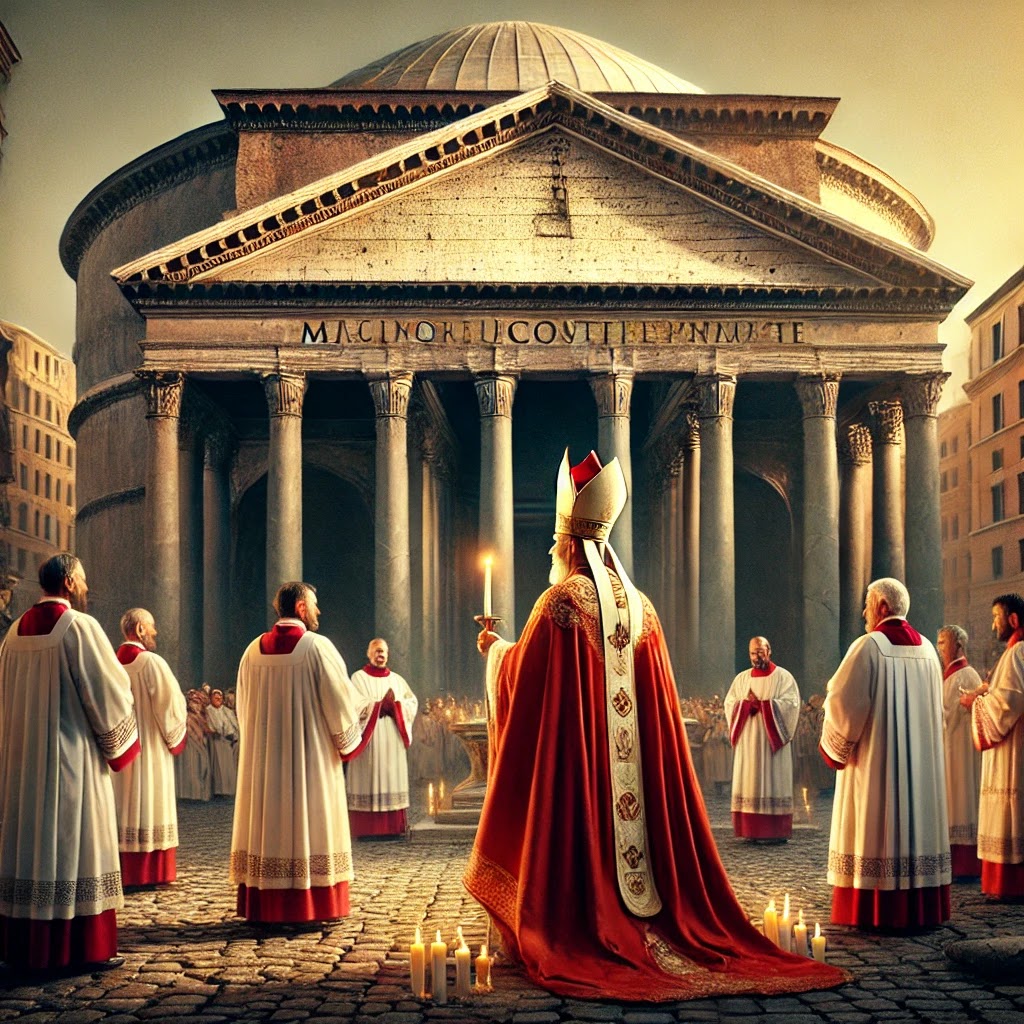
The Pantheon, originally a Roman temple dedicated to all the gods of pagan Rome, was an architectural marvel and a significant symbol of the Roman Empire’s religious life. When Christianity became the official religion of the empire, many pagan temples were either abandoned or repurposed for Christian use. Pope Boniface IV saw an opportunity to transform this iconic pagan structure into a place of Christian worship. On May 13, 609 AD, he consecrated the Pantheon to the Virgin Mary and all the Christian martyrs, renaming it the "Church of St. Mary and the Martyrs." This act symbolized the Church's triumph over paganism and honored the memory of those who had died for their Christian faith. This dedication is considered one of the earliest instances of the feast now known as All Saints' Day.
Pope Gregory III Moves the Feast to November 1st

While May 13th was initially observed as a feast day in honor of all martyrs and saints, the date was eventually changed. In the 8th century, Pope Gregory III (731-741) decided to move the celebration of All Saints to November 1st. The reason behind this shift was the dedication of a new church in Rome. Pope Gregory III consecrated a chapel in St. Peter’s Basilica specifically to "all saints," particularly those whose relics were unknown or had no feast day. This new date, November 1st, became the official day of the feast for the entire Western Church.
Broader Significance of November 1st
By the time of Pope Gregory IV (827-844), the observance of All Saints’ Day on November 1st was extended to the entire Christian world. This move allowed for a more universal celebration, encompassing all saints—known and unknown—throughout the Christian Church.
The re-dedication of the Pantheon and the later establishment of November 1st as the date for All Saints’ Day reflect a broader trend in the Christianization of pagan sites and practices. The Church found ways to adapt and sanctify existing structures and celebrations, reorienting them to reflect Christian theology and the lives of the saints. Thus, what had once been a temple to all the gods became a monument to the saints, and a day once rooted in Roman civic religion became a cornerstone of the Christian liturgical year.
The modern tradition of Halloween, particularly the custom of trick-or-treating and dressing up in costumes, has roots in Christian practices, especially those associated with All Saints’ Day (November 1st) and All Souls’ Day (November 2nd). These Christian observances, intended to honor the saints and pray for the souls of the departed, gave rise to several practices that eventually evolved into the secular customs we see today.
Trick-or-Treating and “Soul Cakes”
.jfif)
The tradition of going door-to-door asking for treats on Halloween is believed to originate from the medieval practice known as "souling." On the eve of All Saints' Day (October 31st), also known as All Hallows' Eve, poor Catholic children would go from house to house offering prayers for the dead in exchange for food, specifically small cakes called "soul cakes." These cakes were often spiced or sweetened and marked with a cross, symbolizing their connection to prayers for the souls in purgatory.
In return for these cakes, the children or beggars would promise to pray for the deceased relatives of the household, believing that such prayers could help the souls of the dead find rest or reduce their time in purgatory. This practice, known as "souling," was common in England, Ireland, and other parts of Europe during the Middle Ages. The act of receiving soul cakes gradually transformed into what we now recognize as trick-or-treating, where children go door to door asking for candy rather than offering prayers for the dead
Costumes: Mocking Demons and Evil

The tradition of wearing costumes on Halloween also has Christian origins. During the festivities surrounding All Hallows’ Eve, Christians would sometimes dress up as demons, evil spirits, or villainous characters. This practice was not meant to celebrate these figures but to mock them and demonstrate Christ’s victory over evil. By wearing costumes that represented the powers of darkness, Christians symbolically declared that these forces had been defeated by Christ through His death and resurrection. It was a form of defiance against the devil and a reminder that no power of evil could prevail over the Church or its faithful .
This practice of dressing up as demons and other dark figures was a way to reinforce the Christian teaching that, through Christ, death and evil had been overcome. Over time, the tradition of dressing in costume expanded to include more secular or playful costumes, but the original intent was to mock the forces of evil and to celebrate the triumph of good.
Lighting Candles and Prayers for the Dead

Lighting candles during the Halloween and All Saints’/All Souls’ celebrations has its origins in the Christian tradition of praying for the dead. Candles were often lit in churches, homes, and graveyards to symbolize the light of Christ guiding souls out of purgatory and into eternal peace. On All Hallows' Eve and All Souls' Day, many families would light candles in memory of deceased loved ones, offering prayers for their souls.
The belief in praying for the dead is rooted in Catholic doctrine, which teaches that souls in purgatory benefit from the prayers and good works of the living. All Souls’ Day, in particular, is dedicated to the remembrance of all the faithful departed, and lighting candles was a visible sign of that remembrance .
Visiting Gravesites

Another Christian tradition tied to Halloween is the custom of visiting the graves of loved ones. Families would often go to cemeteries on All Hallows' Eve or All Souls' Day to clean the graves, lay flowers, and pray for the souls of the departed. This practice emphasizes the communal aspect of the Church, which includes not only the living but also the souls of the faithful who have passed away. Visiting gravesites and praying for the dead remind the faithful of their connection to the “communion of saints,” which includes those on earth, in purgatory, and in heaven .
In many Catholic countries, such, the tradition of honoring the dead is still very much alive, especially in celebrations like Día de los Muertos (Day of the Dead), which is closely tied to the Catholic feast days of All Saints’ and All Souls’. Families build altars for deceased relatives, offer prayers, and visit cemeteries to celebrate and remember their loved ones.
Conclusion
The roots of modern Halloween can be traced back to these medieval Christian traditions, where going door-to-door for “soul cakes” reflected Catholic teachings on purgatory and prayers for the dead. The practice of wearing costumes began as a way to mock the forces of evil, celebrating Christ’s victory over death. Lighting candles and visiting graves were essential parts of the celebrations surrounding All Saints’ and All Souls’ Days, serving as acts of prayer and remembrance for the departed.
While Halloween today has become largely secular, these customs have deep connections to the spiritual traditions of the Christian Church, particularly its teachings on death, the afterlife, and the power of prayer.
The perception of Halloween as an "evil" holiday with pagan roots is a belief that has been shaped, in part, by historic Protestant anti-Catholic sentiments in the United States. This suspicion of Catholicism, combined with misunderstandings of Halloween's origins, fueled accusations that the holiday was inherently pagan or even diabolical.
Protestant Anti-Catholic Sentiment in America
During the 19th and early 20th centuries, waves of Catholic immigrants from Ireland, Italy, and other parts of Europe arrived in the United States, bringing with them their traditions, including the observance of All Saints' Day (November 1st) and All Souls' Day (November 2nd). As part of these religious observances, some customs—such as "souling" (offering prayers for the dead in exchange for soul cakes) and lighting candles for deceased loved ones—were adapted into what became the American version of Halloween.
However, at the time, America was predominantly Protestant, and many Protestants harbored deep suspicion toward Catholic practices. Catholic rituals surrounding death and the afterlife, including prayers for souls in purgatory, were unfamiliar to many Protestants and viewed as superstitious or even heretical. This anti-Catholic sentiment became entwined with broader fears about Halloween. The holiday's connection to Catholic traditions led some Protestants to view it with suspicion and to associate it with older, pre-Christian practices, such as the Celtic festival of Samhain, further distorting its origins.
Accusations of Paganism
One of the central accusations against Halloween is that it has pagan roots, particularly in the Celtic festival of Samhain, which was celebrated in Ireland and other parts of Europe on October 31st. Samhain marked the end of the harvest season and the beginning of winter and was associated with death and the supernatural. While some elements of Samhain, like the lighting of bonfires, may have influenced Halloween customs, it is a significant oversimplification to reduce Halloween to a “pagan” festival. The Catholic Church, particularly during the early Middle Ages, transformed many pre-Christian festivals by incorporating Christian elements, often by placing Christian holy days on or near these older holidays to replace pagan rituals with Christian observances. All Saints' Day and All Souls' Day are examples of this adaptation.
Nevertheless, Protestant critics often accused Halloween of being a continuation of paganism, claiming that the Church had merely “baptized” pagan rituals without fully eradicating their heathen origins. The Protestant Reformation further solidified this divide, as Reformers rejected the Catholic veneration of saints, prayers for the dead, and the concept of purgatory—all central aspects of Halloween's religious roots. The continued rejection of these Catholic teachings by many Protestant groups contributed to the perception that Halloween, with its associations with death, saints, and prayers for the deceased, was at odds with biblical Christianity. Some even labeled it “evil” or “Satanic” due to these associations .
The Rise of Anti-Catholicism in the 20th Century
In the 20th century, as evangelical and fundamentalist Protestant groups gained influence in the U.S., they renewed their opposition to Halloween. Many saw the holiday as glorifying death, darkness, and the occult—further reinforcing the misconception that Halloween had deep pagan, and even demonic, roots. Some evangelical leaders warned against celebrating Halloween, claiming that its activities (such as dressing up in costumes and trick-or-treating) had connections to witchcraft and Satanism, despite the holiday’s historical and Christian origins.
This suspicion was often fueled anti-Catholic sentiments, which persisted in some circles. Since Halloween's roots are intertwined with Catholic traditions like praying for the dead and observing All Saints' Day, Protestant groups that rejected Catholic theology saw these practices as suspicious or dangerous. The belief that Catholicism itself was steeped in superstition and idolatry further contributed to these negative perceptions of Halloween.
Conclusion
The accusations that Halloween is an "evil" or "pagan" holiday are, in large part, a product of Protestant anti-Catholic bigotry and misunderstanding. While elements of older traditions, like the Celtic Samhain, may have influenced certain Halloween customs, the holiday's development is deeply rooted in Christian observances of All Saints' Day and All Souls' Day. The perception of Halloween as diabolical or rooted in paganism was shaped by centuries of religious tension and cultural misunderstanding, particularly in the American context, where Protestant fears about Catholic influence played a significant role.
Today, while Halloween is primarily a secular celebration, it retains elements of its Catholic origins, such as the focus on death, the supernatural, and remembrance of the departed. However, much of the criticism about its "pagan" or "evil" nature stems from historical misunderstandings and religious prejudices that date back to earlier periods of anti-Catholic sentiment.
Even today, many Catholics in the United States have come to believe, or have been influenced by the surrounding Protestant and secular culture, to view Halloween as a pagan or evil holiday. This misconception has its roots in both historical anti-Catholic sentiment and the rise of fundamentalist Christian opposition to Halloween in the 20th century, which portrayed the celebration as inherently tied to the occult, witchcraft, and paganism. Over time, these fears seeped into broader American society, affecting Catholics as well.
Influence of Protestant Anti-Catholicism on Catholic Beliefs
During the waves of Catholic immigration to America in the 19th and 20th centuries, Catholics found themselves in a predominantly Protestant culture that often viewed their customs and beliefs with suspicion. The distinctly Catholic traditions of honoring the dead—such as All Saints’ Day, All Souls’ Day, and prayers for souls in purgatory—were misunderstood by many Protestant groups. These groups rejected Catholic teachings on purgatory and the veneration of saints, and they often equated these practices with superstition or even idolatry.
Because Halloween evolved from these Catholic feast days, it too became associated with “superstitious” practices in the eyes of many Protestants. Over time, the idea that Halloween was a continuation of pagan rituals—an accusation originally fueled by anti-Catholic bigotry—took hold in the broader American culture, influencing even Catholics themselves. Despite the Christian origins of Halloween, many Catholics absorbed the dominant cultural narrative that the holiday had pagan or occult roots.
Evangelical Opposition and its Broader Cultural Impact
By the mid-20th century, the rise of evangelical and fundamentalist Christian movements in America further intensified opposition to Halloween. Many evangelical leaders began warning against the holiday, claiming it glorified the occult, witchcraft, and even Satanism. This message was amplified through churches, media, and popular culture, leading to widespread beliefs that Halloween was dangerous and inherently evil.
Catholics, living in an overwhelmingly Protestant culture, were not immune to these messages. Over time, some Catholics came to share the same fears, even though Halloween's origins were rooted in Christian traditions. The idea that Halloween was evil became so widespread that some Catholic parishes began discouraging participation in Halloween celebrations, particularly in areas where evangelical influence was strong. These messages of fear and distrust of Halloween led many Catholics to view the holiday with suspicion, forgetting or never learning about its true Christian roots.
Secularization and the Loss of Christian Context
Another factor contributing to this misconception among Catholics is the increasing secularization of Halloween. As the holiday became more commercialized, the original Christian meaning behind All Saints’ Day and All Souls’ Day faded from popular memory. The focus shifted to costumes, parties, and trick-or-treating, with little to no reference to the holiday’s religious origins. This made it easier for critics to label Halloween as a pagan or occult celebration, further distancing it from its Catholic roots.
In a society where the religious significance of holidays is often overshadowed by consumerism, many Catholics found themselves adopting the secular or anti-religious narratives surrounding Halloween. Some began to believe that the holiday was disconnected from their faith, or worse, that it was incompatible with their Christian beliefs.
The Ongoing Debate Among Catholics
Today, Catholics remain divided on the issue of Halloween. Some recognize its origins in Catholic tradition and celebrate it in ways that honor All Saints’ Day and All Souls’ Day, using the holiday as an opportunity to teach children about the communion of saints and the importance of praying for the dead. Others, however, have internalized the surrounding culture’s suspicion of Halloween, associating it with the occult and choosing to avoid it altogether.
For example, many Catholic schools and parishes now host "All Saints' Day parties" as an alternative to Halloween, where children dress up as saints instead of ghosts or witches. While this practice reinforces Catholic identity and teaches children about the lives of the saints, it also reflects the broader cultural discomfort with Halloween and the belief that the holiday has pagan or evil origins.
Conclusion
The belief that Halloween is pagan or evil, even among some Catholics, is the result of a complex history of Protestant anti-Catholic sentiment, the rise of evangelical opposition to Halloween, and the secularization of the holiday. While Halloween’s roots are deeply tied to Christian traditions surrounding All Saints’ and All Souls’ Days, many Catholics have come to share the broader cultural perception that the holiday is incompatible with their faith. This misconception reflects the powerful influence of surrounding cultural forces on religious practices and beliefs, particularly in a society where religious traditions are often misunderstood or distorted.
However, for those Catholics who embrace Halloween’s true Christian origins, the holiday remains a meaningful occasion to honor the saints, pray for the dead, and celebrate Christ’s victory over evil.
Protestant anti-Catholic bigotry in America has a long and complicated history, and this bias played a significant role in shaping negative perceptions of Halloween. These perceptions, fueled by anti-Catholic sentiment, contributed to the belief that Halloween was pagan or even evil. Below are specific examples of Protestant anti-Catholic bigotry in America, particularly regarding Halloween and its associated traditions:
1. Nativist Movements and Anti-Catholic Rhetoric
In the 19th century, as large numbers of Catholic immigrants from Ireland, Italy, and Eastern Europe began to settle in the United States, they brought with them their Catholic customs, including the celebration of All Saints' Day and All Souls' Day, which eventually influenced the development of Halloween in America. This wave of immigration led to widespread anti-Catholic sentiment among native-born Protestant Americans.
- The Know-Nothing Party (active in the 1840s and 1850s) was an influential nativist political movement that promoted anti-Catholic policies and rhetoric. They saw Catholicism as a threat to American values, which they believed were rooted in Protestantism. Catholic practices such as praying for the dead and venerating saints were considered superstitious and foreign, which fed into broader fears about Halloween’s supposedly pagan connections.
- Protestant leaders and publications often derided Catholic traditions as idolatrous or overly mystical, and they used Halloween as an example of the “superstitions” that Catholics supposedly carried over from their European homelands.
2. The Ku Klux Klan and Anti-Catholic Attacks

The Ku Klux Klan (KKK), which re-emerged in the early 20th century, not only targeted African Americans but also Catholics, seeing them as a dangerous foreign influence on Protestant America. The Klan was particularly active in promoting the idea that Catholic practices were inherently un-American and pagan.
The KKK distributed pamphlets and held rallies accusing Catholics of engaging in idolatry and devil worship, with Halloween being one of the practices they associated with this. They linked Halloween’s connection to Catholic traditions like praying for the dead and saint veneration with dark, occult forces. By doing so, they perpetuated the myth that Halloween was a pagan holiday, despite its roots in Christian observances such as All Saints’ and All Souls’ Days.
3. Fundamentalist Christian Opposition to Halloween
In the 20th century, many fundamentalist Protestant groups, especially in the United States, became increasingly vocal in their opposition to Halloween. As evangelical and fundamentalist movements grew, they adopted and amplified the notion that Halloween was pagan and evil, largely due to their rejection of Catholic theology and practices related to the afterlife, such as purgatory and prayers for the dead.
In the 1980s and 1990s, evangelical pastors and televangelists such as Jerry Falwell and Pat Robertson warned their congregations about the dangers of celebrating Halloween, labeling it as a Satanic holiday. Much of their opposition stemmed from the belief that Halloween’s origins lay in ancient pagan festivals, which, in their view, Catholicism had failed to fully erase. These pastors often ignored or dismissed the Catholic roots of the holiday in favor of sensationalized claims about its ties to witchcraft and the occult.
Jack Chick, a fundamentalist Christian cartoonist, widely distributed anti-Catholic tracts, one of the most famous being "The Trick" (published in 1986), which portrayed Halloween as a Satanic holiday that involved child sacrifice and devil worship. His tracts regularly featured strong anti-Catholic messages, suggesting that Catholic practices were corrupt and deceptive, contributing to the perception that Catholic-rooted traditions like Halloween were evil.
4. Halloween in Protestant Public Schools
In the mid-20th century, public schools in predominantly Protestant areas of the United States often discouraged or banned the celebration of Halloween. This was, in part, due to its association with Catholic traditions, which many Protestants viewed with suspicion. Schools that were influenced by Protestant sensibilities sometimes avoided the religious undertones of Halloween and replaced it with secular harvest festivals to distance themselves from what they saw as Halloween’s "Catholic superstition."
For example, in certain areas, harvest festivals were promoted as wholesome alternatives to Halloween, emphasizing autumn and agricultural themes, rather than the traditional focus on death, saints, and the afterlife. This shift reflected Protestant discomfort with Catholic practices of remembering the dead and honoring saints, which were integral to Halloween’s origins.
5. The Rise of Anti-Halloween Sentiment in the Evangelical Community
By the late 20th century, the notion that Halloween was a "pagan" or "Satanic" holiday had become widespread, in large part due to evangelical Christian influence. Evangelicals often rejected Halloween because of its connections to death, spirits, and Catholic practices of venerating the dead, which they believed bordered on heresy. The rejection of these Catholic traditions by Protestant leaders reinforced the idea that Halloween was evil.
- Some evangelical churches, particularly in the Bible Belt, began organizing “Hell Houses” or “Judgment Houses” as alternatives to traditional Halloween haunted houses. These events often portrayed Halloween as dangerous, promoting the belief that participating in the holiday opened people up to demonic influences. Catholic practices related to Halloween, such as praying for the dead, were depicted as superstitious or occultic, further entrenching the idea that Halloween had pagan or evil origins.
Conclusion
Protestant anti-Catholic bigotry in America has played a significant role in shaping the way Halloween is viewed today. From early nativist movements to the rise of fundamentalist and evangelical Christian opposition, the celebration of Halloween has often been misunderstood and misrepresented. Protestant fears and suspicions about Catholic customs—especially those surrounding death, saints, and the afterlife—led to accusations that Halloween was a pagan or evil holiday. These misconceptions have persisted over time, influencing not only Protestants but also many Catholics, who have come to view Halloween with suspicion despite its Christian origins.
So don’t give in to Protestant anti-Catholic bigotry or the cultural misconceptions it has fostered. Resist being swayed by these false narratives, and don’t allow so-called "pagans" or "devil worshipers" to steal what is rightfully ours. Proudly embrace and celebrate Halloween for what it truly is—a deeply Catholic, thoroughly Christian tradition: All Hallows’ Eve. Honor it for the right reasons—to mock the devil, glorify God, and rejoice in Christ’s victory over death and evil. Celebrate it in a wholesome, moral, and Christian way. It’s time to reclaim Halloween!


