Showing posts with label pagans. Show all posts

Monday, September 7, 2026

My Annual "Halloween is not Pagan" post


Reclaiming Halloween: The Christian Roots Behind the Pagan Myth


Time for my annual “No, Halloween is not pagan” post.

I shouldn’t have to do this, but it never fails: whenever a traditional Christian holiday like Halloween, Christmas, or Easter comes around, somebody inevitably appears to explain that it is not really Christian at all.

Apparently, Christians have spent the last two thousand years doing nothing but stealing pagan holidays.

Halloween? Pagan.

Christmas? Pagan.

Easter? Pagan.

Saints? Pagan.

Candles? Pagan.

Incense? Pagan.

Relics? Pagan.

Prayers for the dead? Pagan.

At some point, you begin to wonder whether Christianity is allowed to have invented or developed anything.

And every October the Halloween version returns with almost ritual precision: Samhain! Druids! Witches! Demons! The occult! The Catholic Church supposedly took a pagan festival, slapped Christian names onto it, and fooled generations of gullible believers into celebrating it.

There is just one problem:

That story is far too simplistic, and much of the modern suspicion surrounding Halloween grew within cultures that were already deeply suspicious of Catholicism itself.

For generations, critics of the Catholic Church have looked at Catholic practices they reject—honoring saints, praying for the dead, venerating relics, lighting candles, visiting cemeteries, keeping vigils—and declared them “pagan.” Halloween became an especially easy target because it sits directly beside two unmistakably Catholic holy days: All Saints’ Day and All Souls’ Day.

So when someone triumphantly announces that Halloween is really pagan, Catholics should recognize the argument.

We have heard this song before.

The historical reality is considerably more interesting.

The very word Halloween comes from All Hallows’ Eve: the evening before All Hallows’ Day, better known as All Saints’ Day, on November 1.

Halloween therefore did not acquire a Christian name sometime last Tuesday in a desperate attempt to disguise a pagan festival.

Its name literally identifies its place in the Christian calendar.

And the larger celebration surrounding it was concerned with profoundly Christian themes: the saints, the faithful departed, death, judgment, heaven, prayer, resurrection, and Christ’s victory over evil.

From the Martyrs to All Saints


The Christian practice of honoring martyrs long predates medieval Halloween customs.

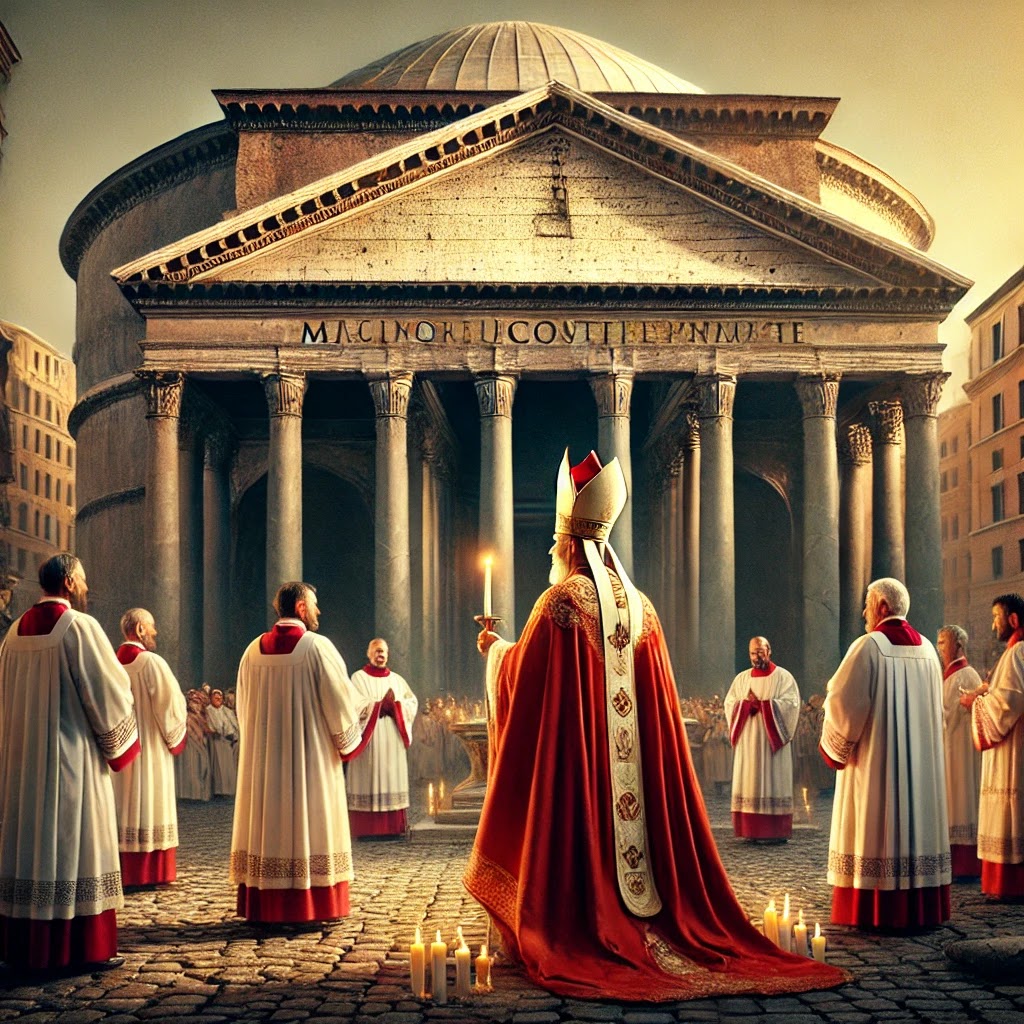
In 609 AD, Pope Boniface IV consecrated the Roman Pantheon—formerly associated with the gods of pagan Rome—as the Church of St. Mary and the Martyrs.

That was not paganism sneaking into Christianity.

It was Christianity taking possession of something pagan and effectively declaring:

Your gods are gone. Christ is Lord now.

In the eighth century, Pope Gregory III established a November 1 observance honoring all the saints, and the feast was later extended more broadly throughout the Western Church.

The evening preceding the feast became All Hallows’ Eve—eventually contracted into the word we still use today:

Halloween.

But What About Samhain?


This is usually where somebody dramatically produces the supposed historical smoking gun:

Samhain.

Yes, Celtic peoples observed a pre-Christian seasonal festival called Samhain.

Yes, Europeans had customs surrounding winter, harvests, death, fire, spirits, and seasonal transitions long before Christianity.

Nobody needs to deny that.

What does not follow is the popular internet conclusion:

Samhain existed near the same time of year, therefore Halloween is Samhain.

That is not historical reasoning. That is guilt by calendar.

Agricultural societies everywhere marked seasonal transitions. Christianity entered societies that already possessed festivals, customs, food, music, architecture, languages, and cultural traditions.

Some customs disappeared.

Some survived.

Some changed.

Some acquired entirely new meanings.

The existence of a pagan autumn festival does not magically erase the specifically Christian identity of All Hallows’ Eve.

By medieval times, Halloween belonged to the Christian observance often called Allhallowtide:

October 31 — All Hallows’ Eve

November 1 — All Saints’ Day

November 2 — All Souls’ Day

Saints.

Prayer.

Death.

Judgment.

Heaven.

The faithful departed.

Resurrection.

Not exactly a druid convention.

Where Did Trick-or-Treating Come From?


One important predecessor was the medieval Christian practice known as souling.

Poor people and children went from house to house requesting food—including small cakes sometimes called soul cakes—while promising prayers for deceased members of the household.

In other words, an ancestor of children going door to door on Halloween involved:

Catholics praying for the dead.

That is not witchcraft.

That is medieval Catholicism.

Over generations, Christian customs mixed with local folk traditions, immigration, community celebrations, commercialization, and eventually modern American trick-or-treating.

The eight-year-old Spider-Man standing on your porch asking for a Snickers bar is not unknowingly reenacting a Satanic initiation ceremony.

He wants candy.

Why All the Skeletons, Ghosts, and Demons?


Modern Americans sometimes seem to assume that if something contains skulls, graves, demons, or images of death, it must belong to the occult.

Medieval Christianity would like a word.

Christian churches and artwork have been filled with imagery of death for centuries: skulls, tombs, martyrs, demons, hell, judgment, cemeteries, and the Last Things.

Christians were encouraged to remember:

Memento mori — remember that you will die.

Death was not hidden away.

It was confronted.

And in some Christian festivities, frightening or demonic imagery could even become a way of mocking evil.

The message was not:

“Demons are wonderful.”

It was:

“You lost.”

Death lost.

Hell lost.

The devil lost.

Christ won.

That is a rather important distinction.

Candles, Cemeteries, and Prayers for the Dead


Catholics traditionally visited cemeteries, cleaned graves, lit candles, remembered deceased relatives, and prayed for the faithful departed around All Saints’ and All Souls’ Days.

These customs express the Catholic understanding of the communion of saints: the Church extends beyond Christians presently walking around on earth.

Modern secular Halloween has largely forgotten that theological context.

But its fascination with cemeteries, death, candles, spirits, and remembrance did not emerge from nowhere.

It developed within cultures where Christians regularly contemplated death because Christianity claims something astonishing about it:

Death has been conquered.

How Did Halloween Become “Satanic”?


Now we reach an uncomfortable part of the story.

America has a very long history of anti-Catholicism.

During the nineteenth and early twentieth centuries, millions of Catholic immigrants arrived from Ireland, Italy, Germany, Eastern Europe, and elsewhere.

Their religion looked strange to many Protestants.

Catholics had statues.

Relics.

Saints.

Candles.

Incense.

Processions.

Priests.

Prayers for the dead.

Purgatory.

Holy days.

To hostile critics, Catholicism itself already looked suspiciously “pagan.”

Nativist movements such as the Know-Nothings portrayed Catholicism as foreign and incompatible with American culture.

The revived Ku Klux Klan likewise targeted Catholics, along with African Americans, Jews, and immigrants.

Catholic devotional practices were repeatedly caricatured as superstition, idolatry, or disguised paganism.

So naturally, a Catholic feast-season involving saints, cemeteries, prayers for the dead, candles, and medieval imagery was going to attract suspicion.

Then twentieth-century fundamentalism poured gasoline onto the fire.

Some evangelical and fundamentalist preachers began portraying Halloween as a Satanic festival tied to witchcraft, occultism, human sacrifice, and demon worship.

During the Satanic Panic era, such claims spread widely through churches, television, books, pamphlets, and popular culture.

Anti-Catholic polemicists such as Jack Chick enthusiastically joined in.

Eventually the accusation became so culturally widespread that even some Catholics began repeating it.

And that is perhaps the greatest irony of this entire story:

Catholics sometimes became afraid of their own religious heritage because they absorbed arguments from religious traditions that historically rejected the Catholic beliefs underlying it.

The Pagan-Origin Fallacy


There is another enormous problem with the standard “pagan origins” argument.

It usually works like this:

Pagans once did something resembling X.

Christians later did X.

Therefore X is pagan.

Apply that logic consistently and Christianity becomes impossible.

Pagans lit candles.

So did Christians.

Pagans burned incense.

So did Christians.

Pagans built temples.

Christians built churches.

Pagans sang religious songs.

Christians sing hymns.

Pagans held religious festivals.

Christians have feast days.

Pagans used sacred art.

Christians use sacred art.

Pagans had religious meals.

Christians celebrate the Eucharist.

Pagans prayed.

Pagans buried their dead.

Pagans celebrated weddings.

Pagans gave gifts.

Pagans decorated buildings.

Pagans celebrated seasonal changes.

Apparently humanity should have stopped doing everything the moment someone pagan happened to do it first.

Obviously, that makes no sense.

The important question is not:

“Did a pagan ever do something similar?”

The important question is:

“What does this practice mean within Christianity?”

Christianity entered cultures, rejected what contradicted the Gospel, preserved what was harmless, and transformed what could be redirected toward Christ.

That is not paganism.

That is conversion.

Halloween Today


None of this means that everything associated with modern Halloween is automatically good.

Obviously not.

Some people deliberately use Halloween to celebrate occultism, extreme violence, sexualized entertainment, or things Christians should avoid.

Don't participate in those things.

Simple.

But abuse does not determine identity.

Christmas has been transformed into a consumer shopping frenzy.

Is Christmas therefore anti-Christian?

Easter has become rabbits, chocolate eggs, and department-store sales.

Is Easter therefore pagan?

St. Patrick’s Day has become an excuse for public drunkenness.

Did St. Patrick therefore spend his missionary career inventing green beer?

Of course not.

Modern distortions do not erase historical meaning.

Halloween deserves the same fairness.

Catholics Do Not Need to Be Afraid of Halloween


Catholics can celebrate Halloween perfectly well.

Dress your children as saints.

Or knights.

Or princesses.

Or Batman.

Or dinosaurs.

Or ghosts.

Carve pumpkins.

Hand out candy.

Tell spooky stories.

Visit a cemetery.

Remember your grandparents.

Pray for your deceased relatives.

Read about the saints.

Go to Mass for All Saints’ Day.

And please stop panicking every time somebody puts a plastic skeleton on their lawn.

Christianity is not a religion terrified of graveyards.

We worship a Savior who entered a tomb and walked back out.

Our most recognizable religious symbol is literally an ancient instrument of torture and execution.

Christianity looked at the Cross itself and transformed it into a symbol of victory.

I think we can survive a jack-o’-lantern.

Reclaim Halloween


So no, Catholics do not need to surrender October 31 to occultists.

And we certainly do not need to surrender it to anti-Catholic polemicists who insist that every Catholic tradition they dislike must secretly be pagan.

Halloween is All Hallows’ Eve.

It stands at the entrance to the Christian celebration of the saints and the faithful departed.

Celebrate it morally.

Celebrate it intelligently.

Celebrate it without superstition.

Remember the saints.

Pray for the dead.

Mock the darkness.

And remember why Christians have no reason to fear death:

Christ is risen.

Death is defeated.

The saints live in Him.

And no—

the devil does not get Halloween.

It is time to take All Hallows’ Eve back.

Here are some good YouTube sources on this subject: Halloween is not Pagan


No, Catholics Do Not Celebrate Halloween Because We Are Too Ignorant to Know Better


There is another argument that deserves to be addressed because it is not really an argument at all.

It is an insult disguised as concern.

It goes something like this:

Catholics celebrate Halloween because they do not know its “real” history.

They never questioned it.

Their parents did it.

Their parish does it.

Their priest permits it.

They like costumes and candy.

They were simply handed a tradition and obediently followed along without bothering to investigate whether they had been deceived into participating in paganism.

In other words, the argument is not merely:

“I believe Halloween has pagan associations.”

It becomes:

“If you celebrate Halloween, you must be ignorant, deceived, spiritually careless, or unwilling to question your traditions.”

That stereotype should be rejected.

Catholics are perfectly capable of reading history, studying Scripture, examining theology, distinguishing legitimate Christian customs from superstition, and reaching a conclusion different from that of a fundamentalist preacher or anti-Catholic YouTuber.

Disagreement is not evidence of ignorance.

A Catholic who knows exactly what All Hallows’ Eve, All Saints’ Day, and All Souls’ Day are—and who understands the Christian traditions surrounding saints, death, judgment, prayer for the departed, cemeteries, candles, and the communion of saints—may have considerably more historical context for Halloween than someone whose entire understanding of the holiday consists of:

“Samhain. Druids. Witchcraft. Therefore Satan.”

The possibility should at least be entertained that Catholics are not celebrating Halloween because nobody ever told us the truth.

Perhaps we studied the question and simply rejected the fundamentalist conclusion.

Tradition Does Not Mean Mindless Obedience


There is also something revealing about the accusation that Catholics celebrate Halloween merely because it is “tradition.”

Christianity itself is a religion filled with tradition.

St. Paul explicitly tells Christians:

“Stand firm and hold to the traditions which you were taught by us, either by word of mouth or by letter.”

2 Thessalonians 2:15

The problem is therefore not whether something is traditional.

The question is whether the tradition contradicts the Christian faith.

Catholics do not believe that every inherited cultural custom is automatically sacred. Traditions can be examined, purified, abandoned, or redirected.

But neither do we assume that anything old, festive, symbolic, or culturally inherited is automatically pagan.

That would be an equally irrational superstition.

And enjoying something does not invalidate an informed judgment about it.

Yes, Catholics may celebrate Halloween because children enjoy dressing up.

Yes, people like candy.

Yes, families enjoy carving pumpkins and decorating their homes.

That does not prove they are ignorant of history any more than enjoying Christmas lights proves someone knows nothing about the Incarnation.

Pleasure and understanding are not mutually exclusive.

But Doesn't the Bible Condemn Halloween?


Here we need to make an important distinction.

The Bible certainly condemns occultism.

Catholics agree.

The Catholic Church condemns divination, magic, sorcery, attempts to summon the dead, and deliberate involvement with occult powers.

So when fundamentalist Christians quote biblical warnings about witchcraft, necromancy, demons, and idolatry, Catholics do not need to run away from those passages.

We can say:

Amen.

The disagreement is over whether those passages actually describe celebrating Halloween.

Deuteronomy 18:10–12 — Sorcery and Necromancy

One of the most frequently cited passages is:

“There shall not be found among you anyone who… practices divination, a soothsayer, or an augur, or a sorcerer, or a charmer, or a medium, or a wizard, or a necromancer.”

Deuteronomy 18:10–11

That prohibition is serious.

But notice what it prohibits.

Divination.

Sorcery.

Mediumship.

Necromancy.

Attempting to contact supernatural powers.

It does not say:

Do not carve pumpkins.

Do not wear costumes.

Do not eat candy on October 31.

Do not tell ghost stories.

Do not visit cemeteries.

Do not celebrate the eve of a Christian feast.

A Catholic participating in an actual séance should stop.

A Catholic attempting to summon a spirit should stop.

A Catholic practicing witchcraft should stop.

But a six-year-old dressed as a dinosaur collecting Reese's Cups is not practicing necromancy.

Those are not remotely the same activity.

Leviticus 19:31 — Mediums and Spirits

Another passage says:

“Do not turn to mediums or wizards; do not seek them out.”

Leviticus 19:31

Again:

Catholics agree.

Do not consult mediums.

Do not participate in séances.

Do not attempt to contact spirits.

Do not play with occult practices merely because Halloween provides a convenient atmosphere for doing so.

But that still does not establish the proposition:

Therefore Halloween itself is forbidden.

That conclusion has been inserted into the text.

Galatians 5:19–21 — Sorcery

St. Paul lists sorcery among the “works of the flesh” in Galatians 5.

Once again, Christianity condemns sorcery.

But wearing a witch costume is not the same thing as practicing witchcraft any more than dressing as Darth Vader means someone has joined the Sith.

Representation is not participation.

Christians routinely portray evil characters in plays, films, paintings, literature, Passion plays, and religious art without worshiping or imitating them.

Context and intention matter.

Acts 19:19 — Christians Burning Magic Books

The Book of Acts describes converts at Ephesus bringing their books of magic and burning them publicly.

Excellent.

Christians should reject magic.

That passage actually helps clarify the distinction.

Those people were not burning autumn decorations.

They were abandoning actual magical practices.

Christian opposition to occultism is therefore not an argument against Halloween.

It is an argument against occultism at Halloween—or on any other day of the year.

Ephesians 5:11 — “Take No Part in the Unfruitful Works of Darkness”

Another favorite passage is:

“Take no part in the unfruitful works of darkness, but instead expose them.”

Ephesians 5:11

Absolutely.

But first one must establish that handing candy to children or dressing as Batman constitutes a “work of darkness.”

You cannot simply label something darkness and then quote a verse saying Christians should avoid darkness.

That is circular reasoning.

The verse condemns sinful activity.

It does not define every activity involving nighttime, skulls, costumes, graves, or frightening imagery as sinful.

Christian art itself contains demons, skulls, death, hell, judgment, dragons, serpents, executions, martyrs, and crucifixions.

Dark imagery and works of darkness are not synonymous.

1 Corinthians 10:20–21 — “You Cannot Drink the Cup of the Lord and the Cup of Demons”

This passage deserves serious attention.

St. Paul warns Christians that pagan sacrifices are offered to demons and says:

“You cannot drink the cup of the Lord and the cup of demons.”

1 Corinthians 10:21

Precisely.

A Christian may not participate in pagan worship.

If Halloween meant sacrificing to pagan gods, invoking spirits, worshiping demons, or performing an occult ritual, Catholics should have nothing to do with it.

But Paul makes an important distinction elsewhere in the same discussion.

He recognizes that an idol is nothing in itself, while warning Christians not to participate intentionally in idolatrous worship.

That distinction is extremely useful.

An object or cultural practice is not automatically an act of pagan worship merely because pagans have used something resembling it.

Eating meat is not pagan sacrifice.

Lighting a candle is not pagan worship.

Burning incense is not idolatry.

Wearing a costume is not sorcery.

Having a feast is not demon worship.

The moral character of an action depends upon what is actually being done and what it signifies.

Deuteronomy 12:30–31 — Don't Worship God the Way Pagans Worship Their Gods

Another commonly raised passage warns Israel not to ask how pagan nations worshiped their gods and then imitate them.

That is a legitimate biblical principle.

Christians should not take an act of pagan worship and simply perform the same worship toward God.

But even here we must distinguish religious worship from ordinary human culture.

Pagans used music.

Pagans ate meals.

Pagans lit lamps.

Pagans married.

Pagans buried their dead.

Pagans decorated buildings.

Pagans had holidays.

Those activities do not become permanently contaminated because pagans once performed them.

Otherwise almost every human cultural practice would become forbidden.

The biblical prohibition concerns idolatry, not the existence of cultural similarities.

“Abstain From All Appearance of Evil”

The King James rendering of 1 Thessalonians 5:22—“Abstain from all appearance of evil”—is sometimes used to argue that Christians must avoid anything that looks dark or questionable.

But most modern translations render the meaning along the lines of:

“Abstain from every form of evil.”

The command is to reject evil itself.

It does not mean Christians must avoid everything someone somewhere might misunderstand.

If that were the standard, Christians could scarcely display a crucifix.

To someone unfamiliar with Christianity, a bloody human body nailed to a wooden execution device looks horrifying.

Yet Christians know what the Cross means.

Meaning matters.

Scripture Gives Us a Better Principle


St. Paul gives Christians an extraordinarily useful principle:

“Test everything; hold fast what is good.”

1 Thessalonians 5:21

That is much healthier than:

“This scares me, therefore it is pagan.”

Test it.

Ask what it means.

Ask what is actually being practiced.

Reject what is evil.

Keep what is good.

A Catholic can therefore say:

Séances?

No.

Ouija boards and attempts to contact spirits?

No.

Divination?

No.

Actual witchcraft?

No.

Invoking demons?

Obviously no.

Glorifying sadistic violence or deliberately celebrating evil?

No.

But dressing your daughter as St. Joan of Arc?

Fine.

Dressing your son as a knight?

Fine.

Dressing as Batman?

Fine.

Wearing a silly ghost costume?

Fine.

Carving a jack-o’-lantern?

Fine.

Giving children candy?

Fine.

Visiting your grandparents' graves?

Not only fine—it can be profoundly Christian.

Praying for the faithful departed?

Catholics have been doing that for centuries.

Going to Mass for All Saints’ Day?

That is literally Christian worship.

The Catholic Position Is Actually More Discerning


The fundamentalist argument often presents itself as the cautious position:

“Avoid all of it, just to be safe.”

But Catholic moral reasoning asks for something more demanding:

discernment.

What exactly is the practice?

What does it mean?

What are you intending?

Does it contradict Christian faith?

Does it involve superstition?

Does it glorify evil?

Can it be enjoyed innocently?

Can it be redirected toward something good?

That requires considerably more thought than simply declaring the entire holiday Satanic.

Catholics therefore do not need to choose between two ridiculous extremes:

Everything about Halloween is evil.

or

Everything anybody does on Halloween is harmless.

Neither is true.

Christians can reject the occult while enjoying Halloween.

We can condemn superstition while celebrating All Hallows’ Eve.

We can tell children that demons are real without teaching them to tremble at plastic skeletons.

We can acknowledge death without worshiping it.

We can visit graves without practicing necromancy.

We can remember the dead without attempting to summon them.

And we can mock evil precisely because we believe evil does not have the final word.

No, We Have Not Simply Been Deceived


So please retire the condescending argument that Catholics celebrate Halloween only because we have never investigated it.

Some of us have investigated it.

Some of us know the biblical passages.

We know what Scripture says about sorcery.

We know what Scripture says about idolatry.

We know what the Church teaches about superstition and the occult.

And after considering all of that, we still do not believe that a child wearing a costume, a glowing jack-o’-lantern, a bowl of candy, a cemetery candle, or the Christian vigil of All Hallows’ Eve constitutes pagan worship.

That is not ignorance.

That is a theological judgment.

You are free to disagree with it.

But disagreement does not entitle anyone to accuse Catholics of being stupid, brainwashed, deceived, spiritually lazy, or incapable of questioning their traditions.

Perhaps we asked the question.

Perhaps we studied the evidence.

Perhaps we read the Bible.

And perhaps we simply reached a different conclusion.

Scripture prohibits occultism.

It does not prohibit Halloween.

And there is a very large difference between the two.

Thursday, December 4, 2025

Advent is Pagan!


Is Advent Pagan?

A Catholic Reflection and Defense

By Chris M. Forte

Every December, as the purple candles appear and the Church enters the quiet season of Advent, the same old accusations start to surface — that Advent is “pagan,” that it borrows from ancient solstice rituals, or that it’s just a repackaged version of sun-worship. Some even claim it’s “unbiblical” or “man-made tradition.”

Let’s be honest: these attacks don’t come from serious historical research. They come from ignorance, prejudice, and the same old anti-Catholic bigotry that’s been recycled for centuries. I’ve read the tracts, the blogs, the videos, and the “proofs.” None of them hold up to Scripture or history.

As a Catholic, I know Advent is not pagan — it’s profoundly Christian. Its meaning, symbols, and structure come straight from Scripture and the Church’s earliest understanding of Christ’s coming. The fact that some superficial parallels exist with pagan customs doesn’t make it pagan any more than pagans using fire made the discovery of fire demonic.

Let’s look at what the critics say — and then what the Church actually teaches.


1. The Accusations Against Advent

“It’s based on the pagan solstice festivals.”

Critics often point to the timing of Advent — late November through December — noting that it coincides with ancient midwinter festivals like Saturnalia or Yule. They claim the Church “Christianized” pagan sun celebrations to win converts. Some even say the increasing candlelight of the Advent wreath mimics pagan rituals celebrating the “return of the sun.”

This argument floats around the internet and in old anti-Catholic pamphlets. Writers like Alexander Hislop in The Two Babylons (1853) claimed most Catholic traditions, including Advent and Christmas, were just baptized Babylonian practices. Hislop wrote, “Papal worship is nothing else than the worship of Nimrod and his wife.” (Hislop, 1853).

Evangelical and fundamentalist circles have echoed this for decades. The accusation: that Advent — like Christmas — is just a pagan winter solstice party with Jesus’ name slapped on it.


“The Advent wreath is a pagan symbol.”

Another popular claim is that the Advent wreath — a circle of evergreens with four candles — comes from pre-Christian Germany, where pagans supposedly lit candles on evergreen wreaths to celebrate the return of the sun.

Yes, evergreen wreaths existed in ancient Europe. But the Christian Advent wreath as we know it was first developed in the 1800s by Johann Hinrich Wichern, a Lutheran pastor in Hamburg who used candles to teach children about waiting for Christmas. The custom spread quickly, and the Catholic Church embraced it as a devotional symbol, not a dogma.

So yes, the idea of a circle of greenery existed before Christianity — but so did bread, wine, and fire. The Church doesn’t run from these things; it redeems and re-purposes them for God’s glory.


“Advent isn’t in the Bible.”

This is another favorite of critics who claim, “If it’s not in Scripture, it’s not from God.” They argue that Advent, like Lent or the liturgical calendar itself, was invented later and is therefore “tradition of men.”

But that’s not how the Bible works. The concept of Advent — waiting for the Lord — is thoroughly biblical. The prophets spoke of it:

“The people who walked in darkness have seen a great light.” — Isaiah 9:2

John the Baptist lived it:

“Prepare the way of the Lord.” — Luke 3:4

And Christ Himself commanded His followers to “keep watch” for His return (Mark 13:35). The liturgical season of Advent simply formalizes that command into a rhythm of prayer and preparation.


2. The Truth About Advent

The Word “Advent”

“Advent” comes from the Latin adventus — meaning coming or arrival. In the early Church, Christians celebrated both the first coming of Christ (His birth) and His second coming (the end of time). The season was never about the sun’s return — it was about the Son’s return.

From the 4th century onward, the Church began setting aside several weeks before Christmas as a time of fasting, prayer, and repentance — not to mimic pagans, but to prepare the heart for the coming of Christ. Historical evidence shows Advent began in Spain and Gaul as a penitential season, similar to Lent, long before any “Christianization” of pagan customs.

“In the early centuries of the Church, Advent arose as a result of the fixed dating of Christmas.” — The Gospel Coalition (historical overview of Advent’s origin)

So Advent’s development wasn’t a compromise with paganism — it was a deepening of Christian theology.


The Wreath, Candles, and Colors

The Advent wreath’s four candles symbolize the four weeks of waiting — Hope, Peace, Joy, and Love — leading to the birth of Christ, the Light of the World (John 8:12). The growing light of each candle represents that Light overcoming darkness, just as Christ conquers sin.

The purple (or violet) candles represent penance and royalty; the rose candle on the third Sunday — Gaudete Sunday — marks joy and anticipation. These meanings are entirely rooted in Christian Scripture and liturgical symbolism.

Evergreens symbolize eternal life. Circles represent God’s unending love. Pagans might have used greenery to celebrate nature — but Catholics use it to celebrate divine grace.

As St. Paul said,

“Test everything; hold fast what is good.” — 1 Thessalonians 5:21
The Church didn’t steal pagan symbols — it purified them.


3. The Real Roots of Advent

Advent was formalized in the Western Church by the 4th or 5th century, as Christians began observing a preparatory season before Christmas much like Lent before Easter. In some regions, it lasted six weeks; in others, four.

The earliest documents — like the Council of Saragossa (380 A.D.) and the Sermons of St. Gregory the Great (6th century) — show that Advent was a season of penance, prayer, and anticipation. The emphasis was always the coming of Christ, not the cycles of nature.

That distinction matters. Paganism is about humanity’s attempt to manipulate the natural world for favor from the gods. Christianity is about God entering human history to save it. Advent reverses the logic of paganism: it’s not man reaching up, but God coming down.


4. The Modern Misunderstanding

Today, many of the same voices who call the Mass “pagan” now say the same about Advent, Christmas, and even Easter. They see any ritual, symbolism, or season as “idolatry.” But this rejection of the sacred is not biblical — it’s reactionary.

These accusations are not born from theology or reason; they’re born from hatred. They come from a deep suspicion of anything Catholic, from centuries of anti-Catholic propaganda that labeled the Church as “Babylon,” “the Whore,” and “the synagogue of Satan.”

It’s tragic, really — because the people who scream “pagan!” at Advent are attacking one of the most deeply biblical and Christ-centered seasons in the Christian year. Advent is not a festival of darkness; it’s the solemn lighting of the way toward the Light of the world.


5. Advent: The Christian Answer to Paganism

The Church has always taught that Christ is the fulfillment of every human longing — including the ones expressed in ancient myths and seasonal rituals. People throughout history have yearned for light, renewal, and redemption. Pagan cultures expressed that longing through symbols of fire and greenery, but Christianity revealed what they were really yearning for: Christ Himself.

In that sense, Advent isn’t pagan. It’s the answer to paganism. It’s the season when the ancient world’s hope becomes flesh and dwells among us.

As Pope Benedict XVI once said:

“Advent invites us to pause in silence to understand a presence… It is an invitation to understand that every event of history is a word spoken by God to us.” — Homily, December 2, 2006

That’s the beauty of Advent: it sanctifies time. It transforms winter darkness into spiritual light. It’s not about the birth of a sun god — it’s about the Incarnation of the Son of God.


6. Conclusion: The Light Has Come

When I light the candles of my Advent wreath, I don’t see echoes of pagan fire festivals or ancient superstitions. I see the promise of Isaiah fulfilled:

“The people who walked in darkness have seen a great light.” — Isaiah 9:2

I see the Church waiting in silence, hope, and faith — not for the turning of the seasons, but for the coming of the Savior.

Advent is not pagan. Advent is prophecy fulfilled. It is the heartbeat of the Church preparing for the Lord who was, is, and is to come.

“The night is far gone; the day is at hand.” — Romans 13:12


Notes & Selected Sources (Chicago Style)

  1. Alexander Hislop, The Two Babylons (Edinburgh: 1853).

  2. The Gospel Coalition, “The History of Advent,” 2020.

  3. Johann Hinrich Wichern and the Advent Wreath, Christian Heritage Fellowship (2021).

  4. Catechism of the Catholic Church, §§ 524–526.

  5. Pope Benedict XVI, Homily for First Sunday of Advent, December 2, 2006.

  6. Council of Saragossa (380 A.D.).

  7. St. Gregory the Great, Homilies on the Gospels, Book I.


About the Author


Chris M. Forte is a Catholic writer and storyteller based in Downtown San Diego. His work — from My Catholic Defense to The Italian Californian — explores faith, history, and identity. Through essays and stories, Chris confronts modern misconceptions about Catholicism and celebrates the timeless truth of the Church’s teachings. His writing reflects his conviction that the same light awaited in Advent still burns in every heart that seeks Christ.

Saturday, October 11, 2025

Reclaiming Halloween: Uncovering the Christian Roots Behind the Misconceptions and Bigotry

 Historic Protestant anti-Catholic bigotry has profoundly shaped America’s perception of Halloween, influencing even Catholics. The slanderous accusations that Halloween has pagan or occult roots were amplified by pop culture, becoming part of the cultural zeitgeist, and are now widely accepted as truth—sometimes even by Catholics, albeit reluctantly. However, the reality is that Halloween, or "All Hallows' Eve," is deeply Christian in origin, rooted in the vigil for the Catholic celebration of All Saints' Day. Let’s explore the true origins of All Saints' Day and examine how and why it became something viewed with suspicion in America:


All Saints' Day, celebrated on November 1st, has an interesting history tied to the early Christian Church and the transformation of pagan monuments into Christian sites of worship. The origins of the feast can be traced back to Pope Boniface IV, who in 609 AD re-dedicated the Pantheon in Rome to the Church of All Saints.

Re-dedication of the Pantheon by Pope Boniface IV (609 AD)


The Pantheon, originally a Roman temple dedicated to all the gods of pagan Rome, was an architectural marvel and a significant symbol of the Roman Empire’s religious life. When Christianity became the official religion of the empire, many pagan temples were either abandoned or repurposed for Christian use. Pope Boniface IV saw an opportunity to transform this iconic pagan structure into a place of Christian worship. On May 13, 609 AD, he consecrated the Pantheon to the Virgin Mary and all the Christian martyrs, renaming it the "Church of St. Mary and the Martyrs." This act symbolized the Church's triumph over paganism and honored the memory of those who had died for their Christian faith. This dedication is considered one of the earliest instances of the feast now known as All Saints' Day.

Pope Gregory III Moves the Feast to November 1st


While May 13th was initially observed as a feast day in honor of all martyrs and saints, the date was eventually changed. In the 8th century, Pope Gregory III (731-741) decided to move the celebration of All Saints to November 1st. The reason behind this shift was the dedication of a new church in Rome. Pope Gregory III consecrated a chapel in St. Peter’s Basilica specifically to "all saints," particularly those whose relics were unknown or had no feast day. This new date, November 1st, became the official day of the feast for the entire Western Church.

Thus, the timing of this Christian holiday, falling right after October 31st—what pagans traditionally celebrated as Samhain—is purely coincidental. However, it's important to remember that pagan festivals were closely tied to the seasonal cycle, with major celebrations marking the start of autumn, winter, summer, and so on. Given this natural alignment with the seasons, it's no surprise that some Christian holidays, which also follow seasonal patterns, occasionally overlap with pagan ones.

Broader Significance of November 1st

By the time of Pope Gregory IV (827-844), the observance of All Saints’ Day on November 1st was extended to the entire Christian world. This move allowed for a more universal celebration, encompassing all saints—known and unknown—throughout the Christian Church.

The re-dedication of the Pantheon and the later establishment of November 1st as the date for All Saints’ Day reflect a broader trend in the Christianization of pagan sites and practices. The Church found ways to adapt and sanctify existing structures and celebrations, reorienting them to reflect Christian theology and the lives of the saints. Thus, what had once been a temple to all the gods became a monument to the saints, and a day once rooted in Roman civic religion became a cornerstone of the Christian liturgical year.

The modern tradition of Halloween, particularly the custom of trick-or-treating and dressing up in costumes, has roots in Christian practices, especially those associated with All Saints’ Day (November 1st) and All Souls’ Day (November 2nd). These Christian observances, intended to honor the saints and pray for the souls of the departed, gave rise to several practices that eventually evolved into the secular customs we see today.

Trick-or-Treating and “Soul Cakes”


The tradition of going door-to-door asking for treats on Halloween is believed to originate from the medieval practice known as "souling." On the eve of All Saints' Day (October 31st), also known as All Hallows' Eve, poor Catholic children would go from house to house offering prayers for the dead in exchange for food, specifically small cakes called "soul cakes." These cakes were often spiced or sweetened and marked with a cross, symbolizing their connection to prayers for the souls in purgatory.

In return for these cakes, the children or beggars would promise to pray for the deceased relatives of the household, believing that such prayers could help the souls of the dead find rest or reduce their time in purgatory. This practice, known as "souling," was common in England, Ireland, and other parts of Europe during the Middle Ages. The act of receiving soul cakes gradually transformed into what we now recognize as trick-or-treating, where children go door to door asking for candy rather than offering prayers for the dead

Costumes: Mocking Demons and Evil 


The tradition of wearing costumes on Halloween also has Christian origins. During the festivities surrounding All Hallows’ Eve, Christians would sometimes dress up as demons, evil spirits, or villainous characters. This practice was not meant to celebrate these figures but to mock them and demonstrate Christ’s victory over evil. By wearing costumes that represented the powers of darkness, Christians symbolically declared that these forces had been defeated by Christ through His death and resurrection. It was a form of defiance against the devil and a reminder that no power of evil could prevail over the Church or its faithful .

This practice of dressing up as demons and other dark figures was a way to reinforce the Christian teaching that, through Christ, death and evil had been overcome. Over time, the tradition of dressing in costume expanded to include more secular or playful costumes, but the original intent was to mock the forces of evil and to celebrate the triumph of good.

Lighting Candles and Prayers for the Dead


Lighting candles during the Halloween and All Saints’/All Souls’ celebrations has its origins in the Christian tradition of praying for the dead. Candles were often lit in churches, homes, and graveyards to symbolize the light of Christ guiding souls out of purgatory and into eternal peace. On All Hallows' Eve and All Souls' Day, many families would light candles in memory of deceased loved ones, offering prayers for their souls.

The belief in praying for the dead is rooted in Catholic doctrine, which teaches that souls in purgatory benefit from the prayers and good works of the living. All Souls’ Day, in particular, is dedicated to the remembrance of all the faithful departed, and lighting candles was a visible sign of that remembrance .

Visiting Gravesites


Another Christian tradition tied to Halloween is the custom of visiting the graves of loved ones. Families would often go to cemeteries on All Hallows' Eve or All Souls' Day to clean the graves, lay flowers, and pray for the souls of the departed. This practice emphasizes the communal aspect of the Church, which includes not only the living but also the souls of the faithful who have passed away. Visiting gravesites and praying for the dead remind the faithful of their connection to the “communion of saints,” which includes those on earth, in purgatory, and in heaven .

In many Catholic countries, such, the tradition of honoring the dead is still very much alive, especially in celebrations like Día de los Muertos (Day of the Dead), which is closely tied to the Catholic feast days of All Saints’ and All Souls’. Families build altars for deceased relatives, offer prayers, and visit cemeteries to celebrate and remember their loved ones.

Conclusion

The roots of modern Halloween can be traced back to these medieval Christian traditions, where going door-to-door for “soul cakes” reflected Catholic teachings on purgatory and prayers for the dead. The practice of wearing costumes began as a way to mock the forces of evil, celebrating Christ’s victory over death. Lighting candles and visiting graves were essential parts of the celebrations surrounding All Saints’ and All Souls’ Days, serving as acts of prayer and remembrance for the departed.

While Halloween today has become largely secular, these customs have deep connections to the spiritual traditions of the Christian Church, particularly its teachings on death, the afterlife, and the power of prayer.

The perception of Halloween as an "evil" holiday with pagan roots is a belief that has been shaped, in part, by historic Protestant anti-Catholic sentiments in the United States. This suspicion of Catholicism, combined with misunderstandings of Halloween's origins, fueled accusations that the holiday was inherently pagan or even diabolical.

Protestant Anti-Catholic Sentiment in America

During the 19th and early 20th centuries, waves of Catholic immigrants from Ireland, Italy, and other parts of Europe arrived in the United States, bringing with them their traditions, including the observance of All Saints' Day (November 1st) and All Souls' Day (November 2nd). As part of these religious observances, some customs—such as "souling" (offering prayers for the dead in exchange for soul cakes) and lighting candles for deceased loved ones—were adapted into what became the American version of Halloween.

However, at the time, America was predominantly Protestant, and many Protestants harbored deep suspicion toward Catholic practices. Catholic rituals surrounding death and the afterlife, including prayers for souls in purgatory, were unfamiliar to many Protestants and viewed as superstitious or even heretical. This anti-Catholic sentiment became entwined with broader fears about Halloween. The holiday's connection to Catholic traditions led some Protestants to view it with suspicion and to associate it with older, pre-Christian practices, such as the Celtic festival of Samhain, further distorting its origins.

Accusations of Paganism 

One of the central accusations against Halloween is that it has pagan roots, particularly in the Celtic festival of Samhain, which was celebrated in Ireland and other parts of Europe on October 31st. Samhain marked the end of the harvest season and the beginning of winter and was associated with death and the supernatural. While some elements of Samhain, like the lighting of bonfires, may have influenced Halloween customs, it is a significant oversimplification to reduce Halloween to a “pagan” festival. The Catholic Church, particularly during the early Middle Ages, transformed many pre-Christian festivals by incorporating Christian elements, often by placing Christian holy days on or near these older holidays to replace pagan rituals with Christian observances. All Saints' Day and All Souls' Day are examples of this adaptation.

Nevertheless, Protestant critics often accused Halloween of being a continuation of paganism, claiming that the Church had merely “baptized” pagan rituals without fully eradicating their heathen origins. The Protestant Reformation further solidified this divide, as Reformers rejected the Catholic veneration of saints, prayers for the dead, and the concept of purgatory—all central aspects of Halloween's religious roots. The continued rejection of these Catholic teachings by many Protestant groups contributed to the perception that Halloween, with its associations with death, saints, and prayers for the deceased, was at odds with biblical Christianity. Some even labeled it “evil” or “Satanic” due to these associations .

The Rise of Anti-Catholicism in the 20th Century

In the 20th century, as evangelical and fundamentalist Protestant groups gained influence in the U.S., they renewed their opposition to Halloween. Many saw the holiday as glorifying death, darkness, and the occult—further reinforcing the misconception that Halloween had deep pagan, and even demonic, roots. Some evangelical leaders warned against celebrating Halloween, claiming that its activities (such as dressing up in costumes and trick-or-treating) had connections to witchcraft and Satanism, despite the holiday’s historical and Christian origins.

This suspicion was often fueled anti-Catholic sentiments, which persisted in some circles. Since Halloween's roots are intertwined with Catholic traditions like praying for the dead and observing All Saints' Day, Protestant groups that rejected Catholic theology saw these practices as suspicious or dangerous. The belief that Catholicism itself was steeped in superstition and idolatry further contributed to these negative perceptions of Halloween.

Conclusion

The accusations that Halloween is an "evil" or "pagan" holiday are, in large part, a product of Protestant anti-Catholic bigotry and misunderstanding. While elements of older traditions, like the Celtic Samhain, may have influenced certain Halloween customs, the holiday's development is deeply rooted in Christian observances of All Saints' Day and All Souls' Day. The perception of Halloween as diabolical or rooted in paganism was shaped by centuries of religious tension and cultural misunderstanding, particularly in the American context, where Protestant fears about Catholic influence played a significant role.

Today, while Halloween is primarily a secular celebration, it retains elements of its Catholic origins, such as the focus on death, the supernatural, and remembrance of the departed. However, much of the criticism about its "pagan" or "evil" nature stems from historical misunderstandings and religious prejudices that date back to earlier periods of anti-Catholic sentiment.

Even today, many Catholics in the United States have come to believe, or have been influenced by the surrounding Protestant and secular culture, to view Halloween as a pagan or evil holiday. This misconception has its roots in both historical anti-Catholic sentiment and the rise of fundamentalist Christian opposition to Halloween in the 20th century, which portrayed the celebration as inherently tied to the occult, witchcraft, and paganism. Over time, these fears seeped into broader American society, affecting Catholics as well.

Influence of Protestant Anti-Catholicism on Catholic Beliefs

During the waves of Catholic immigration to America in the 19th and 20th centuries, Catholics found themselves in a predominantly Protestant culture that often viewed their customs and beliefs with suspicion. The distinctly Catholic traditions of honoring the dead—such as All Saints’ Day, All Souls’ Day, and prayers for souls in purgatory—were misunderstood by many Protestant groups. These groups rejected Catholic teachings on purgatory and the veneration of saints, and they often equated these practices with superstition or even idolatry.

Because Halloween evolved from these Catholic feast days, it too became associated with “superstitious” practices in the eyes of many Protestants. Over time, the idea that Halloween was a continuation of pagan rituals—an accusation originally fueled by anti-Catholic bigotry—took hold in the broader American culture, influencing even Catholics themselves. Despite the Christian origins of Halloween, many Catholics absorbed the dominant cultural narrative that the holiday had pagan or occult roots.

Evangelical Opposition and its Broader Cultural Impact

By the mid-20th century, the rise of evangelical and fundamentalist Christian movements in America further intensified opposition to Halloween. Many evangelical leaders began warning against the holiday, claiming it glorified the occult, witchcraft, and even Satanism. This message was amplified through churches, media, and popular culture, leading to widespread beliefs that Halloween was dangerous and inherently evil.

Catholics, living in an overwhelmingly Protestant culture, were not immune to these messages. Over time, some Catholics came to share the same fears, even though Halloween's origins were rooted in Christian traditions. The idea that Halloween was evil became so widespread that some Catholic parishes began discouraging participation in Halloween celebrations, particularly in areas where evangelical influence was strong. These messages of fear and distrust of Halloween led many Catholics to view the holiday with suspicion, forgetting or never learning about its true Christian roots.

Secularization and the Loss of Christian Context

Another factor contributing to this misconception among Catholics is the increasing secularization of Halloween. As the holiday became more commercialized, the original Christian meaning behind All Saints’ Day and All Souls’ Day faded from popular memory. The focus shifted to costumes, parties, and trick-or-treating, with little to no reference to the holiday’s religious origins. This made it easier for critics to label Halloween as a pagan or occult celebration, further distancing it from its Catholic roots.

In a society where the religious significance of holidays is often overshadowed by consumerism, many Catholics found themselves adopting the secular or anti-religious narratives surrounding Halloween. Some began to believe that the holiday was disconnected from their faith, or worse, that it was incompatible with their Christian beliefs.

The Ongoing Debate Among Catholics

Today, Catholics remain divided on the issue of Halloween. Some recognize its origins in Catholic tradition and celebrate it in ways that honor All Saints’ Day and All Souls’ Day, using the holiday as an opportunity to teach children about the communion of saints and the importance of praying for the dead. Others, however, have internalized the surrounding culture’s suspicion of Halloween, associating it with the occult and choosing to avoid it altogether.

For example, many Catholic schools and parishes now host "All Saints' Day parties" as an alternative to Halloween, where children dress up as saints instead of ghosts or witches. While this practice reinforces Catholic identity and teaches children about the lives of the saints, it also reflects the broader cultural discomfort with Halloween and the belief that the holiday has pagan or evil origins.

Conclusion

The belief that Halloween is pagan or evil, even among some Catholics, is the result of a complex history of Protestant anti-Catholic sentiment, the rise of evangelical opposition to Halloween, and the secularization of the holiday. While Halloween’s roots are deeply tied to Christian traditions surrounding All Saints’ and All Souls’ Days, many Catholics have come to share the broader cultural perception that the holiday is incompatible with their faith. This misconception reflects the powerful influence of surrounding cultural forces on religious practices and beliefs, particularly in a society where religious traditions are often misunderstood or distorted.

However, for those Catholics who embrace Halloween’s true Christian origins, the holiday remains a meaningful occasion to honor the saints, pray for the dead, and celebrate Christ’s victory over evil.

Protestant anti-Catholic bigotry in America has a long and complicated history, and this bias played a significant role in shaping negative perceptions of Halloween. These perceptions, fueled by anti-Catholic sentiment, contributed to the belief that Halloween was pagan or even evil. Below are specific examples of Protestant anti-Catholic bigotry in America, particularly regarding Halloween and its associated traditions:

1. Nativist Movements and Anti-Catholic Rhetoric

In the 19th century, as large numbers of Catholic immigrants from Ireland, Italy, and Eastern Europe began to settle in the United States, they brought with them their Catholic customs, including the celebration of All Saints' Day and All Souls' Day, which eventually influenced the development of Halloween in America. This wave of immigration led to widespread anti-Catholic sentiment among native-born Protestant Americans.

  • The Know-Nothing Party (active in the 1840s and 1850s) was an influential nativist political movement that promoted anti-Catholic policies and rhetoric. They saw Catholicism as a threat to American values, which they believed were rooted in Protestantism. Catholic practices such as praying for the dead and venerating saints were considered superstitious and foreign, which fed into broader fears about Halloween’s supposedly pagan connections.
  • Protestant leaders and publications often derided Catholic traditions as idolatrous or overly mystical, and they used Halloween as an example of the “superstitions” that Catholics supposedly carried over from their European homelands.

2. The Ku Klux Klan and Anti-Catholic Attacks


The Ku Klux Klan (KKK), which re-emerged in the early 20th century, not only targeted African Americans but also Catholics, seeing them as a dangerous foreign influence on Protestant America. The Klan was particularly active in promoting the idea that Catholic practices were inherently un-American and pagan.

The KKK distributed pamphlets and held rallies accusing Catholics of engaging in idolatry and devil worship, with Halloween being one of the practices they associated with this. They linked Halloween’s connection to Catholic traditions like praying for the dead and saint veneration with dark, occult forces. By doing so, they perpetuated the myth that Halloween was a pagan holiday, despite its roots in Christian observances such as All Saints’ and All Souls’ Days.

3. Fundamentalist Christian Opposition to Halloween

In the 20th century, many fundamentalist Protestant groups, especially in the United States, became increasingly vocal in their opposition to Halloween. As evangelical and fundamentalist movements grew, they adopted and amplified the notion that Halloween was pagan and evil, largely due to their rejection of Catholic theology and practices related to the afterlife, such as purgatory and prayers for the dead.

  • In the 1980s and 1990s, evangelical pastors and televangelists such as Jerry Falwell and Pat Robertson warned their congregations about the dangers of celebrating Halloween, labeling it as a Satanic holiday. Much of their opposition stemmed from the belief that Halloween’s origins lay in ancient pagan festivals, which, in their view, Catholicism had failed to fully erase. These pastors often ignored or dismissed the Catholic roots of the holiday in favor of sensationalized claims about its ties to witchcraft and the occult.

  • Jack Chick, a fundamentalist Christian cartoonist, widely distributed anti-Catholic tracts, one of the most famous being "The Trick" (published in 1986), which portrayed Halloween as a Satanic holiday that involved child sacrifice and devil worship. His tracts regularly featured strong anti-Catholic messages, suggesting that Catholic practices were corrupt and deceptive, contributing to the perception that Catholic-rooted traditions like Halloween were evil.

4. Halloween in Protestant Public Schools

In the mid-20th century, public schools in predominantly Protestant areas of the United States often discouraged or banned the celebration of Halloween. This was, in part, due to its association with Catholic traditions, which many Protestants viewed with suspicion. Schools that were influenced by Protestant sensibilities sometimes avoided the religious undertones of Halloween and replaced it with secular harvest festivals to distance themselves from what they saw as Halloween’s "Catholic superstition."

For example, in certain areas, harvest festivals were promoted as wholesome alternatives to Halloween, emphasizing autumn and agricultural themes, rather than the traditional focus on death, saints, and the afterlife. This shift reflected Protestant discomfort with Catholic practices of remembering the dead and honoring saints, which were integral to Halloween’s origins.

5. The Rise of Anti-Halloween Sentiment in the Evangelical Community

By the late 20th century, the notion that Halloween was a "pagan" or "Satanic" holiday had become widespread, in large part due to evangelical Christian influence. Evangelicals often rejected Halloween because of its connections to death, spirits, and Catholic practices of venerating the dead, which they believed bordered on heresy. The rejection of these Catholic traditions by Protestant leaders reinforced the idea that Halloween was evil.

  • Some evangelical churches, particularly in the Bible Belt, began organizing “Hell Houses” or “Judgment Houses” as alternatives to traditional Halloween haunted houses. These events often portrayed Halloween as dangerous, promoting the belief that participating in the holiday opened people up to demonic influences. Catholic practices related to Halloween, such as praying for the dead, were depicted as superstitious or occultic, further entrenching the idea that Halloween had pagan or evil origins.

Conclusion

Protestant anti-Catholic bigotry in America has played a significant role in shaping the way Halloween is viewed today. From early nativist movements to the rise of fundamentalist and evangelical Christian opposition, the celebration of Halloween has often been misunderstood and misrepresented. Protestant fears and suspicions about Catholic customs—especially those surrounding death, saints, and the afterlife—led to accusations that Halloween was a pagan or evil holiday. These misconceptions have persisted over time, influencing not only Protestants but also many Catholics, who have come to view Halloween with suspicion despite its Christian origins.

So don’t give in to Protestant anti-Catholic bigotry or the cultural misconceptions it has fostered. Resist being swayed by these false narratives, and don’t allow so-called "pagans" or "devil worshipers" to steal what is rightfully ours. Proudly embrace and celebrate Halloween for what it truly is—a deeply Catholic, thoroughly Christian tradition: All Hallows’ Eve. Honor it for the right reasons—to mock the devil, glorify God, and rejoice in Christ’s victory over death and evil. Celebrate it in a wholesome, moral, and Christian way. It’s time to reclaim Halloween!