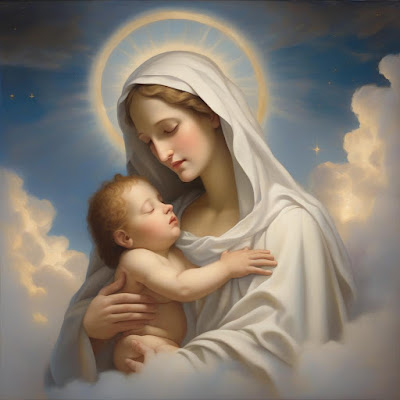
Showing posts with label queen of heaven. Show all posts

Wednesday, July 2, 2025

Praying to the Saints


Why Do Catholics Pray to Saints?

A Biblical, Historical, and Supernatural Defense**
By Chris M. Forte

Catholics pray to the saints because we believe what Scripture reveals, what the early Christians practiced, and what the Church Fathers taught: death does not sever the Body of Christ, and the saints in heaven participate actively in God’s heavenly assembly.

Praying to saints reflects the fully supernatural worldview of ancient Judaism, early Christianity, Second Temple literature, and the earliest post-apostolic churches—a worldview later flattened in many Protestant traditions.

The following defense incorporates the Bible, the Deuterocanon, Second Temple texts, and the writings of early Christians.


1. The Dead Are Alive and Intercede—According to Scripture

Jesus teaches that God “is not the God of the dead, but of the living” (Matt. 22:32). Scripture consistently depicts the righteous dead as alive, conscious, and active in God’s presence.

The clearest biblical evidence for the saints’ intercession comes from the Deuterocanonical books, accepted by the Church since antiquity but later removed from the Protestant canon.


2. 2 Maccabees: Direct Biblical Proof That the Saints Intercede

In 2 Maccabees 15:12–16, the prophet Jeremiah and the deceased high priest Onias appear from heaven, praying for God’s people. Jeremiah is described as:

“a man who prays much for the people and the holy city.”¹

Onias likewise intercedes:

“He loves his brethren and prays much for the people.”²

This passage explicitly depicts the righteous dead praying for the living.


3. Tobit and Raphael the Archangel: Angels Present Prayers to God

In Tobit 12:12, the archangel Raphael reveals:

“I presented your prayer before the Holy One.”³

Thus angels carry prayers to God. Revelation 5:8 shows the saints doing the same. Scripture therefore depicts both angels and holy souls as intercessors.

Catholic teaching simply continues the biblical pattern.


4. Other Deuterocanonical Passages Supporting Intercession

Sirach 46–50 — Praise of the Fathers

Sirach praises the enduring holiness and ongoing spiritual activity of biblical heroes such as Elijah, Samuel, and Josiah, reflecting Jewish belief in the righteous dead.⁴

Wisdom 3:1

“The souls of the righteous are in the hand of God… and immortality is their reward.”⁵

This was the worldview Jesus and His contemporaries held: the righteous dead are alive with God and active in His purposes.


5. Jewish Second Temple Literature: The Book of Enoch

The Book of Enoch (1 Enoch), directly quoted in Jude 1:14–15, shaped the worldview of Second Temple Judaism and early Christianity. It depicts:

  • heavenly watchers,

  • intercessory angels,

  • the spirits of the righteous pleading before God,

  • a heavenly assembly governing creation.

In 1 Enoch 39:5, the souls of the holy ones intercede:

“I saw the souls of the righteous… making petitions and supplications.”⁶

In 1 Enoch 15–16, angels are shown delivering prayers and petitions.⁷

Catholics pray to saints because we have retained this biblical cosmology that Protestantism later minimized.


6. Early Christian Writings That Nearly Made It Into the Bible

Before later canon debates, the early Church freely used writings like The Shepherd of Hermas, 1 Clement, and the Didache. These reveal how earliest Christians understood the Communion of Saints.

The Shepherd of Hermas

Widely considered Scripture in the second century, Hermas describes visions of saints in heaven praying for believers:

“holy men of God who pray unceasingly for you.”⁸

1 Clement

Clement of Rome refers to the righteous dead as those:

“who served Him perfectly… and continue to intercede for us.”⁹

Odes of Solomon

An early Christian hymnal that speaks of heavenly worship and intercession:

“The saints are gathered, and the prayers of the righteous ascend.”¹⁰

These writings assume heavenly intercession as normal Christian belief.


7. The Early Church Fathers Explicitly Taught Intercession

The Church Fathers unanimously affirmed the intercession of saints.

St. Cyril of Jerusalem

“We mention those who have fallen asleep… for they pray for us.”¹¹

St. Jerome

“If the apostles and martyrs while still in the body can pray for others… how much more after their crowns?”¹²

St. Augustine

“The angels and saints… assist us in our spiritual needs.”¹³

St. Gregory of Nazianzus

“May the spirits of the righteous run to our aid.”¹⁴

St. Basil

“The martyrs help us by their prayers.”¹⁵

Not one early Christian writer taught the Protestant view.


8. “God Became Man So That Man Might Become God”—Theosis and Intercession

St. Athanasius famously wrote:

“God became man so that man might become god.”¹⁶

He meant participation in God’s life and glory by grace. Intercession naturally flows from this participation:

  • the saints see God,

  • love God perfectly,

  • and act as members of God’s family and heavenly council.

St. Irenaeus

“The glory of God is man fully alive.”¹⁷

The saints are “fully alive,” and their intercession flows from their glorification.


9. The Divine Council Worldview Makes Intercession Logical

While modern Christians often imagine heaven as an empty expanse, Scripture reveals a populated, active heavenly assembly:

  • angels,

  • archangels,

  • elders,

  • martyrs,

  • thrones and dominions,

  • “the spirits of the righteous made perfect.”

This is not metaphor—it is the structure of God’s cosmos.

Revelation 4–5

Shows the Lamb surrounded by angels and saints offering prayers.

Daniel 7

Reveals the heavenly “court” with thrones and divine council members.

Hebrews 12:22–23

“You have come… to innumerable angels… and to the spirits of the righteous made perfect.”

“You have come”—present tense.

To be Christian is to belong to a supernatural family spanning heaven and earth.

Praying to saints is not consulting the dead; it is participating in the life of the living Body of Christ.


10. Why Protestants Reject It—And Why Catholics Retain the Biblical View

Protestantism inherited:

  • a reduced canon,

  • fear of medieval abuses,

  • suspicion of anything “too Catholic,”

  • and a flattened supernatural worldview.

Thus many Protestants reject:

  • the saints’ intercession,

  • the heavenly council,

  • the activity of the righteous dead,

  • the fullness of the Communion of Saints.

Catholics reject none of these, because the early Church rejected none of these.


Conclusion: Catholics Pray to Saints Because the Bible and Early Church Did

Catholics pray to the saints because:

  1. Scripture shows the righteous dead praying for the living (2 Macc. 15).

  2. Angels and saints present prayers before God (Tob. 12; Rev. 5:8).

  3. Intercession is commanded (1 Tim. 2:1; Jas. 5:16).

  4. The Church is one across death (Rom. 8; Heb. 12).

  5. Second Temple Judaism saw heaven as alive and intercessory (1 Enoch).

  6. Early Christian writings assume heavenly intercession (Hermas, Clement).

  7. The Church Fathers unanimously affirm it.

  8. The Divine Council worldview makes it necessary.

  9. Theosis implies participation in Christ’s mediation.

In short:

Heaven is alive.
The saints are alive.
Christ unites us.
Prayers cross the veil.
The Church is one.

This is the supernatural fullness of the Gospel—not the truncated version later Christians inherited.


Footnotes

  1. 2 Maccabees 15:14 (LXX), in New American Bible, Revised Edition.

  2. 2 Maccabees 15:12 (LXX).

  3. Tobit 12:12 (LXX).

  4. Sirach 46–50 (LXX).

  5. Wisdom 3:1 (LXX).

  6. R. H. Charles, trans., The Book of Enoch (Oxford: Clarendon Press, 1893), 39:5.

  7. Ibid., 15–16.

  8. The Shepherd of Hermas, Vision 3, in J.B. Lightfoot & J.R. Harmer, eds., The Apostolic Fathers (Grand Rapids: Baker, 1989).

  9. 1 Clement 46, in Lightfoot & Harmer, Apostolic Fathers.

  10. Odes of Solomon 6, in James H. Charlesworth, ed., The Old Testament Pseudepigrapha, Vol. 2 (New York: Doubleday, 1985).

  11. Cyril of Jerusalem, Catechetical Lectures 23:9, in Philip Schaff, ed., Nicene and Post-Nicene Fathers, 2nd Series, Vol. 7.

  12. Jerome, Against Vigilantius 6, in Schaff, Nicene and Post-Nicene Fathers, 2nd Series, Vol. 6.

  13. Augustine, City of God 20.9, in Schaff, Nicene and Post-Nicene Fathers, 1st Series, Vol. 2.

  14. Gregory of Nazianzus, Oration 43:26, in Schaff, Nicene and Post-Nicene Fathers, 2nd Series, Vol. 7.

  15. Basil the Great, Homily on the Forty Martyrs 8, in Schaff, Nicene and Post-Nicene Fathers, 2nd Series, Vol. 8.

  16. Athanasius, On the Incarnation 54:3, in Schaff, Nicene and Post-Nicene Fathers, 2nd Series, Vol. 4.

  17. Irenaeus, Against Heresies 4.20.7, in Ante-Nicene Fathers, Vol. 1.


Bibliography (Chicago Style)

Athanasius. On the Incarnation. In Nicene and Post-Nicene Fathers, 2nd Series, Vol. 4. Edited by Philip Schaff. Peabody, MA: Hendrickson, 1994.

Augustine. City of God. In Nicene and Post-Nicene Fathers, 1st Series, Vol. 2. Edited by Philip Schaff. Peabody, MA: Hendrickson, 1994.

Basil the Great. Homily on the Forty Martyrs. In Nicene and Post-Nicene Fathers, 2nd Series, Vol. 8.

Charles, R. H., trans. The Book of Enoch. Oxford: Clarendon Press, 1893.

Charlesworth, James H., ed. The Old Testament Pseudepigrapha. Vol. 2. New York: Doubleday, 1985.

Cyril of Jerusalem. Catechetical Lectures. In Nicene and Post-Nicene Fathers, 2nd Series, Vol. 7.

Gregory of Nazianzus. Orations. In Nicene and Post-Nicene Fathers, 2nd Series, Vol. 7.

Irenaeus. Against Heresies. In Ante-Nicene Fathers, Vol. 1.

Jerome. Against Vigilantius. In Nicene and Post-Nicene Fathers, 2nd Series, Vol. 6.

Lightfoot, J.B., and J.R. Harmer, eds. The Apostolic Fathers. Grand Rapids: Baker, 1989.

New American Bible, Revised Edition. USCCB Publishing.

Odes of Solomon. In The Old Testament Pseudepigrapha, Vol. 2. Edited by James H. Charlesworth.

Sirach (Ecclesiasticus). In Septuagint (LXX).

Tobit. In Septuagint (LXX).

Wisdom of Solomon. In Septuagint (LXX).


Thursday, August 22, 2024

Mary: Mother of God & Queen of Heaven & The Pagan Connection

 The superficial resemblance between Catholic practices and certain pagan customs is not because the Church is derived from paganism, but because paganism can be seen as a distorted mirror of the truth. As St. Justin Martyr observed, the devil mimics the true faith to mislead people, creating false versions that resemble the divine reality but lack its truth (First Apology, Chapter 54). Therefore, the similarities some point to are not evidence of pagan origins, but rather a testament to how the enemy seeks to counterfeit God’s work, making the authentic Church appear suspicious to those unaware of its true nature.


There’s a lingering anti-Catholic sentiment that some non-Catholic Christians continue to promote, claiming that Catholics either worship Mary or that devotion to her is just a continuation of ancient pagan practices involving mother goddesses. A lot of criticism is directed at the title "Queen of Heaven," which critics falsely associate with pagan worship, suggesting that Catholics have merely repackaged devotion to ancient goddesses like the Canaanite "Queen of Heaven" or the goddess Diana of Ephesus.

These accusations often imply that the Catholic Church, particularly at the Council of Ephesus, somehow revived pagan goddess worship under the guise of honoring Mary. However, this claim ignores historical context and misrepresents the true nature of Marian devotion. It’s as misleading as saying that Christians worship a mere man when they honor Jesus. To reach such conclusions, one must distort Church teachings and ignore the clear distinction between veneration of Mary and worship, which is due to God alone.

The Title "Mother of God" (Theotokos)


The title "Mother of God" (Theotokos in Greek, meaning "God-bearer") was officially affirmed for Mary at the Council of Ephesus in 431 AD. This council was convened to address the Nestorian controversy, which arose from the teachings of Nestorius, the Patriarch of Constantinople. Nestorius argued that Mary should be called Christotokos ("Christ-bearer") instead of Theotokos because, according to him, Mary gave birth to the human nature of Christ, not His divine nature.

The Council of Ephesus affirmed that Jesus Christ is one person with two natures—fully God and fully man—united in a single person. Therefore, because Mary gave birth to Jesus Christ, who is both God and man, she rightly bears the title Theotokos. The council declared that denying this title undermines the doctrine of the Incarnation and the unity of Christ’s divine and human natures.

Mary as the "Queen of Heaven"


The title "Queen of Heaven" is rooted in the Church’s understanding of Mary’s unique role in salvation history. This title is derived from her being the mother of Christ the King, as described in Revelation 12, where a "woman clothed with the sun" is depicted with a crown of twelve stars. The title was formalized in Christian tradition over centuries and was most notably affirmed by Pope Pius XII in his 1954 encyclical Ad Caeli Reginam ("To the Queen of Heaven"), which officially instituted the feast of the Queenship of Mary.

The concept of Mary as the Queen of Heaven is not drawn from pagan worship but from her role in salvation history as the mother of the King, Jesus Christ. In ancient Israel, the queen was often the king’s mother, known as the Gebirah or "Queen Mother." This biblical concept supports Mary’s title as Queen of Heaven in a Christian context.

In addition, the existence of a false ‘Queen of Heaven’ mentioned in Jeremiah does not negate the possibility of a true Queen of Heaven. In fact, one of Satan’s most effective tactics is to create counterfeit versions of God’s truths to confuse and mislead people. As Scripture warns, Satan disguises himself as an angel of light (2 Corinthians 11:14), so it’s no surprise that he would create false imitations of divine realities to deceive.

The true Queen of Heaven, recognized by the Catholic Church, stands in stark contrast to the false deity worshipped by the pagans. The Church teaches that Mary, as the Mother of Jesus, the King of Heaven, holds a unique and exalted place in God’s plan. The title ‘Queen of Heaven’ is thus fitting, rooted in biblical typology and the Church’s understanding of Mary’s role. The Catechism of the Catholic Church explains, ‘Finally the Immaculate Virgin, preserved free from all stain of original sin, when the course of her earthly life was finished, was taken up body and soul into heavenly glory, and exalted by the Lord as Queen over all things, so that she might be more fully conformed to her Son’ (CCC 966, quoting Lumen Gentium 59).

Similarly, just because pagans turned to false gods and demigods does not undermine the truth that there are many saints in heaven who can intercede for us. The Communion of Saints, as affirmed by the Church, is a spiritual solidarity between the faithful on earth, the souls in purgatory, and the saints in heaven. As the Book of Revelation depicts the saints in heaven offering the prayers of the faithful to God (Revelation 5:8), so too does the Church encourage us to seek the intercession of the saints, knowing that they are united with Christ in glory.

The superficial resemblance between Catholic practices and certain pagan customs is not because the Church is derived from paganism, but because paganism can be seen as a distorted mirror of the truth. As St. Justin Martyr observed, the devil mimics the true faith to mislead people, creating false versions that resemble the divine reality but lack its truth (First Apology, Chapter 54). Therefore, the similarities some point to are not evidence of pagan origins, but rather a testament to how the enemy seeks to counterfeit God’s work, making the authentic Church appear suspicious to those unaware of its true nature.

Sources:

  • Catechism of the Catholic Church, sections 966, 971, 2679.
  • Second Vatican Council, Lumen Gentium, Chapter 8.
  • St. Justin Martyr, First Apology, Chapter 54.
  • The Bible: 2 Corinthians 11:14, Revelation 5:8.

Addressing Claims of Pagan Influence

Some critics claim that Mary’s veneration is a continuation of ancient pagan goddess worship, such as that of Diana, Artemis, or the "Queen of Heaven" mentioned in Jeremiah 7:18, who was associated with a pagan deity. However, these claims are based on superficial similarities and not on historical or theological continuity.

  1. The Distinction from Pagan Goddesses:


    • Pagan goddesses like Diana or Artemis were worshipped as deities in their own right, often associated with fertility, hunting, or the moon. In contrast, Mary is venerated not as a goddess but as a human being who was uniquely chosen by God to be the mother of Jesus. She is honored for her role in God’s plan, not worshipped as a deity.
  2. Jeremiah’s "Queen of Heaven":


    • The "Queen of Heaven" mentioned in Jeremiah (Jeremiah 7:18; 44:17-19) refers to a pagan deity, likely Ishtar or Astarte, worshipped by some Israelites in violation of their covenant with God. This figure has no connection to Mary, who is honored in a completely different religious and cultural context. The Church’s use of the title "Queen of Heaven" for Mary is rooted in her relationship to Christ, not in any association with pagan goddesses.

Conclusion

The titles "Mother of God" and "Queen of Heaven" reflect deep theological truths about Mary’s role in the mystery of the Incarnation and her unique relationship with her Son, Jesus Christ. These titles were affirmed in the early Church to safeguard the doctrine of Christ’s divinity and humanity, and they emphasize Mary’s place in salvation history. Claims that Mary’s veneration is a continuation of pagan goddess worship are based on misunderstandings and lack historical or theological grounding. Mary is honored as a pivotal figure in Christian faith, distinct from any pagan deities.

Sources:

  • Council of Ephesus, 431 AD. Proceedings of the Council of Ephesus.
  • Catechism of the Catholic Church, sections 495, 966, 971.
  • Pius XII, Ad Caeli Reginam (1954).
  • Pelikan, Jaroslav. Mary Through the Centuries: Her Place in the History of Culture. Yale University Press, 1996.
  • Hahn, Scott. Hail, Holy Queen: The Mother of God in the Word of God. Doubleday, 2001.

Do Catholics Worship Mary?

No, Catholics do not worship Mary. Worship (latria) is due to God alone. Catholics give Mary hyperdulia, which is a higher form of veneration than that given to saints (dulia), but it is still distinct from worship. The Catholic Church teaches that worship belongs to God alone, as stated in the Bible (Exodus 20:3-5, Luke 4:8) and reinforced by the Catechism of the Catholic Church (CCC 971). The honor given to Mary is because of her unique role as the mother of Jesus, not because she is seen as a deity.


Do Marian Devotions Go Too Far?

Marian devotions, such as the Rosary, are practices that honor Mary and seek her intercession. These devotions are intended to draw the faithful closer to Jesus Christ. The Church is clear that Marian devotion must always lead to a deeper relationship with Christ and must never overshadow the worship due to God (CCC 971, CCC 2679). The Second Vatican Council, in Lumen Gentium (Chapter 8), emphasizes that all Marian devotion should be Christocentric, meaning it should center on Christ.

Is Mary a "Co-Redeemer" or "Co-Mediator"?

The terms "co-redeemer" (co-redemptrix) and "co-mediator" (mediatrix) are sometimes used in Catholic theology but are often misunderstood. The prefix "co-" in this context comes from the Latin cum, meaning "with," not "equal to." These titles reflect Mary’s unique participation in Christ’s redemptive work, particularly through her consent to bear Jesus and her suffering at the Cross (Luke 1:38, John 19:25-27). However, the Church teaches that Jesus Christ is the sole Redeemer and Mediator between God and humanity (1 Timothy 2:5).

The Catechism of the Catholic Church clarifies that Mary’s role in salvation is subordinate to Christ’s: "This motherhood of Mary in the order of grace continues uninterruptedly from the consent which she loyally gave at the Annunciation and which she sustained without wavering beneath the Cross, until the eternal fulfillment of all the elect. Taken up to heaven she did not lay aside this saving office but by her manifold intercession continues to bring us the gifts of eternal salvation… No creature could ever be counted as equal with the Incarnate Word and Redeemer" (CCC 969, 970).

Is Mary Seen as a Goddess?

No, the Catholic Church does not and has never regarded Mary as a goddess. The Church has consistently taught that Mary is a created being, fully human, who was chosen by God for her unique role in salvation history. The Council of Ephesus (431 AD), which declared Mary as Theotokos ("Mother of God"), did so to affirm the divinity of Christ, not to elevate Mary to divine status. The Church Fathers, including St. Augustine and St. Ambrose, emphasized that Mary’s greatness is derived from her relationship with Christ, not from any intrinsic divinity.

Conclusion

In summary, Catholics do not worship Mary, nor do they regard her as a goddess. Marian devotions are meant to honor her unique role in salvation and lead the faithful closer to Christ. While titles like "co-redeemer" and "co-mediator" are sometimes used, they do not imply equality with Christ but rather acknowledge her cooperation in God’s plan. The Church’s teachings, rooted in Scripture, Tradition, and the insights of the Church Fathers, ensure that Mary’s role is always understood in the context of Christ’s unique mediatorship and redemptive work.

Sources:

  • Catechism of the Catholic Church, sections 963-975, 971.
  • Lumen Gentium, Chapter 8, Second Vatican Council.
  • Council of Ephesus, 431 AD.
  • St. Augustine, On the Virginity of Mary.
  • St. Ambrose, De Institutione Virginis et S. Mariae Virginitate Perpetua.


Why Do Catholics Pray to Mary?

Catholics pray to Mary not as an act of worship, but as a form of intercession. The Catholic Church teaches that Mary, as the Mother of Jesus, has a special role in the plan of salvation. Praying to Mary is asking her to intercede on behalf of the faithful, just as one might ask a friend or family member to pray for them. This practice is rooted in the Communion of Saints, a belief that all members of the Church, both living and deceased, are united in Christ.

Is Praying to Mary Idolatry or Paganism?

No, praying to Mary is not idolatry or paganism. Idolatry involves worshiping something or someone other than God, and the Catholic Church is clear that worship (latria) is due to God alone (Exodus 20:3-5, Matthew 4:10). Mary is honored (hyperdulia), but not worshipped. The distinction between veneration and worship is key to understanding Catholic devotion to Mary.

Biblical Basis for Marian Intercession

  1. Intercession of the Saints: The Bible supports the idea of intercession. In Revelation 5:8, the prayers of the saints are depicted as being offered to God. Catholics believe that Mary, as the foremost of the saints, can intercede for believers.
  2. Mary’s Role in the Bible: The Bible shows Mary’s unique role, such as her intercession at the Wedding at Cana, where she asks Jesus to perform His first miracle (John 2:1-12). This passage is seen as a model for Marian intercession.

The Catechism of the Catholic Church

The Catechism of the Catholic Church clarifies that prayer to Mary is about seeking her intercession, not worshiping her:

  • CCC 2679: "Mary is the perfect Orans (pray-er), a figure of the Church. When we pray to her, we are adhering with her to the plan of the Father, who sends his Son to save all men. Like the beloved disciple, we welcome Jesus' mother into our homes, for she has become the mother of all the living."
  • CCC 971: "The Church’s devotion to the Blessed Virgin is intrinsic to Christian worship. The Church rightly honors the Blessed Virgin with special devotion."

Teachings of the Church Fathers

The early Church Fathers, including St. Irenaeus, St. Ambrose, and St. Augustine, recognized Mary’s special role. St. Irenaeus called Mary the "New Eve," emphasizing her obedience to God’s will, which contrasts with Eve’s disobedience (Against Heresies, 3.22.4). St. Ambrose encouraged devotion to Mary, seeing her as a model for all Christians (On Virginity, 2.6).

Church Councils

The Council of Ephesus (431 AD) declared Mary as Theotokos (God-bearer), affirming her role in bearing the divine Christ. This title highlights her unique place in salvation history, which is why Catholics seek her intercession.

Conclusion

Praying to Mary is not idolatry or paganism. It is a form of veneration rooted in biblical principles, the teachings of the Church Fathers, and the doctrine of the Communion of Saints. Catholics believe that by asking Mary to intercede, they are drawn closer to Christ, who is the sole mediator between God and humanity (1 Timothy 2:5).

The claim that Catholic statues and devotions to Mary and Jesus are repackaged versions of pagan mother/son myths, such as those involving Semiramis and Tammuz, is a common argument among some critics of Catholicism. However, this assertion does not hold up under historical or theological scrutiny.

Distinction Between Pagan Myths and Christian Belief

  1. Different Origins and Meanings:


    • Semiramis and Tammuz: In ancient Mesopotamian mythology, Semiramis was a legendary queen, and Tammuz was a god associated with vegetation and fertility, who dies and is reborn. The relationship between these figures is part of a mythological narrative that revolves around cycles of nature and fertility rituals.


    • Mary and Jesus: In Christianity, Mary is a human being, chosen by God to be the mother of Jesus, who is fully God and fully man. The relationship between Mary and Jesus is rooted in the unique Christian understanding of the Incarnation, where God takes on human nature to redeem humanity. The veneration of Mary is based on her role in salvation history, not on any divine or semi-divine status of her own.
  2. Historical Context of Christian Doctrine:

    • The Council of Ephesus in 431 AD affirmed the title of Mary as Theotokos ("God-bearer" or "Mother of God") to protect the doctrine of the Incarnation against the Nestorian heresy, which separated Christ’s divine and human natures. This council had nothing to do with promoting or restoring pagan mother/son worship but was focused on maintaining the correct understanding of Christ's nature.
    • The early Church Fathers, including St. Irenaeus and St. Augustine, explicitly rejected pagan myths and practices, making clear distinctions between Christian teachings and the surrounding pagan cultures.
  3. Theological Distinction:

    • Christian veneration of Mary and Jesus is entirely different from the worship of pagan deities. In Christianity, worship (latria) is reserved for God alone, while veneration (dulia) is given to saints, with a special form of veneration (hyperdulia) reserved for Mary because of her unique role in salvation history. This is fundamentally different from the worship given to pagan gods and goddesses.

Refuting the "Pagan Continuity" Argument

The argument that Catholic devotion to Mary and Jesus is simply a repackaging of pagan myths is based on superficial similarities and ignores the profound differences in meaning, context, and theology. For instance, the story of Tammuz is part of a fertility cult, whereas the Christian story of Jesus is about the redemption of humanity through His death and resurrection. The role of Mary as the Mother of God is about her unique participation in God’s plan of salvation, not about divinity or fertility.

Conclusion

The claim that Catholic statues and devotions to Mary and Jesus are derived from pagan mother/son myths like those of Semiramis and Tammuz is not supported by historical evidence or theological analysis. The similarities are only superficial, and the differences are substantial and fundamental. Christian veneration of Mary and Jesus is rooted in the unique and historical events of the Incarnation and the salvation history as recorded in Scripture, not in the repackaging of pagan deities.

Sources:

  • Catechism of the Catholic Church, sections 963-975.
  • Jaroslav Pelikan, Mary Through the Centuries: Her Place in the History of Culture (Yale University Press, 1996).
  • Early Church Fathers, Against Heresies (St. Irenaeus).