Showing posts with label passover. Show all posts

Sunday, April 20, 2025

Easter Sunday Mass


Easter Sunday Mass: History and Theology from My Catholic Perspective

For me, Easter Sunday Mass is the heart of the entire liturgical year. Everything the Church celebrates leads to this day. Without Easter, there is no Christianity. When I step into Mass on Easter Sunday, I am not reenacting a myth or honoring a seasonal idea. I am celebrating a real event that changed history: the Resurrection of Jesus Christ.

Historically, the Church has celebrated the Resurrection from the very beginning. The earliest Christians gathered on Sunday, the day Christ rose from the dead, to break bread and proclaim the Gospel. Easter was the original Christian feast, long before Christmas was formally celebrated. From the first centuries, the Church marked this day as the fulfillment of everything promised in Scripture. Christ, who truly died, truly rose.

The theology of Easter Sunday Mass flows directly from that truth. The Resurrection is not a metaphor. It is the Father’s confirmation that Christ’s sacrifice was accepted, that sin is conquered, and that death no longer has the final word. When the Church proclaims “He is risen,” she is declaring victory, not offering poetry.

Easter Sunday is inseparable from the Paschal Mystery. Christ passes through suffering and death into new life, and He does so for us. This is why the Church connects Easter so closely with baptism. In the early Church, new converts were baptized at the Easter Vigil and then attended their first Easter Sunday Mass. Rising from the waters of baptism mirrored Christ rising from the tomb. Even today, when I hear the renewal of baptismal promises, I am reminded that Easter is not just about what happened to Jesus. It is about what now happens to me because of Him.

The Mass itself reflects this joy and triumph. The Gloria returns after its absence during Lent. The Alleluia, silenced for forty days, is proclaimed again. Scripture readings announce that the tomb is empty and that Christ is alive. Every part of the liturgy points to new life, restoration, and hope grounded in reality, not wishful thinking.

Easter Sunday also shapes how I understand suffering. The Church does not deny the cross. She proclaims that the cross leads somewhere. Resurrection does not erase suffering, but it transforms it. That is central to Catholic theology. Christ does not escape death. He defeats it from within.

Debunking the Claim That Easter Is “Pagan”

I often hear the claim that Easter is pagan, usually based on misunderstandings about springtime symbols or the name used in English. From my perspective, this argument collapses as soon as history and theology are taken seriously.

Easter is rooted in the Jewish Passover. The Gospels are explicit about this. Christ is crucified and rises during Passover, and the Church understands Him as the true Passover Lamb. This is not borrowed pagan imagery. It is fulfilled biblical theology. The timing of Easter is tied to Passover because salvation history is continuous, not because of fertility festivals.

Symbols like eggs or flowers came much later and are cultural, not theological. They are not part of the Mass and have never defined the Church’s belief about Easter. The Resurrection was proclaimed centuries before those customs existed. To confuse folk traditions with doctrine is to misunderstand how Christianity works.

As for the accusation that the Resurrection itself is a recycled myth, it fails on every level. Pagan myths do not claim a real person, executed under a known Roman authority, rose bodily from the dead and appeared to witnesses who then died for that testimony. The Church proclaims the Resurrection because the apostles proclaimed it, because they saw it, and because they staked their lives on it.

For me, calling Easter pagan requires ignoring Scripture, early Christian witness, Jewish context, and historical continuity. Easter is not a nature cycle. It is a historical claim with eternal consequences.

Why Easter Sunday Matters to Me

Easter Sunday Mass reminds me that my faith stands or falls on one truth: Christ is risen. If that is true, everything changes. Sin is forgiven. Death is defeated. Hope is justified.

This is why the Church celebrates Easter not as an idea, but as a victory. It is not pagan. It is not symbolic. It is the center of my faith and the reason I believe Christianity is not just meaningful, but true.

Holy Saturday: The Silent Triumph Before the Dawn


Holy Saturday: The Silent Triumph Before the Dawn

“Something strange is happening—there is a great silence on earth today, a great silence and stillness.”
Ancient Homily for Holy Saturday

The Stillness of the Tomb

Holy Saturday is the solemn bridge between the sorrow of Good Friday and the joy of Easter Sunday. It is a day cloaked in quiet mystery, as the body of Christ lies in the tomb. Unlike other days of the Triduum, Holy Saturday is marked by stillness, contemplation, and an eager but hushed anticipation of the Resurrection.

Historical Origins and Early Christian Practice

Holy Saturday, or the Great Sabbath, is among the oldest liturgical observances in the Christian calendar. Early Christians, particularly in the Eastern Church, saw this day as one of cosmic significance. Christ's death was not merely the end of his earthly ministry; it marked his descent into Sheol or Hades—a doctrine deeply embedded in both Scripture and Tradition.

As St. Epiphanius of Salamis (c. 315–403 AD) wrote:

“Today there is a great silence over the earth, a great silence, and stillness, a great silence because the King sleeps; the earth was in terror and was still because God slept in the flesh.” (Sermo de Sabbato Sancto)

The early Church spent Holy Saturday in prayer and fasting, preparing for the joyful announcement of the Resurrection at the Easter Vigil. By the fourth century, it was already customary to hold baptisms on this holy night.

Theology of the Day: Christ's Descent into Hell


The Apostles’ Creed proclaims: “He descended into hell.” This descent—Christus Descendit ad Inferos—is not merely poetic language. According to Catechism of the Catholic Church (CCC) §632:

“Jesus did really die and through his death for us conquered death and the devil ‘who has the power of death’ (Heb 2:14). In his human soul united to his divine person, the dead Christ went down to the realm of the dead.”

This realm, known as the "hell of the just" or Limbo of the Fathers, was not the hell of the damned but the state of those who died in friendship with God before the gates of Heaven were opened. Pope Benedict XVI beautifully explained this mystery in Spe Salvi:

“Jesus’ descent into hell means that even in the night of extreme loneliness, we can hear a voice that calls us and find a hand that takes us out.” (Spe Salvi, §36)

Scriptural Echoes

Holy Saturday is not devoid of scriptural resonance. Though no events are directly recorded for this day, Scripture foreshadows and reflects upon Christ’s rest in the tomb:

  • Isaiah 53:9 – “And they made his grave with the wicked and with a rich man in his death…”

  • Matthew 27:62-66 – The chief priests and Pharisees place guards at the tomb.

  • 1 Peter 3:18-19 – “He was put to death in the body but made alive in the Spirit. After being made alive, he went and made proclamation to the imprisoned spirits.”

St. Augustine (354–430 AD) saw in this descent a proclamation of hope:

“The Lord descended into the depths of death so that ‘the dead will hear the voice of the Son of God, and those who hear will live.’” (In Psalmum 63)

The Silence of the Church

From the end of the Good Friday Liturgy until the Easter Vigil, the Church refrains from the celebration of the Eucharist. The altar is bare. Tabernacles are empty. Holy Communion is not distributed, except as Viaticum to the dying.

The Catechism affirms the Church’s participation in Christ’s burial:

“The Church pauses as if at the Lord’s tomb, meditating on his Passion and Death, and awaiting his Resurrection with prayer and fasting.” (CCC §624)

The Easter Vigil: Night of Watching and Victory

The solemnity of Holy Saturday culminates in the Easter Vigil—“the mother of all Vigils,” as St. Augustine called it. Celebrated after nightfall, this liturgy is the most dramatic and theologically rich of the entire liturgical year.

The Structure of the Vigil:

  1. Lucernarium (Service of Light) – The new fire is kindled, the Paschal candle is lit, symbolizing Christ the Light of the World.

  2. Liturgy of the Word – Up to nine readings trace salvation history from Genesis to the Resurrection.

  3. Baptismal Liturgy – New catechumens are baptized, confirmed, and welcomed into full communion.

  4. Liturgy of the Eucharist – The first celebration of the Resurrection in the Mass.

The Exsultet, the ancient Easter Proclamation, is sung:

“This is the night when Christ broke the prison-bars of death and rose victorious from the underworld.”

Welcoming New Catholics: Baptism, Confirmation, and Eucharist

A central part of the Vigil is the Sacraments of Initiation. Those who have been preparing through the Rite of Christian Initiation of Adults (RCIA) are:

  • Baptized, washed of original sin.

  • Confirmed, sealed with the Holy Spirit.

  • Receive First Eucharist, becoming full members of the Catholic Church.

As St. Paul reminds us in Romans 6:4:

“We were buried therefore with him by baptism into death, so that, just as Christ was raised from the dead… we too might walk in newness of life.”

This moment, often accompanied by tears of joy, applause, and candlelight, is a powerful witness of renewal not just for the individuals, but for the entire Church.

Witness from the Fathers and Scholars

Early Church Fathers such as St. Cyril of Jerusalem taught the catechumens during Holy Week, preparing them for this night:

“You were led by the hand to the holy pool of divine baptism… there you died and were born.” (Catechetical Lecture 20)

Modern scholars emphasize the cosmic dimension of Holy Saturday. Theologian Hans Urs von Balthasar wrote:

“The descent into hell belongs to the mystery of Holy Saturday, a day of death in which the Word of God is silent.” (Mysterium Paschale)

In Our Parish: A Celebration of Light and New Life

In the link below are videos and photos from Our Lady of the Rosary Catholic Church, an Italian National Parish in San Diego’s Little Italy. Our Easter Vigil captures the sacred drama of the night: the lighting of the Paschal flame, the solemn chanting of the Exsultet, and the joyful reception of new Catholics into the Church. The video posted here are of the Litany of the Saints:


[More photos and videos]

The flickering candlelight, the scent of chrism, the ancient words of Scripture, and the joyous ringing of bells as “Alleluia” returns—these elements bring us into the mystery of Christ’s passage from death to life, and ours with Him.


Conclusion: Awaiting the Dawn

Holy Saturday reminds us that God is at work even in the silence. It is a day of divine stillness, of descent into the depths to bring light to the dead, and of preparation for Resurrection joy. The Church keeps vigil, for night is ending and the Light of Christ is about to rise.

As Pope St. John Paul II once reflected:

“Holy Saturday is the day of the ‘death of God,’ a day of the hidden seed… We await the morning of the Resurrection."


 ______________________________________

๐Ÿ•ฏ️ Is Holy Saturday Pagan? Separating Myth from Mystery

As Holy Saturday passes each year—quietly nestled between the solemnity of Good Friday and the jubilation of Easter—questions sometimes arise: Is Holy Saturday rooted in pagan rituals? Did early Christians simply rebrand a seasonal spring festival?

These claims have made the rounds in internet forums, documentaries, and pop-theology books. Let’s dig into the evidence to understand what Holy Saturday really is, what it’s not, and whether the “pagan origins” theory holds any weight.


๐ŸŒ’ The Claim: A Pagan Shadow?

Some critics suggest that Holy Saturday (and Easter in general) borrows from ancient pagan traditions. They point to:

  • Fertility deities like Ishtar, Demeter, or Persephone, who were associated with cycles of death and rebirth.

  • Springtime rituals, particularly around the equinox, as symbolic of renewal.

  • Shared symbols such as fire, water, and light.

Given that Christianity arose within the Roman Empire, which was saturated with pagan religion, the argument goes that early Christians adapted familiar elements to make their new faith more culturally palatable.


✝️ The Response: A Deeply Biblical Day

The reality is that Holy Saturday is thoroughly Christian, emerging directly from the earliest theological reflections on Christ's death, burial, and descent into the realm of the dead.

1. Christ’s Rest in the Tomb

Holy Saturday commemorates the day Christ lay in the tomb—a literal rest, paralleling the Sabbath rest of God in Genesis:

“And on the seventh day God finished his work... and rested.” (Genesis 2:2)

Likewise, Luke 23:56 notes that the women who followed Jesus “rested on the Sabbath in obedience to the commandment.”

2. The Descent into Hell (Sheol/Hades)

The most profound theological theme of the day is Christ’s descent to the dead to liberate the righteous who awaited redemption:

“He went and preached to the spirits in prison...” (1 Peter 3:18–19)

“The Gospel was preached even to the dead...” (1 Peter 4:6)

The Catechism of the Catholic Church teaches:

“The dead Christ went down to the realm of the dead. He opened heaven’s gates for the just who had gone before him.”
CCC §634

3. Liturgical History and Practice

Holy Saturday has been observed from the earliest days of the Church. The Apostolic Tradition of Hippolytus (c. 215 A.D.) outlines how catechumens were to fast and prepare for Baptism during this time.

The evening’s Easter Vigil—with fire, Scripture, water, and Baptism—dates back to the 4th century and is richly symbolic of salvation history, not seasonal cycles.


๐Ÿ”ฅ Pagan Symbols, Christian Meaning?

It’s true that Christianity uses universal religious symbols—fire, water, light, darkness. These are not borrowed in the sense of imitation but are transfigured in meaning.

  • ๐Ÿ”ฅ Fire becomes Christ, the Light of the World.

  • ๐Ÿ’ง Water is no longer ritual purification—it is rebirth in Baptism.

  • ๐ŸŒ… Light conquering darkness isn’t seasonal—it’s the Resurrection of the Son of God.

Theologian Louis Bouyer writes:

“Christian worship did not borrow from paganism but baptized the cosmos.”
The Paschal Mystery: Meditations on the Last Three Days of Holy Week

Similarly, Catholic apologist Dr. Scott Hahn emphasizes:

“Holy Saturday isn’t about a mythic cycle of death and rebirth—it’s about a real descent into death and the triumph of divine love.”
Letter and Spirit: From Written Text to Living Word in the Liturgy


๐Ÿ“œ What About Easter’s Name?

In English-speaking countries, critics often cite the word “Easter” as proof of pagan roots, possibly linked to the Anglo-Saxon goddess ฤ’ostre. But this is a linguistic anomaly. Most of the Christian world uses names derived from Pascha, the Greek and Latin word for Passover, such as:

  • Pรขques (French)

  • Pasqua (Italian)

  • Pascua (Spanish)

This emphasizes that Christ is the Paschal Lamb, as described in 1 Corinthians 5:7.


✅ Summary: Holy Saturday Is Not Pagan

While some superficial similarities exist between Christian and pagan rites, the core of Holy Saturday is Christ, not crops or celestial cycles. It is a day of hopeful silence, of Christ’s triumph in the realm of the dead, and of anticipation for Resurrection glory.

Sources & References:

  • Catechism of the Catholic Church, §§ 624–635

  • The Apostolic Tradition, St. Hippolytus, ca. 215 A.D.

  • St. Augustine, Sermon 231, In Psalmum 63

  • Scott Hahn, Letter and Spirit

  • Louis Bouyer, The Paschal Mystery

  • Pope Benedict XVI, Spe Salvi, §36

  • 1 Peter 3:18–19; 4:6, Romans 6:3–4, Luke 23:56

  • N.T. Wright, The Resurrection of the Son of God


๐Ÿ’ฌ Final Thought

The Church does not wait in fear on Holy Saturday, nor in superstition. It waits in love and hope, knowing that Christ has gone to the furthest depths—not to imitate myths, but to redeem real souls in real time.

“Even in the silence of death, God speaks life.”


Want to explore more Holy Week mysteries?
➡️ Check out My In-Depth Article on Holy Saturday and the Easter Vigil
๐Ÿ“ธ Or view Photos from Our Lady of the Rosary Catholic Church’s Easter Vigil

Saturday, April 19, 2025

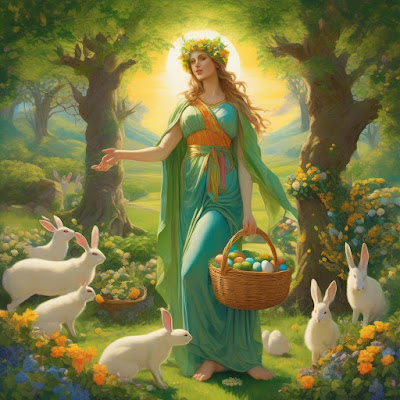
Easter is Pagan!

 The claim that Easter is pagan often revolves around the names and dates associated with the celebration, specifically the association with the pagan goddess Eostre or the Mesopotamian goddess Ishtar. To understand whether Easter is pagan, it’s essential to examine the origins of the celebration and the alleged connections to these deities.

The Origins of Easter


Easter, in Christian tradition, is the celebration of the resurrection of Jesus Christ, a central event in Christianity. The timing of Easter is linked to the Jewish festival of Passover, which commemorates the Exodus from Egypt and often overlaps with the Christian celebration. The New Testament describes how Jesus was crucified during Passover, and His resurrection is celebrated on the Sunday following Passover (Matthew 26-28, Mark 14-16, Luke 22-24, John 18-20).

The term "Easter" itself is derived from the Old English word ฤ’astre or ฤ’ostre, which was mentioned by the Anglo-Saxon monk Bede in the 8th century. Bede noted that ฤ’osturmonath (April) was named after a goddess named Eostre, who was associated with spring and fertility. However, there is limited evidence outside of Bede’s writings about the worship of Eostre, and it’s unclear how widespread her veneration was.

The Goddess Eostre


Eostre, or Ostara, is a purported Anglo-Saxon goddess of spring and dawn. According to Bede’s De Temporum Ratione, she was honored in a festival during the month of April, and it is from this name that the term "Easter" is believed to have been derived in English-speaking countries. However, outside of Bede's account, there is no substantial historical evidence of Eostre’s worship, leading some scholars to speculate that Bede might have extrapolated or misinterpreted the connection.

The Goddess Ishtar


Ishtar is a Mesopotamian goddess associated with love, war, and fertility. She is one of the most significant deities in the Mesopotamian pantheon. Some modern claims assert that Easter derives from Ishtar, due to the phonetic similarity between "Easter" and "Ishtar." However, this connection is not supported by historical evidence. The word "Easter" is not derived from "Ishtar"; rather, it comes from the Old English ฤ’astre. Furthermore, the themes and rituals of Easter have no direct connection to Ishtar’s worship, which was focused on entirely different concepts.

Christianization and Adaptation

While it’s true that early Christians sometimes adapted existing pagan festivals when introducing Christianity to new regions, the core of Easter—the resurrection of Christ—remains distinctly Christian. The use of symbols like eggs and rabbits, which are associated with fertility and spring, may have been integrated into Easter celebrations over time, but these are cultural additions rather than indicators that Easter itself is pagan.

Conclusion

The idea that Easter is pagan because of its association with Eostre or Ishtar is based on superficial similarities rather than historical evidence. The Christian celebration of Easter is firmly rooted in the resurrection of Jesus, a historical and theological event that predates any alleged connections to pagan festivals. While the name "Easter" may have been influenced by a local goddess in certain regions, the celebration’s content and meaning are thoroughly Christian.

Sources

  • Bede, De Temporum Ratione.
  • McDougall, Sara. Easter: Myth, Religion, and Tradition. Cambridge University Press, 2019.
  • Hutton, Ronald. The Stations of the Sun: A History of the Ritual Year in Britain. Oxford University Press, 1996.
  • Leithart, Peter J. Deep Comedy: Trinity, Tragedy, and Hope in Western Literature. Canon Press, 2006.

The Official Name of Easter: Pascha (Passover)

While the term "Easter" is commonly used in English-speaking countries, the official name of the celebration in the Christian liturgical calendar remains Pascha, which is derived from the Hebrew word Pesach, meaning Passover. This reflects the historical and theological connection between the Jewish Passover and the Christian celebration of Jesus' resurrection. In most languages, the name for Easter is still closely related to "Pascha," emphasizing its roots in the Passover feast. The early Christians saw Christ’s death and resurrection as the fulfillment of the Passover, with Jesus being the new Passover lamb who delivers humanity from the bondage of sin.

The Council of Nicaea and the Change of Date


The date of Easter was a significant issue in the early Church, as different Christian communities celebrated it on different dates. Some followed the Jewish calendar, celebrating Easter on the 14th of Nisan (the date of Passover), regardless of the day of the week, while others celebrated it on the following Sunday. This difference led to disputes and confusion.

To address this, the First Council of Nicaea, convened by Emperor Constantine in 325 AD, sought to establish a uniform date for the celebration of Easter. The Council decided that Easter should be celebrated on the first Sunday after the first full moon following the vernal equinox. This decision meant that Easter would no longer be directly tied to the Jewish Passover but would still maintain a connection to the lunar calendar. The goal was to ensure that all Christians would celebrate Easter on the same day, emphasizing unity within the Church.

Constantine’s Influence: Constantine’s motivations for standardizing the date of Easter were both theological and political. He wanted to separate Christian practices from Jewish customs, as indicated by his letter to the bishops after the Council, where he emphasized the importance of distinguishing the Christian celebration from Jewish Passover practices. Constantine wrote, “We ought not to have anything in common with the Jews, for the Savior has shown us another way… it is our duty not to have anything in common with the murderers of our Lord” (Eusebius, Life of Constantine, Book III, Chapter 18).

The decision at Nicaea to set Easter on a Sunday was also aimed at reinforcing the significance of Sunday as the day of the Lord’s resurrection, distancing Christian practices from Jewish traditions, and promoting a unified Christian identity.

Conclusion

The claim that Easter is pagan is not supported by historical evidence. The celebration of Easter, or Pascha, is rooted in the Jewish Passover and the Christian belief in the resurrection of Jesus. While cultural elements, such as the name "Easter" in English, may have some connections to pre-Christian traditions, the core of the celebration is distinctly Christian. The decision to change the date of Easter at the Council of Nicaea was made to unify the Church and to ensure that the celebration of Christ's resurrection would be observed consistently across all Christian communities.

Sources:

  • Bede, De Temporum Ratione.
  • Eusebius, Life of Constantine, Book III, Chapter 18.
  • Council of Nicaea, Canon 1.
  • Hutton, Ronald. The Stations of the Sun: A History of the Ritual Year in Britain. Oxford University Press, 1996.
  • McGowan, Andrew. Ancient Christian Worship: Early Church Practices in Social, Historical, and Theological Perspective. Baker Academic, 2014.