Thursday, November 7, 2024

How Should Catholics and Other Christians View the 2024 Re-election of President Trump? A Faithful, Objective Approach


How Should Catholics and Other Christians View the 2024 Re-election of President Trump? A Faithful, Objective Approach

The re-election of President Donald Trump in 2024 raises significant questions for Catholics and other Christians regarding the appropriate Christian response to leadership, political engagement, and moral discernment. From the Catholic Church’s social teachings to early Christian writings, the Christian tradition provides a framework for evaluating leaders and their policies objectively. This approach emphasizes fidelity to Gospel principles, respect for authority, commitment to the common good, and a balanced understanding of patriotism and global solidarity.

1. Respect for Authority and Civil Governance

Catholics and other Christians are called to respect legitimate authority, as stated by St. Paul: “Let every person be subject to the governing authorities” (Romans 13:1). The Catechism of the Catholic Church (CCC 1897-1900) echoes this sentiment, viewing government as a necessary institution that serves society by establishing order and promoting the common good. The Church teaches that obedience to civil authority is an expression of the Fourth Commandment, which calls Christians to honor father and mother by respecting those in leadership.

However, respect for authority is not unconditional. The Church emphasizes that true authority derives its legitimacy from the pursuit of justice and the common good (CCC 1902). When a government fails to uphold these principles, Christians are encouraged to work for change through peaceful, constructive means. Thus, respect for a leader like President Trump should be tempered by careful scrutiny, especially if any policies appear to conflict with the Church’s understanding of justice, human dignity, and peace.

2. The Christian Imperative of Moral Integrity and the Common Good

The Church calls on Catholics to prioritize the common good, defined as “the sum total of social conditions which allow people, either as groups or as individuals, to reach their fulfillment more fully and more easily” (CCC 1906). Policies that impact healthcare, education, social welfare, and human rights are evaluated based on their alignment with the dignity of the human person, solidarity, and subsidiarity (CCC 1928-1942).

Historically, Church leaders have emphasized the need for moral integrity in leadership. St. Augustine wrote that rulers are accountable to a higher moral law and must serve the common good rather than personal interests (City of God, Book V). Likewise, Pope Francis has spoken against policies that marginalize the vulnerable and prioritize profit over people’s welfare. In Fratelli Tutti, he advocates for “politics that promotes human dignity” and warns against divisive or exclusionary politics (Fratelli Tutti, 154-155).

When considering Trump’s re-election, Catholics and other Christians may reflect on how his policies align with these principles, especially regarding the poor, marginalized, immigrants, and those impacted by social and economic inequality.

3. Nationalism, Patriotism, and the Global Common Good

Catholic teaching respects patriotism as a form of love for one’s country but warns against excessive nationalism that disregards the global common good. St. John Paul II emphasized the need for patriotism that respects the dignity of all people, without turning into an “exclusivist nationalism” that excludes others (Memory and Identity, 2005). This is reinforced by the U.S. bishops’ document, Forming Consciences for Faithful Citizenship, which calls Catholics to prioritize the global common good over national self-interest.

Pope Francis has highlighted the responsibility of nations to care for vulnerable populations, especially immigrants and refugees, stating, “Love of one’s country is a virtue, but it must also include the universal love of all humanity” (Fratelli Tutti, 141). Trump’s policies on immigration, national security, and international relations may be evaluated in light of this balance, as Christians discern whether his policies foster solidarity or favor national interest over universal human dignity.

4. Peace, Nonviolence, and Justice

Christian teachings on peace and nonviolence are rooted in Jesus’ Beatitudes: “Blessed are the peacemakers, for they will be called children of God” (Matthew 5:9). Early Christians, including figures like Tertullian and Origen, advocated for a pacifist stance, believing that Christians should avoid violence and seek reconciliation.

The Catholic Church acknowledges that governments have a duty to protect their citizens but stresses that this must be done within the bounds of justice. The Catechism (CCC 2304-2309) teaches that peace is “the work of justice and the effect of charity” and calls for diplomacy and nonviolent solutions to conflicts. St. John XXIII’s encyclical Pacem in Terris (“Peace on Earth”) also emphasized the need for global cooperation and peace over aggressive or militaristic policies.

In evaluating Trump’s approach to foreign policy, defense, and national security, Christians are encouraged to consider whether his policies reflect a commitment to peace and justice. While some may argue that strong national defense is necessary for protection, others may reflect on whether an emphasis on peace-building and diplomacy better aligns with the Gospel values of reconciliation and mercy.

5. Moral Conscience and Discernment in Political Participation

Catholic social teaching holds that political participation is a moral duty for Christians. The Catechism (CCC 2240) encourages citizens to vote and engage in politics as a way of promoting the common good. However, the Church also warns against aligning too closely with any one political ideology, reminding Catholics to remain “in the world, but not of the world” (John 17:16).

Pope Benedict XVI expressed the need for a Christian approach to politics that avoids “the idolatry of power and success” (Deus Caritas Est, 28). Christians are encouraged to exercise discernment, holding leaders accountable and working toward policies that align with Gospel values. This means Catholics should weigh Trump’s policies on social, economic, and moral issues without uncritical loyalty, prioritizing the teachings of Christ over political partisanship.

In line with this, Protestant theologians like Reinhold Niebuhr and Martin Luther King Jr. have warned against allowing faith to be co-opted by politics. Niebuhr’s Christian Realism argues for a balanced, morally conscious approach to politics, recognizing the imperfect nature of human leaders. Dr. King advocated for Christians to serve as the “moral conscience” of society, challenging injustices and promoting social justice.

6. A Kingdom Perspective: Primary Allegiance to Christ

The ultimate perspective for Catholics and other Christians is one of allegiance to the Kingdom of God. Jesus’ statement, “My Kingdom is not of this world” (John 18:36), serves as a reminder that Christians are called to seek God’s Kingdom above earthly power and to embody Gospel values in every area of life.

Pope Francis reminds Christians that politics should be an expression of Christian love, striving for a just society that reflects God’s love for all people. In Gaudium et Spes, the Second Vatican Council stated, “The Church…serves as a leaven and as a kind of soul for human society as it is to be renewed in Christ and transformed into God’s family” (GS, 40). This perspective challenges Catholics to engage in politics as a means of building a more just, compassionate world, regardless of political affiliations.

Conclusion: An Objective Call to Faithful Engagement

Catholics and other Christians are called to view the re-election of any political leader, including President Trump, with prayerful discernment, evaluating policies in light of the Gospel and Catholic social teaching. Rather than endorsing or rejecting leaders based solely on party affiliation, the Church encourages an objective, principled approach that holds leaders accountable to the principles of justice, peace, and human dignity.

Catholics are urged to pray for all leaders (1 Timothy 2:1-2), engage in political life with integrity, and advocate for policies that reflect Christian values. The Church’s ultimate call is to promote the Kingdom of God, one that transcends earthly political systems and works toward the common good of all humanity. In the words of Pope Francis, “True Christians do not look for the ‘return of power,’ they look for justice and peace for all.”


Saturday, November 2, 2024

Why do Catholics try to convert people to their Church instead of to Christ?


Catholics are often accused of focusing on converting people to the Church rather than to Jesus Christ, with the implication that we place more importance on a human institution than on Christ Himself. However, this question—and the assumption behind it—stems from a misunderstanding, or perhaps a willful oversight. For Catholics, the Church and Jesus Christ are inseparable; one cannot exist without the other. It’s not a matter of “either/or” but rather “both/and.” Let’s explore this concept in greater depth:

Catholics believe that the Church is intrinsically connected to Jesus Christ. In their view, bringing people into the Catholic Church isn’t just about gaining members but about guiding people to a deeper relationship with Christ within what they see as the fullness of His teachings and grace. Here’s a closer look at why Catholics focus on introducing people to the Church as the means to knowing Jesus Christ:

1. The Church as the Body of Christ

  • Catholics believe that the Church is the "Body of Christ," a mystical union between believers and Christ. St. Paul emphasizes this idea, especially in 1 Corinthians 12, where he speaks about each member of the Church as a part of Christ's body. By joining the Church, Catholics see converts as becoming part of this body, uniting them with Christ in a communal and sacramental way.

2. The Sacraments as Pathways to Jesus

  • In Catholicism, sacraments (like Baptism, Eucharist, and Reconciliation) are viewed as special encounters with Christ. They’re not just symbolic acts; they are believed to be actual ways of receiving God’s grace. The Church teaches that these sacraments were instituted by Christ, and through them, believers experience His presence and grace. Thus, conversion to Catholicism provides access to these means of deepening one’s relationship with Jesus.

3. Apostolic Authority and Tradition

  • Catholics hold that the Church was founded by Jesus, who gave authority to His apostles, particularly Peter, whom Catholics see as the first pope. This “apostolic succession” is viewed as a direct line of spiritual authority from Christ to the present-day Church. Therefore, Catholics see the Church as the custodian of Christ’s teachings and a reliable guide for understanding and following Him faithfully.

4. Scripture and Tradition Together

  • While Catholics emphasize the importance of Scripture, they also uphold Tradition — teachings passed down from the apostles. They believe that both Scripture and Tradition are necessary to fully understand Christ’s teachings. The Catholic Church considers itself responsible for preserving and interpreting this Tradition. This perspective leads Catholics to guide others to the Church as the foundation for receiving Christ’s teachings in their fullness.

5. Unity and Communion

  • Catholics view unity with the Church as essential to communion with Christ. Jesus prayed for unity among His followers (John 17:21), and Catholics interpret this as a call to be one in belief, worship, and practice. For Catholics, this unity is most fully realized within the Catholic Church. Therefore, bringing others into the Church is seen as a way to honor Jesus’ prayer for unity among His followers.

6. Evangelization as a Call to “Fullness of Faith”

  • Catholics see evangelization as an invitation to the “fullness of faith.” The idea is not simply to introduce people to Jesus but to help them grow into a holistic understanding and experience of Him. From the Catholic perspective, this fullness is found in the Church’s teachings, the sacraments, and the community of believers. For this reason, converting people to Catholicism is viewed as the means by which they can fully encounter Jesus.

7. Historical and Communal Identity

  • The Catholic Church has a profound sense of continuity with the early Christian community. Catholics see the Church as a direct continuation of the original community of Jesus’ followers, preserving the faith and practices of early Christians. Conversion to the Catholic Church, in this light, is a way of joining the historical community of believers united in Christ over centuries.

In summary, Catholics aim to bring people to Jesus through the Church because they see it as the “sacrament of salvation,” a communal and sacramental path established by Christ Himself. For Catholics, conversion to the Church and conversion to Jesus are not separate goals but rather two sides of the same mission: to know, love, and follow Jesus fully in the community He established.

Friday, November 1, 2024

Parallels between the opposition to Christianity in pagan Rome and among modern Native Americans

 The striking parallels between the opposition to Christianity in pagan Rome and among modern Native Americans present a fascinating topic for exploration. Let’s delve deeper into this intriguing comparison:

Many pagan Romans in the first few centuries AD perceived Christianity as a threat to their culture, religion, empire, and even civilization. Similarly, some Native Americans in modern times have viewed Christianity as a force that threatened their indigenous traditions, beliefs, and way of life. Both instances involve the encounter of a dominant culture with a missionary religion, often resulting in tensions over identity, autonomy, and heritage.

Pagan Roman Concerns about Christianity

  1. Threat to Roman Religion:
    The Romans believed their success and stability were intertwined with the favor of their gods. Christianity's refusal to honor Roman gods and participate in traditional rituals was seen as atheistic and disrespectful.

    • Tacitus described Christians as "haters of mankind" because their beliefs rejected Roman public rituals essential to civic unity (Annals 15.44).
    • The Christian refusal to worship the emperor as divine was seen as treasonous, as exemplified in martyrdom accounts such as that of Polycarp, where the refusal to sacrifice was directly interpreted as defiance of the state.
  2. Social Disruption:
    Christianity's message of universal salvation and equality under God challenged the hierarchical Roman society.

    • The Apostle Paul, in Galatians 3:28, stated, "There is neither Jew nor Greek, slave nor free, male nor female, for you are all one in Christ Jesus."
    • This inclusivity upset traditional Roman social structures, where loyalty to family, clan, and patronage was central.
  3. Political Concerns:
    Christianity was considered a secretive sect that met in private and preached allegiance to a "Kingdom of God," which some Romans interpreted as a political threat.

    • The Roman historian Suetonius referred to Christian unrest under Nero as stemming from a group causing "new and mischievous superstition" (Life of Nero 16).
    • This view persisted until Constantine's Edict of Milan (313 AD), which legalized Christianity and reframed it as compatible with the Roman state.
  4. Cultural Clash:
    Romans valued traditional education rooted in Greco-Roman mythology and philosophy, while Christians criticized such pagan practices.

    • Early Church Fathers like Tertullian famously asked, "What has Athens to do with Jerusalem?" signaling a rejection of pagan philosophy (De Praescriptione Haereticorum 7).
    • Christians also condemned gladiatorial games and practices like infanticide, both integral to Roman society.

Parallels with Native American Views on Christianity

  1. Cultural Erosion:
    Native Americans often viewed Christianity, introduced through colonization, as a threat to their spiritual traditions and communal life. Missionary efforts frequently involved suppression of indigenous practices and imposition of European cultural norms.

    • The Cherokee and other tribes lost religious autonomy as Christian boarding schools punished traditional practices and promoted Christian doctrine.
    • Vatican documents, like Dominus Iesus (2000), have acknowledged the Church's efforts to spread Christianity but faced criticism for not fully addressing its impact on indigenous cultures.
  2. Imposition of Foreign Values:
    Similar to Roman pagan concerns, Native Americans saw Christianity as undermining their societal values.

    • Many tribes practiced communal landholding, which clashed with the individualism encouraged by Christianized settlers.
    • Theologians like Vine Deloria Jr., a Native American scholar, have critiqued Christianity's role in displacing indigenous spiritualities.
  3. Political and Sovereignty Concerns:
    Just as Roman authorities feared the subversive potential of Christianity, Native Americans experienced Christianity as a tool of colonial control.

    • Treaties were often signed with missionaries as intermediaries, creating distrust.
    • The Doctrine of Discovery, a papal decree (1493), granted Christian explorers rights over "discovered" lands, ignoring indigenous sovereignty.
  4. Resistance and Adaptation:
    Despite initial rejection, both Romans and Native Americans showed instances of blending traditional and Christian beliefs.

    • In the Roman Empire, the rise of syncretism allowed for a gradual blending of pagan festivals into Christian traditions (e.g., Saturnalia into Christmas).
    • Among Native Americans, figures like Black Elk found ways to reconcile Christianity with indigenous spirituality.

Objective Historical and Theological Perspectives

  1. Historians:

    • Edward Gibbon, in The Decline and Fall of the Roman Empire, argued that Christianity contributed to the weakening of Roman civic virtues.
    • Modern historians, like Peter Brown, emphasize Christianity's adaptability and the sociopolitical factors behind its success.
  2. Theologians:

    • Augustine of Hippo, in The City of God, defended Christianity against accusations that it undermined Rome, arguing it provided a moral foundation superior to paganism.
    • Contemporary theologians such as Karl Rahner recognize the tension between Christianity's missionary mandate and cultural respect, emphasizing dialogue over domination.

Conclusion

The reactions of pagan Romans and Native Americans to Christianity share significant parallels. Both viewed the faith as a threat to their religious, cultural, and political systems, yet both also engaged with it in ways that led to adaptation and resistance. By studying these interactions, we gain insight into the broader dynamics of cultural encounters and the challenges of religious expansion.

Tuesday, October 8, 2024

Are Catholic Saints Renamed Pagan Gods? Separating Fact from Fiction


 The veneration and intercession of saints have never troubled me. Scripture clearly states that we will “partake of the divine nature” (2 Peter 1:4)—meaning that, in Heaven, we will be like God. In Catholicism, this process is called “sanctification,” and in Eastern Orthodoxy, it’s known as “theosis.” While we won’t become God Himself—an impossibility for created beings—we will share in His attributes, knowledge, and glory (cf. 1 John 3:2; 1 Corinthians 13:12). Christ Himself affirmed that His followers would perform great miracles through Him (John 14:12), which supports the Catholic understanding of saints’ intercessory powers.


I also believe that the pagans, in their own way, received a shadow of divine revelation about the truth of Christianity, including the future role of the saints. However, they misunderstood and distorted this revelation, turning saints into polytheistic gods, goddesses, and demigods. Since all religions contain some measure of truth and goodness—misinterpreted reflections of God’s revelation—it makes sense to me that the one true faith, the Catholic Church, would embody these truths while rejecting the errors. This conviction is yet another reason I’m Catholic.

Nevertheless, critics claim that Catholic saints are simply renamed pagan gods, that the Church compromised the Gospel and adopted a form of polytheism by replacing pagan deities with so-called "saints" to appeal to pagans. But is this accusation really true? Let’s examine this more closely.

Are Catholic Saints Renamed Pagan Gods? Separating Fact from Fiction

The question of whether Catholic saints are merely “renamed” pagan gods is a longstanding accusation that has been directed at the Church for centuries. Critics argue that the Church, in its efforts to convert pagan populations, simply replaced their deities with Christian saints to facilitate the process. But is this claim accurate, or is it a misunderstanding of the Church’s teachings and historical practices? A careful examination of scripture, Church documents, and scholarly opinions provides clarity.

Understanding the Role of Saints in Catholicism


The veneration of saints in Catholicism is rooted in the belief that they are holy individuals who, by God’s grace, exemplify Christian virtues and intercede on behalf of the faithful. The Church does not worship saints as gods, as made clear in the Catechism of the Catholic Church: “The Church venerates the saints and asks for their intercession, but worship and adoration are due to God alone” (CCC 971). Saints are seen as models of faith and conduits to Christ, not deities in themselves.

This distinction is further emphasized by Church Fathers such as St. Augustine, who in his City of God rejected any suggestion that the saints are equivalent to pagan gods. He argued that while pagans worshiped their gods as entities with powers independent of God, Christians view saints as completely dependent on and subordinate to God’s will (cf. City of God, Book VIII).

The Church’s Position: No Syncretism Allowed

The Church has always been cautious about accusations of syncretism (the blending of different religious beliefs). The Council of Nicaea (AD 325) and the Council of Trent (1545-1563) both clarified the role and veneration of saints to ensure it aligned with Christian doctrine. The Second Vatican Council reaffirmed this, stating: “The veneration of the saints is to be distinguished from the worship which is due to God alone” (Lumen Gentium, 51).

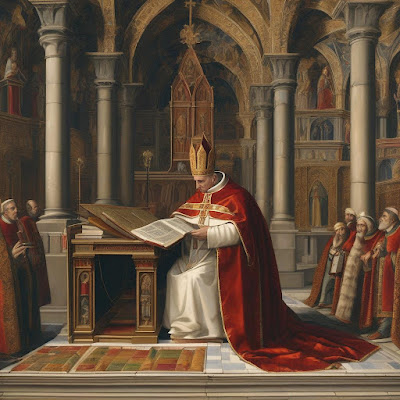
AI created image of Pope St. Gregory


In the fourth century, Pope Gregory the Great clarified the Church’s stance when writing to St. Mellitus, a missionary in Britain. He instructed not to destroy pagan temples but to purify them for Christian use and to encourage the celebration of Christian feast days, so that the people would “celebrate these, instead of the pagan feasts.” However, he was clear that pagan practices and beliefs were to be eradicated, not assimilated (cf. Letter to Abbot Mellitus, 601 AD).

Addressing the Misconception: Origins of the Critique

The misconception that Catholic saints are merely renamed pagan gods likely arises from a superficial similarity between certain saints and pagan figures. For instance, St. Brigid of Ireland is often said to have replaced the Celtic goddess Brigid. However, historical evidence indicates that St. Brigid was a real Christian woman who established monasteries and was known for her charity. The Church did not create or rename her to replace a deity, but rather elevated her to sainthood for her devout Christian life.

This critique is also commonly aimed at the celebration of feast days, which some claim were adapted from pagan festivals. For example, Christmas and All Saints’ Day are said to have replaced pagan solstice celebrations. But as historian Ronald Hutton notes, the selection of these dates was more complex and based on theological considerations, not a deliberate co-opting of pagan holidays (Stations of the Sun: A History of the Ritual Year in Britain, 1996).

Another example of a saint often mistaken for a pagan deity is St. Nicholas, commonly associated with the Greek god Poseidon or the Roman god Neptune. This confusion arises from his connection to sailors and the sea.

St. Nicholas vs. Poseidon/Neptune

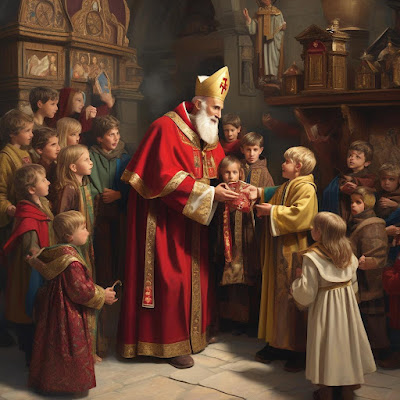
AI created image of St. Nicholas, Bishop of Myra


St. Nicholas, a 4th-century bishop of Myra (in modern-day Turkey), is widely known as the patron saint of sailors. Many legends about St. Nicholas involve his miraculous interventions at sea, such as calming storms and saving sailors from shipwreck. This has led some to draw parallels between St. Nicholas and Poseidon/Neptune, who were revered by ancient Greeks and Romans as gods of the sea.

AI created image of the pagan Roman god Neptune


However, the association of St. Nicholas with the sea has a distinctly Christian origin. Historical records show that St. Nicholas’s protection of sailors was not an attempt to replace or Christianize Poseidon, but rather a reflection of the bishop’s intercessory power and the deep faith of seafaring Christians. His legends emphasize God’s power and mercy, not pagan deities.

According to the Catholic Encyclopedia, the cult of St. Nicholas spread rapidly in both the East and West, and by the 6th century, he was already being honored as a miracle worker. The Byzantine Emperor Justinian I even built a church in his honor, recognizing him as a saint whose life and deeds exemplified Christian virtues, completely separate from any pagan association (Catholic Encyclopedia, "St. Nicholas of Myra").

Moreover, the Catechism of the Catholic Church distinguishes clearly between the veneration of saints and any form of worship that could be attributed to pagan gods. St. Nicholas is celebrated for his generosity, protection, and compassion, qualities that set him apart from the more capricious nature of mythological gods like Poseidon. The celebration of his feast day on December 6th eventually led to the development of various Christmas traditions, but his status as a saint was rooted in historical fact and Christian devotion, not a repurposing of pagan mythology.

Thus, while St. Nicholas’s connection to sailors may superficially resemble that of Poseidon/Neptune, he was not a replacement for these deities but rather a Christian saint whose life inspired devotion among the faithful, especially those who relied on the sea for their livelihood.

St. Martin of Tours and His Association with Pagan Gods

AI created image of St. Martin of Tours


St. Martin of Tours is another example of a Christian saint who has been mistakenly identified with a pagan god. A 4th-century bishop and former Roman soldier, St. Martin is celebrated as the patron saint of soldiers and is known for his acts of charity and humility. His feast day, November 11th, falls around the time of many pre-Christian autumnal festivals, leading some to speculate that his veneration is merely a continuation of older pagan practices.

St. Martin and the God Mars

AI created image of the Roman god Mars


One of the most common claims is that St. Martin replaced the Roman god Mars, the god of war. This association arises from the similarity of their names—Martin derives from "Martinus," which in turn is related to Mars—and the fact that St. Martin is considered the patron saint of soldiers. Some critics suggest that early Christians co-opted the worship of Mars, transforming the war god into a Christian saint who represented virtues appropriate to soldiers, such as courage, charity, and humility.

However, this theory does not hold up under scrutiny. Historically, St. Martin’s veneration has always been centered around his life story, particularly his act of charity in cutting his cloak in half to share it with a beggar, who was later revealed to be Christ Himself. This episode emphasizes mercy and selflessness rather than the martial valor typically associated with Mars. The Catechism of the Catholic Church (CCC 2633) highlights intercession for others as a key Christian virtue, which was embodied in St. Martin’s life, making him a suitable model for Christians, especially soldiers, who were called to follow Christ’s example of peace and compassion.

St. Martin and Pagan Festivals

St. Martin’s feast day, falling on November 11th, coincides with the timing of pagan harvest festivals in Europe, such as the Germanic celebration of Martinalia and the Celtic festival of Samhain. These festivals marked the end of the agricultural season and the beginning of winter. As the Church sought to evangelize pagan communities, it is likely that St. Martin’s feast day was used as a Christian alternative to these pre-Christian observances. However, this does not mean that St. Martin himself was a transformed pagan figure.

Pope Benedict XVI, in his General Audience on July 4, 2007, described St. Martin as “one of the most famous and revered saints in Europe, as well as a great missionary.” He emphasized that St. Martin’s influence and popularity stemmed not from any association with pagan gods but from his dedication to spreading Christianity and caring for the poor.

Historical Misinterpretation

The mistaken association of St. Martin with Mars or other pagan gods is often the result of superficial similarities in name or the proximity of his feast day to pre-existing pagan festivals. As historian Ronald Hutton explains in Stations of the Sun: A History of the Ritual Year in Britain, the Church’s decision to place Christian feast days near pagan festivals was not an attempt to "rename" pagan gods, but rather a strategy to provide the faithful with opportunities to celebrate Christian mysteries in familiar seasonal contexts.

Moreover, the Second Vatican Council's document Lumen Gentium clarifies that the purpose of venerating saints is to honor the work of Christ in their lives, not to continue or replicate pagan customs (cf. LG 50). The Council reiterates that the saints are honored not as deities, but as friends and servants of God, completely distinct from pagan worship.

In summary, while St. Martin’s feast day and some aspects of his veneration might have been positioned to align with the calendar of pagan festivals, his identity and legacy are firmly rooted in Christian theology and practice. St. Martin is celebrated not as a rebranded pagan god, but as a genuine Christian saint whose life and deeds exemplify the virtues of faith, charity, and humility.

Saint Mary vs. Artemis/Diana


Yet another example Catholic detractors love to use is the Catholic view of Saint Mary, claiming she was just the goddess Artemis and Diana renamed. However, Saint Mary is not a renamed version of the pagan goddess Artemis (or Diana). This claim, often made in certain historical theories or anti-Catholic arguments, lacks substantial evidence and oversimplifies the complexities of religious history and theology. Here’s why:


Distinct Origins and Theologies:

The Virgin Mary and the goddess Artemis (known as Diana in Roman mythology) originate from vastly different religious traditions and have distinct roles and attributes. Artemis was the Greek goddess of the hunt, wilderness, and childbirth, and was often associated with nature and fertility. On the other hand, Mary is a central figure in Christianity, revered as the mother of Jesus Christ. Her veneration is rooted in Christian beliefs about her role in salvation history, not in pagan mythology.

Differences in Attributes and Worship:

Artemis was worshiped as a virgin goddess and protector of young women, but her cult and iconography emphasized independence and nature. In contrast, Mary’s veneration focuses on her purity, humility, and her role as the Mother of God. While both are associated with virginity, the significance of this attribute is entirely different. Additionally, Artemis was worshiped with rituals and offerings specific to her domains, whereas Marian devotion in Christianity involves prayers, intercessions, and feast days related to events in Mary’s life.

Historical Development of Marian Devotion:


Marian devotion developed organically within the context of early Christianity. By the time devotion to Mary grew in prominence (around the 3rd and 4th centuries), Christianity had already established its distinct theological identity, separating itself from pagan practices. While it is true that some aspects of Marian devotion may have been influenced by the broader cultural context (e.g., art styles or terminology), this does not mean Mary was merely a rebranded pagan goddess. Theological reflection on Mary’s role began with early Christian writers like the Church Fathers, who emphasized her unique role in the Incarnation and redemption.

Ephesus and the Connection to Artemis:


The claim often arises from the fact that the Council of Ephesus in 431 AD, which proclaimed Mary as “Theotokos” (Mother of God), was held in a city historically associated with the cult of Artemis. However, this does not imply that Mary is a continuation of Artemis worship. Ephesus was an important center for early Christianity, and the council’s decisions were based on Christological debates, not an attempt to syncretize with the local cult. By that time, Ephesus had long been a Christian city, and any similarities in language or symbolism are more likely due to cultural adaptation rather than religious continuity.

Syncretism and Misunderstanding:

While some scholars have noted that early Christianity occasionally adopted certain symbols or terms familiar to converts from other religions (a process known as inculturation), this was done to communicate Christian truths more effectively, not to merge with or continue pagan worship. The distinct doctrines, teachings, and liturgical practices of Marian devotion show no substantial theological overlap with the worship of Artemis or Diana.

In conclusion, while there may be superficial similarities in iconography or terms due to cultural factors, the theological foundations, historical origins, and religious meanings behind the veneration of Mary and the worship of Artemis/Diana are fundamentally different.


The Protestant Perspective

Many Protestant reformers in the 16th century, such as Martin Luther, criticized the veneration of saints as being too similar to the worship of pagan gods. Luther argued that the intercession of saints detracted from Christ’s role as the sole mediator (cf. Luther’s Works, vol. 25). John Calvin took a similar position, accusing the Catholic Church of encouraging “a mere transference of the worship of idols” (Institutes of the Christian Religion, Book I, Ch. 12).

However, contemporary Protestant scholars like Jaroslav Pelikan recognize that while Catholic practice has a “visual and symbolic” aspect that can seem reminiscent of pagan imagery, it is fundamentally rooted in Christian theology and Christocentric spirituality (Mary Through the Centuries, 1996).

The Church’s Response to the Accusation

The Church has always maintained that any superficial resemblance to pagan practices is coincidental and that the sanctification of elements from local cultures, such as architecture or art, is not an endorsement of pagan beliefs. As Pope Benedict XVI stated, “The Church has always taken the best of pagan culture… but she purifies it and transforms it to conform with the Gospel” (The Spirit of the Liturgy, 2000).

Moreover, the Church has officially denounced any attempt to syncretize Christian beliefs with paganism. The Council of Trent explicitly condemned any practice that would imply the worship of saints as deities (Session XXV, Decree on the Invocation, Veneration, and Relics of Saints).

A Balanced Perspective: Why This Argument Persists

Despite clear teachings and historical evidence to the contrary, the idea that Catholic saints are renamed pagan gods persists because of the complex history of the Church’s interaction with diverse cultures. When Christianity spread, it often built churches over former pagan sites and reinterpreted local symbols in light of Christian theology. This led to a perception of continuity where there was actually a deliberate transformation and redefinition.

The Catholic Church’s position is clear: saints are not worshiped as gods, nor were they adopted to replace pagan deities. Instead, the Church seeks to honor holy individuals who exemplified Christian virtues and to present them as models for the faithful. While pagan religions may contain some elements of truth, these truths are perfected in Christ and His Church.